Showing posts with label Quail Island. Show all posts

Monday, 28 September 2020

Dipping sheep on Quail Island, Western Port in 1866 by James H. Watson

On June 20, 1927, James H. Watson (1), the President of the Royal Australian Historical Society, Sydney presented a paper to the Historical Society of Victoria - Personal Recollections of Melbourne in the 'Sixties. It was a look at various events and activities of the 1860s including this story - Dipping Sheep on Quail Island. The story was published in the Victorian Historical Magazine, v. 12, June 1928 available on-line at the State Library of Victoria (2). It transcribed below.

The trip to Quail Island took place in 1866 (3). Of interest is a description of Cranbourne at that time and a confession that he was actually responsible for the first release of rabbits onto the Island. 

Dipping sheep on Quail Island by James H. Watson. 
The writer starts the story that he was offered a plantation on a small island in Fiji, but he turned the offer down due to his lack of experience. He then continues the story -
Another island, however, came into view a little later, and one that was nearer home. On it I put in some hard work for six months, and all I got out of it was experience. The fellow passenger that I came ashore with (who has been dead for fifty years and left neither kith nor kin) some little while after our arrival leased Quail Island in Western Port, and put some sheep on it. He had had no experience of stock, and on a visit to me, explained that, if he had a mate, he thought he could make a good thing of it for both of us, my stock-in-trade being youth, strength, and willingness. I agreed to go. I well remember the day, for it was the day the news of the loss of the London (4) reached Melbourne in March, 1866.

We took coach at an hotel in Queen-street, the route being along the St. Kilda-road, turning into the Dandenong-road, passing through Dandenong to the termination of the journey at Cranbourne. I do not know whether the township, as it was called, has grown since the railway went to it, but, when I last saw it, 60 years ago, it consisted of the hotel (a long low weatherboard house, the host being named Duff (5)), the central point of the district. The next was the store, where anything that was wanted could be purchased. Then there was the Presbyterian Church, the minister of which was a brother of the landlord of the hotel (6). Two or three small cottages, and the ruins of another with a big stone bush chimney still standing, completed the town of Cranbourne. The ruined cottage is mentioned because in it lived, or rather existed, the local doctor - a clever man, but one who had the habit that many an otherwise good man has fallen a victim to. The minister kept his books and instruments, and, for special cases, he was sobered up for a couple of days, the hotel being tabooed to him till he had completed the case in hand.
  

The Grantville coach at the Cranbourne Hotel established by Robert and Margaret Duff. This was the hotel which James Watson visited on his way to Quail Island in 1866.
Photograph scanned from The Good Country: Cranbourne Shire by Niel Gunson.

Having arrived at the hotel, where horses to take us on had been left in the paddock, they were rounded up, and we set off to do the 11 miles which lay between the town and Quail Island, passing the fences of Mr Cameron's run (7), skirting the town, and following a track through the thick scrub over low hills down to the bight of Western Port. This island is directly behind, or north of, French Island, which stood up about 2 miles away. As the shores of the inlet at the crossing-place are low flats and treacherous to walk on, a thick track of tea-tree had been laid, so that the horses got safely to a sapling bridge that connected the island to the mainland. The total acreage was about 1,500 acres of flat open land on the south and timbered low hills on the north, with two good-sized water-holes or lagoons, which were the haunt of water-fowl and ducks. Mud flats lay all round the shore, covered with mangrove.

On this most unsuitable place were about 800 or 900 ewes, with a fair percentage of lambs, and 300 wethers. There were no fences, as there was no necessity for them. I soon learned that the wethers, which had been bought "stores," had brought the squatters' curse - scab - with them, and the whole flock was infected, and it was to help to eradicate this that my services were required. Preparations had been made by having a dip dug out, about 25 feet x 15 feet x 3 feet, on the margin of which several 400-gallon iron tanks were placed on stone foundations, and under which fires were made to boil the water. For several days water was carted in hogsheads on drays and sledges, till the dip was partly filled and the tanks were filled. This was very hard work, as the water had to be hand-loaded by bucket and the tanks filled from the drays in the same way. The dip was easily supplied direct from the hogsheads by pulling out the plug. The water was procured from the water-holes by backing the drays to a sapling jetty and filling the casks by a bucket and funnel. All this was most laborious work, and occupied half a dozen of us from morning till night, but the weather was fine and bright.

Before the dipping commenced, every sheep and lamb on the place had to be "dressed." We rounded them up from all parts of the island where they would be hidden away in the scrub. Our dogs had unfortunately been poisoned by the bait that had been set for eaglehawks which took the lambs, so we had to keep shouting to get them on the run and into a race at the stockyard, when, one by one, they were passed through our hands and dressed with spirits of tar.


The Swan, which transported the wool from Quail Island to Melbourne.
Image: Western Port Wrecks and Maritime Mishaps by Arthur E. Woodley (Lock Haven books, 1992)

I may here say, as I remarked previously, that the island was a most unsuitable place; this was so, because the flat damp ground on the shores gave the sheep foot-rot, and great numbers of them had to be treated for that before being "dressed" and dipped. I have overlooked the fact that all these had been shorn previous to the dip, the wool baled and sent by the regular Western Port trading cutter Swan, owned and sailed by a man named Lock (8), to Melbourne. The fires were made up and burning for the two days the dressing was being done. When that was over, the boiling water was run into the dip, with the result that there was a tepid bath, knee-deep, ready for the sheep, which were put through the race and seized by us who were standing in the water and thoroughly soused and rubbed and placed in a draining race at the opposite end to which they had entered. This took two days, the fires going to keep up the tepid heat. After this was completed and some weeks passed to allow the shear-marks to grow out of the wool and the colour of the dip to disappear (as the American Essence of Tobacco, which was the scab cure used in the dip, had discoloured it), a permit to travel was issued by the inspector (which was necessary before they could go on the roads), they were all sent to the Melbourne yards and sold. Then my days as an embryo squatter (as all kinds of graziers in those days were misnamed) came to an end, and I returned to town to take up again a business life.

I should have stated earlier that an incident occurred shortly after my arrival on the island which at the time was considered most laudable, but, if perpetrated now, would bring the strong arm of the law down on any who did it. It was the receipt of several cases of pairs of rabbits. They were purchased in Melbourne and came from Barwon Park, the station near Geelong of Mr. Thomas Austin (9), and were the offspring of some he had had sent to him in 1859 by the ship Lightning, his importation by that vessel consisting of 56 partridges, 4 hares, and 26 rabbits. As I knocked the lids off the cases, the rabbits scampered off into the scrub. I cannot remember how many there were, but I think about ten pairs. The result of the experiment I do not know.

I may add that Messrs. Herbert Power (10) and Reginald Bright (11) took up the island and had placed a big Highland Scot in charge before we left, as gamekeeper, the intention being to stock it with pheasants, partridges, &c. What success attended it I am unable to say.

................................................................................................................

Footnotes
(1) James Henry Watson (1841-1934). Read his Australian Dictionary of Biography entry, here.
(3) Mr Watson wrote a letter to the editor of the Sydney Morning Herald  of February 19, 1926 on the subject of rabbits and said they released the rabbits on Quail Island in September 1866. Read letter here. See also Footnote 8.
(4) The London foundered in the Bay of Biscay with 220 drowned and 19 saved.  Most of the passengers were Australians returning from England. Read accounts in The Argus of March 16, 1866, here and the Sydney Morning Herald of the same date, here.
(5) Robert Duff  (1827 - 1861). Robert and his wife Margaret (c.1832 - 1902) established the Cranbourne Hotel, around 1860. It was in High Street, where Greg Clydesdale Square is now and was demolished around the 1970s. Read more, here.
(6) Reverend Alexander Duff (1824-1890), read more here.
(7) Alexander Cameron (1815 - 1881) took over the Mayune lease in 1851. At later land sales he purchased 592 acres, the Pre-emptive Right, on the corner of what is now Cameron Street and the South Gippsland Highway and renamed renamed the property Mayfield, read more here.
(8) The cutter Swan and Captain Lock. The following information comes from Western Port Wrecks and Maritime Mishaps by Arthur E. Woodley (Lock Haven books, 1992) Captain John Lock was one of Phillip Island's pioneer settlers, who for a good many years contributed greatly to the early development of the Western Port area. In 1897 Captain Lock was presented with a bravery medal from the Royal Humane Society for rescuing  the sole survivor of a boat upset, off Mornington. The Swan,  built about 1815 as a French cutter, arrived  in Tasmania about 1837 and traded between Tasmania and Victoria until Captain Lock purchased it in Hobart and converted it into a ketch. It was run down by the steamer Queenscliffe, off Cape Schanck in October 1906, fortunately with no loss of life. Interestingly, Arthur Woodley says that Captain John Lock did not commence trading to and from Western Port with the Swan until late 1868 or early 1869 which does not tally with Mr Watson's date of 1866. John Bamara Lock died August 8, 1908 aged 75 (death notice in The Leader August 15, 1908, see here).
(9) Thomas Austin (1815-1871), of Barwon Park, Winchelsea is 'credited' with introducing the rabbit into Australia. His wife Elizabeth (nee Harding, 1821-1910) was a philanthropist, who established the Austin Hospital in 1882. Read Thomas' Australian Dictionary of Biography entry, here, and Elizabeth's here.
(10) Herbert Power - The son of Thomas Herbert Power (1801-1873) who took up the Eumemmerring Run in 1864 - the run went from  around the Dandenong Creek all the way to Berwick. Power Road is named after him. Herbert Power died in 1919, aged 83. You can read his obituary in the Australasian of June 7, 1919, here.
(11) Reginald Bright - a partner in the firm of Gibbs, Bright & Co. He arrived in Victoria in 1852 and died in London in 1920. There is a short obituary in the Darling Downs Gazette of September 17, 1920, see here.

Wednesday, 14 March 2018

Quail Island

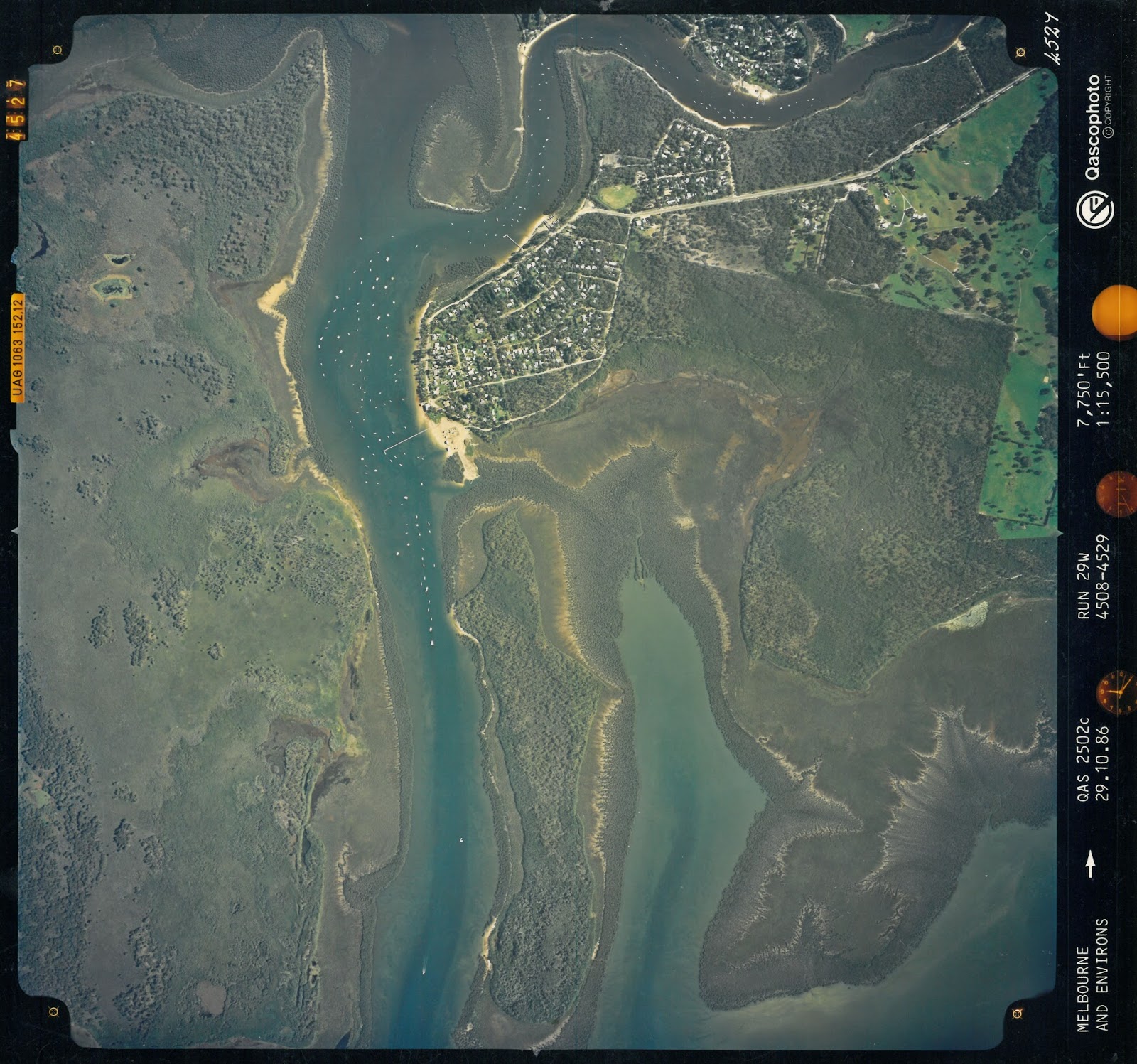
Quail Island is situated at the northern end of Western Port Bay across Rutherford Inlet from Warneet. Adjacent to Quail Island is Chinaman Island. You can see Quail Island on the left of the aerial, below, and Chinaman Island in the centre under the Warneet township. Cannons Creek is at the top of aerial.


Aerial from October 19, 1986. Quail Island on the left of the aerial, below, and Chinaman Island in the centre under the Warneet township. Cannons Creek is at the top of aerial. Towards the top of Quail Island you can see a dam, so that would have been in the vicinity of the house that was once on the Island and destroyed in the 1898 bush fires.


Quail Island was so named due to the number of quail in the island. Chinaman Island was named because Chinese fishermen were said to live on this island and they fished for the type of fish eaten by the Chinese, dried them and sent them to China. Quail Island was originally used as a pastoral run - one of the earlier lease holders appear to be Henry Greer and James Wheatley as the following advertisement appeared in The Age of May 25, 1864.

The Age  May 25, 1864

I presume that in the end James Wheatley took over the lease as in August 1864 he offered a portion of Quail Island to the Acclimatisation Society for them to run stock. Whether Wheatley's offer was accepted or someone else took over the lease, the Island was used to stock game  as Quail Island was 'temporarily reserved for Acclimatization purposes' on April 16, 1866. A report in The Age of August 14, 1867 said that 'nine black Indian partridges and seven Cape partridges had been sent down to Quail Island, for liberation'


State Government Gazette April 24, 1866

This advertisement (below) regarding the sale of Quail Island give us some idea of development on Quail Island as by July 1868 the Island had a 'good three roomed house and sheep yards' and was connected to the main land by a bridge. The house was destroyed in a bush fire in 1898. You can see one of the 'permanent lagoon' or dams in the aerial photo at the top of the post. Graham Patterson, in his Coastal guide, quotes an article from The Argus of November 1, 1865 relating the story of the housekeeper on the Quail Island Station and her misadventure in returning home from Cranbourne one day. It's well worth a read, which you can do, here.


The Argus July 7, 1868

As best as I can I have traced the  lease hold holders or owners of Quail Island - it is part of the Parish of Sherwood and was part of the Cranbourne Shire. The first time I could see Quail island itemised in the Rate Books was 1877/1878 when Alexander Hunter was listed. Hunter also had the Balla Balla run at this time. The Island had been advertised for sale in September 1878 (see advert here) so he may have purchased it around then.  Alexander Hunter had Quail Island until 1884/1885. Donald Tolmie is listed in the Rate Books from 1885/1886 until 1887/1888. From 1888/1889 Charles De Arth (also called De Ath) is listed n the Rate Books until at Quail Island until 1889/1900, the next year his name is crossed out and in July 1901 this notice (see below) appeared in South Bourke and Mornington Journal, reporting on the proceeding of the Cranbourne Police Court. After De Arth, James Ridley had the Quail Island lease until 1912/1913 when Francis Callanan took it over. By then it was listed as 2000 acres although it had been variously listed as being of 3,000 or 4,000 acres - perhaps by this time they could accurately measure the island. Callanan was at the island until 1915/1916 when the Rate Books have the annotation 'Abandon' and 'Reverted to the Crown'


South Bourke and Mornington Journal July 3, 1901

In 1908, the Department of Agriculture inspected Quail Island to see if it was suitable for closer settlement or  a labour colony, but in the end both options did not go ahead  for various reasons including distance from the Cranbourne Railway Station. After Francis Callanan abandoned the Quail Island lease I can find no other lease holders and as it did not become  a labour colony or was taken up for closer settlement I presume that it was unoccupied. In March 1928 it was proclaimed a 'Sanctuary for native game.' The next time we hear of Quail Island is when koalas are transferred there from French Island.


State Government Gazette March 21, 1928


The Argus of January 15, 1930 reported that transference of koalas from French Island to Quail Island has began. Many families of koalas were captured and transferred in boats over the five mile strait between the two islands.  The residents of French Island complained that koalas were present in such large numbers that they denuded every gum tree within reach and they asked for permission to thin them out by shooting or alternatively have them removed. As koalas are protected the second option was chosen.

A report in The Herald in May 1932 also spoke about the koalas being removed, so the process of removal to Quail Island and neighbouring Chinaman Island was still taking place. This article (which you can read here) talks about Mr R.H. Bennetts, from the Department of Fisheries and Game as 'the welfare officer for the little migrants' so this must be the same R. Bennetts who took the photograph, below.


Koalas being placed in boxes to be transported from French Island to Quail Island, 1930. 
Photographer: R. Bennetts


Another photo taken at the same time by, Mr Bennetts, of the koalas and the boxes they were transported in from French to Quail Island. 

In April 1933, The Age reported (read article here) that 200 koalas had already been transferred and that it was recommended that another 150 - 200 also be transferred as gums on French Island were suffering from blight but that Quail Island had an adequate food supply. A later report published in the Argus in June 1933 (read it here) said there were only 1,000 koalas left in Victoria and that eventually the only populations  would be on the Western Port Islands.

However, fast forward ten years to 1943 and there were various reports and letters in the papers about the health of the koalas on Quail Island. They were either starving due to lack of feed or else they were in a state of good health. In March 1944 The Age reported  (read it here) that the Chief Inspector of Fisheries and Game recommended the transfer of a number of koalas from the Western Port Islands in the coming months. Amongst the places suggested as new homes for the koala was the Wombat State Forest, Brisbane Ranges and Healesville. 

There is an interesting film on YouTube, Koalas removed from Quail island,  filmed  around 1944, about the removal of the koalas to near Trentham. You can view it here   https://www.youtube.com/watch?v=2IEhbC6M7EA


Koala in crate which is being transferred from French Island to Quail Island
Argus newspaper collection of  photographs, State Library of Victoria Image H2004.100/1011

There must still have been koalas on Quail Island in 1960 as the 'Regulations for the care, protection and management at the Chinaman Island and Quail Island Koala Reserves' was gazetted in August 1960.


State Government Gazette   August 24, 1960.


There was talk in the early 1960s of turning Quail Island into a jetport but, as you know that never happened. Quail island is now a Nature Conservation Reserve and some of the waters around it are part of the Yaringa Marine National Park. Quail Island and Watson Inlet are also of State Geomorphological Significance - you can read about this here - http://vro.agriculture.vic.gov.au/dpi/vro/portregn.nsf/pages/port_lf_sig_sites_watson

I have created  a list of newspaper articles connected to Quail Island, on Trove. You can access the list, here

Friday, 10 July 2009

Cannons Creek, Warneet and Blind Bight - Part 2

In our last blog post we talked about the two squatting runs, Kilmore and Balla Balla. These two runs were eventually broken into smaller farms and one of these farms was developed as the township of Blind Bight. The development was approved in 1968 and the first 80 blocks were sold in 1974. Two years later there were 13 residents and in 1981 just over 60, and by 1987 around 320. A Progress Association was formed in 1976, Foreshore Committee in 1982, a general store opened in 1986. Warneet and Cannons Creek had a similar start to each other in that they began as fishing camps with a few holiday shacks and it wasn’t until the late 1960s – early 1970s that most of the permanent residents moved in.


In the previous blog post we showed a part of Maritime Chart Aus 151, which covered much of the same area as this October 1986 aerial photograph. In the centre left of the photograph is Rutherford Inlet, to the left is part of Quail Island. The island in the centre is Chinaman Island, immediatley above it is the township of Warneet. At the top of the photograph, towards the right, is Cannons Creek township.


Now is a good time talk about about the place names used in the area. In 1920 the Cranbourne Shire Rate books list the address of an early resident of the area, Nicola Nicolella as Pearcedale, though the year before it had listed the previous owner of the land as living in Tooradin. This fluidity of names went on for a few years as the first Warneet land sales in 1930 were listed as Cannons Creek or Watson’s sub-division and Warneet didn’t appear in the Rate books until 1933, and the area was locally known as Crouch’s Beach after Les Crouch. The name Cannons Creek most likely comes from the Cannon family. William Cannon is first listed in the Shire of Cranbourne Rate Books in 1871, owning one acre in the Parish of Sherwood. In 1874 he is listed as owning 12 acres and Thomas Cannon owning 20 acres with a house. They are both fishermen and both disappear from the Rate Books after 1883. Quail Island is named after the birds on the island and Chinaman Island is named because Chinese fishermen were said to live on the Island.

Early land owners of Cannons Creek included Sir Aaron Danks, a merchant who is listed in the Rate Books from 1920 until he died in 1928. His land was sub-divided in early 1930s. Sir Aaron was the son of John Danks, who founded the hardware firm John Danks & Son in 1859. This Company now owns Home Timber and Hardware. Sir Aaron, was a devout Methodist and donated £6000 in 1919 to the Methodist Church to buy the property in Richmond which housed the original Epworth Hospital. As we mentioned before, the fisherman, Nicola Nicolella also purchased land in the area in 1920 (and was listed as a landowner until 1944) and Lancelot Watson owned land from 1925 and it was some of his land which was sub-divided for the first Warneet land sales in 1930. The Watson name features thrice more in the history of Cannons Creek. Bert Watson is said to be the first permanent resident on Cannons Creek and he built a house in Hardy Avenue in 1940. Bonnie Watson left land to the people of Cannons Creek and this is now called the Bonnie Watson Bushland Reserve. I haven’t worked out how these Watsons are connected, so if you know, then I would be interested in hearing. Watsons Inlet, further around Western Port Bay, is named after James H. Watson who visited Quail Island in 1866.


The view up Rutherford Inlet from Oliver's  jetty, built in 1955.
Image: Heather Arnold


Oliver's Jetty, Cannons Creek
Image: Heather Arnold

It was in the late 1940s and early 1950s that weekend and holiday shacks were built in Cannon’s Creek. A small community developed and in 1955 the small private jetty was built, by Gus D’Oliveira (also known as Oliver) and others, which is still being used by the Community today and maintained by his son Bill Oliver, a Cannons Creek identity. The jetty is pictured above.

Update February 2020 - Oliver's Jetty was demolished in October 2011.  As it was a private jetty, Bill Oliver was given the option of repairing, maintaining and insuring the jetty or demolishing it and he choose to demolish it. [Information from Don Jewell, February 2020 and also see Cannon's Creek Foreshore Coastal Management plan, here] It seems a shame that whatever Government Department was in charge of jetties that they couldn't find a way to keep it for the sake of history.

In 1925 Les Crouch established a bush camp and a boat shed at Warneet, the Crouch family later purchased land at the 1930 Warneet land sales. The Crouch family built their first house on what is now the corner of Rutherford Parade and Balaka Street. Les and Lillian Crouch's daughter, Peggy Banks was a resident of Warneet until her death in 2008 and Bank Street is named after her and her husband, Lionel Banks. Les Crouch was a prominent member of the Warneet community, helped build the first jetty and slip way in the 1930s and was the first President of the Warneet Progress Association which was formed in 1945, and the inaugural Commodore of the Warneet Motor Yacht Club when it began in 1952 with thirty four Foundation members.


If you want more information on Cannons Creek, Warneet or Blind Blight,
then borrow the book Tooradin : 125 years of coastal history - Blind Bight, Cannons Creek, Dalmore, Sherwood, Tooradin North and Warneet. Published by the Tooradin celebrates together 125 years Education Committee in 2000. It is an interesting book that covers the history of Tooradin Primary School No. 1503, including a list of students who attended Tooradin, Tooradin North and Dalmore schools. It also covers early families in the area and the general history of Tooradin and the six other towns listed in the title. This book is an updated version of Tooradin: a history of a Sportsman's Paradise and the first 100 years of State School No. 1503 by David Mickle, published 1975.

Friday, 3 July 2009

Cannons Creek, Warneet and Blind Bight - Part 1

Cannons Creek is a small town on Rutherford Inlet, Western Port Bay. On the other side of Rutherford Inlet is Warneet and further around Chinaman Island, off Gentle Annie Channel, is Blind Bight.
Part of Maritime chart Aus 151, Published by the Hydrographic Service, Royal Australia Navy 1994. The yellow is land, the green represents mud or low tide . Click on the picture to enlarge it and you can clearly see Chinaman Island, Quail Island, Rutherford Inlet and Gentle Annie Creek.


This area was originally covered by two Squatting runs, Balla Balla also known as Allen’s Station and the Bourbinandera Run. Balla Balla was originally 6,000 acres (2,430 hectares) and first leased by Robert Innes Allen in 1839. The Lease was transferred to C.J Haslewood in 1848, in 1850 the run was reduced to 3,840 acres (1,400 hectares) and the lease was transferred to Henry Foley, two years later to Henry Jennings, in 1854 to Dr James Smith Adams and in 1872 to Alexander McLean Hunter, who also had the lease on Quail Island. Dr Adams purchased the Tobin Yallock run in 1858. Tobin Yallock was of 10,000 acres (4,050 hectares) took in the area around the modern town of Lang Lang. Quail Island, of 2000 acres (810 hectares), was proclaimed a wildlife sanctuary in 1928 and is now a site of Geological and Geomorphological significance. It has State significance as it is the least disturbed mangrove and salt marsh area on the mainland shore of Western Port Bay. The Balla Balla homestead is thought to date mainly from the 1870s and is thus linked to Alexander Hunter, however the earlier part was probably built by Dr Adams and dates from 1856.


These two photographs of the Balla Balla homestead are thought to date from the 1940s or 1950s. The view above shows the side of the house which fronts Western Port Bay and Quail Island. The lower portion is built of English bonded hand-moulded brickwork. The palms are Canary palms. The view below show the stuccoed two story wing. The house is built in Colonial Georgian style.


Balla Balla had various owners after Hunter sold the property in 1885 and when it was sold by the Jackson family in 2002 (they had owned Balla Balla since 1938) the homestead was on 300 acres (120 hectares). The Bourbinandera Run was also known as Rutherfords, after the leasee, Thomas Rutherford who took up the lease in 1842. He also gave his name to Rutherford Inlet. It was transferred to Richard Corbett in 1847 and became known as Kilmore. Rutherford Inlet, like Sawtell Inlet at Tooradin, contributed to the area’s reputation as a Sportsman’s Paradise, due to their good fishing. This fact is reflected in the original name of Fisheries Road which leads to Cannons Creek – which was Fisherman’s Road.

 In our next blog post we will look at the more recent history of the area.