Wednesday, 26 October 2011

Pakenham Cemetery tour

The Narre Warren and District Family History Group conducted a tour of the Pakenham Cemetery on Sunday, October 30 2011. It looked at the graves of some of the local pioneer families including the Bourkes, the Dores, the Aherns, the Mulcahys - they all have roads named after them. We also looked at the grave of Mary Frawley, the source of Frawley Road in Hallam. Another grave we visited was that of James and Susannah Thewlis - the source of Thewlis Road which leads to the cemetery.

The site for the Pakenham Cemetery was gazetted on February 13, 1865 and the first Trustees were appointed on May 8 the same year.

From the Victorian Government Gazette, February 21, 1865 p. 459

The original Trustees were John Startup, Richard Fortune, Michael Bourke, Thomas Mulcahy and George Ritchie. They are all buried at the cemetery, apart from Richard Fortune. Richard's wife Jane is buried at Pakenham.

From the Victorian Government Gazette, May 23, 1865 p. 1158

John Startup leased the Mt Ararat run of 17,000 acres (6,800 hectares) which covered the area from Pakenham to Drouin. He later purchased 336 acres (135 hectares) on the corner of Mt Ararat Road and Bald Hills Road. Michael and Kitty Bourke established the Latrobe Inn on what is now the Princes Highway, near Toomuc Creek, around 1850. Michael Bourke also acted as the Post Master for nearly 30 years. Kitty Bourke kept the Hotel and Post Office from the time of her husband’s death in 1877 until 1910. The Latrobe Inn was a Cobb & Co. coach stop and for obvious reasons was later known as Bourke’s Hotel. George Ritchie was the owner of the farm Bald Hill, based around Ryan Road and McDonald's Drain Road, and south of the railway line. George Ritchie’s sister Jane was married to Richard Fortune, another Trustee. Richard died in 1868 leaving Jane with seven young children. Jane continued to farm at Nar Nar Goon and died in 1900. Thomas Mulcahy was a Pakenham landowner

Photo credits: The Pakenham Cemetery photographs were taken by Lynne Bradley.

Monday, 17 October 2011

Better Farming Train comes to Casey Cardinia

The Better Farming Train was established in 1924 by the Victorian Railways and the Departments of Agriculture, Education and Public Health. The train travelled around Victoria, stopping for a day at various country railway stations, and provided lectures and demonstrations to farmers to improve farming techniques and therefore raise agriculture production. If agriculture production was raised then the Railways would also benefit as nearly all produce was moved by rail. The train made 39 tours of country Victoria between 1924 and 1935 and stopped at over 390 towns. Over 250,000 people attended these lectures.

The train consisted of around 15 carriages and once the train arrived at the Station the various displays were set up. Each carriage contained information and exhibits about different areas of agriculture such as potatoes, dairy, bee keeping, poultry. The train actually carried livestock, cattle and pigs, enabling a hands-on approach to the subject. There was also a pasture carriage, which had various plant varieties growing. The train had expert lecturers in each subject to provide information and demonstrate new techniques.


Dr. A. E. V. Richardson, Sup't. of Agriculture (Delivering Inaugural Address on "Better Farming" Train at Bunyip).  Victorian Railways photographer.
State Library of Victoria Image H31183/4

The inaugural stop was at Bunyip, where it arrived at 9.20am on Monday October 13, 1924. It was met by the Berwick Shire President, Cr J. Dore and other members of the Council. Also present was the Prime Minister, Mr Stanley Melbourne Bruce, and the Railways Commissioner, Mr Harold Clapp. The Argus reports that they (the Prime Minister and Mr Clapp) were delighted with the success of the experiment. One thousand people inspected the train that afternoon and listened to the following lectures - Horse Breeding Act, Examination of stallions; Jersey and Red poll cattle; Friesian and Ayrshire cattle; Grading cows; Pigs; Herd testing; Milk grading; Grasses and top dressing; Feeding cattle; Bees and honey; Feeding pigs and Potatoes. For the women, there were demonstrations in needlework and lectures on mothercraft and child welfare. In the evening, Amalgamated Wireless Limited had a set attached to the train and district residents had the opportunity of hearing Dame Nellie Melba in Grand Opera.

The train was at Pakenham on Friday, October 21 1927. The Pakenham Gazette of October 28 reported that the dairyman and grazier found much to interest them in the prize sheep and cattle, the fodder, samples of wool, models of helpful devices, specimens of disease affected organs and tissues and suggested remedies, and the stock demonstrations. There were also lectures on calf rearing, pig breeding, potato culture, and for the orchardists a lecture on fruit culture. Once again the women were entertained by cookery demonstrations, needle work, home nursing lectures amongst other activities. The Gazette ended the report by saying the visit of the train was a success and much benefit should be derived from it.

The Better Farming Train was at Koo-Wee-Rup on November 15, 1927. This was reported in The Argus newspaper. The main topics of agriculture discussed were potato growing and dairying. As the article pointed out, the Koo-Wee-Rup region produced one fifth of Victoria’s total potato production with Carmen being the principal variety grown with yields of five tons to the acre. The potato lectures covered seed selection, storage, cultivation, manure application and disease control. The other focus of the visit was dairying and The Argus reported that 600 cans of milk were sent daily from Koo-Wee-Rup.


Better Farming Train, the Potato Section. Victorian Railways Photographer.
State Library of Victoria Image H28737/5

At Koo-Wee-Rup, over 100 women attended the Better Farming Train demonstration on cookery and needlework, clothing design and an infant welfare nurse was also available to examine babies In fact, so popular was this service that the ‘womens section’ or ‘domestic section’ of the train toured separately from the rest of the train from as early as 1925 and had also visited Koo-Wee-Rup on February 8, 1926.

Other visits to the Casey Cardinia region included - Lang Lang on November 10 1924 on way to South Gippsland and Cranbourne on Saturday 15 November 1924 on the return journey. It went to Berwick on Friday July 3 1930 and the train stopped at Clyde on Tuesday 21 July 1930 and the next day at Yannathan. There may well have been other visits to our region, I was going through reports on the train in The Argus trying to pick up any mentions of the tours, and that reminded me just how extensive the Rail network was in the 1920s and 1930s and so how many small towns could have been visited by the train. There is a great website with maps that show the rise and fall of the Victorian Railways http://www.vrhistory.com/VRMaps/

This is an interesting aspect of our history and reflects the importance of the railway in people’s life at a time when most people didn’t have a car and, until the 1960s, nearly all the farming produce (milk, potatoes other vegetables, cattle) from the area was dispatched by train to market.


Better Farming Train, a lecture on Child Welfare. Victorian Railways Photographer.
State Library of Victoria Image H28737/18

Wednesday, 5 October 2011

Local History Expo

Discover more about the History and Pioneers of the Casey Cardinia Region at our Local History Expo. It's free and it's at the Narre Warren Library on Saturday, October 22 from 10.30am to 3.30pm.

The Local Heritage Groups will feature photograph displays and historical items. They will also be happy to answer your questions. The Groups at the Expo are
Beaconsfield History Committee
Berwick Mechanics’ Institute
Berwick Pakenham Historical Society
Cardinian Embroidery Project
Cranbourne Shire Historical Society
Dandenong High School ex-students Association
Edrington History Research Group
Koo-Wee-Rup Swamp Historical Society
Lang Lang & District Historical Society
Mechanics' Institutes of Victoria
Narre Warren & District Family History Group

All welcome and it's free. Contact me for more details - Heather Arnold Local History Librarian Phone 03 9704 7696.

Monday, 3 October 2011

Yakkerboo Festival in Pakenham

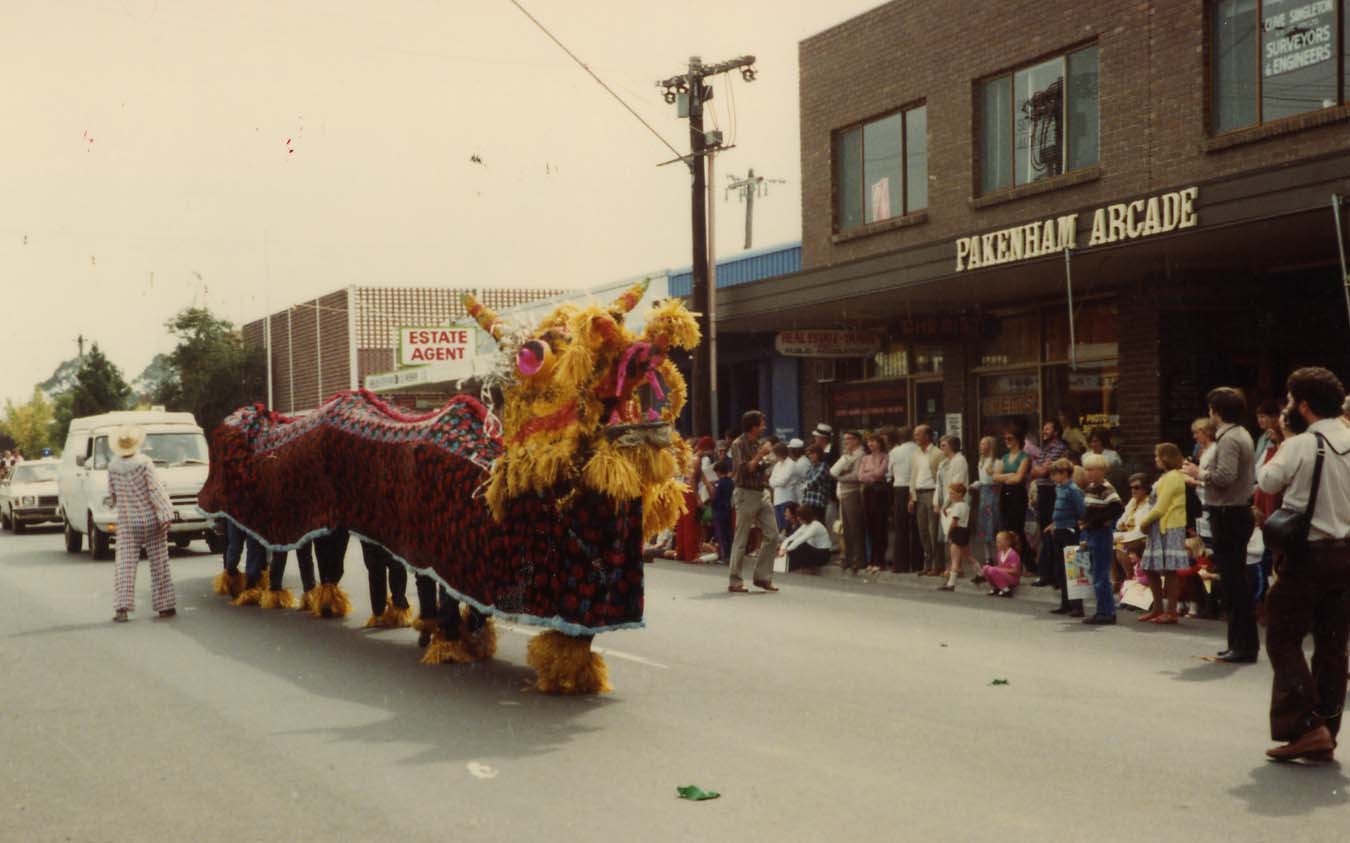
Here are some photographs of the Yakkerboo Festival in Pakenham taken in the late 1980s or early 1990s. The Yakkerboo Festival started in 1976, as light-hearted community Festival. These photographs are from the Library Archive and were taken by the Shire of Pakenham.

The Pakenham Shire float, looking down Main Street towards the railway line. The Pakenham Hotel, built in 1928-29, is on the right. The roof of Hardy's Hardware store can be seen in the centre.


The Pakenham Kindergarten float, with the particularly unattractive Shire Offices behind. The modern facade on the 1912 Shire Offices was erected in 1962.

Above and below, views of floats passing the State Bank in Main Street, obviously taken at different times as the State Bank logo is different.


Another view of theYakkerboo Parade, this time on the corner of Main street and John Street.

Friday, 16 September 2011

Antiques Appraisal Day Saturday, September 24

Do you have a family heirloom at home and what to know what it might be worth? Is the cat's feeding dish that you got at a garage sale really Ming Dynasty china and worth more than your house?
Then bring the items along to the Narre Warren Library on Saturday, September 24 from 11.00am to 3.00pm as the Narre Warren and District Family History Group are holding an Antiques Appraisal Day. It costs $5.00 per item to be appraised and you can also purchase light refreshments. The experts are Vanessa Crew and Adam Truscott from The Collector at Murrumbeena and they appraise everything - china, glass, sculpture, furniture.
For more information go to the Narre Warren & District Family History Group website www.nwfhg.org.au or email treasurer@nwfhg.org.au or ring 5991 4499.

Tuesday, 23 August 2011

South Bourke and Mornington Journal and the Motor Club Hotel, Cranbourne

Exciting news - Trove, the National Library of Australia digitised newspaper resource, has now added issues of the South Bourke and Mornington Journal to its content. It's a great resource and is currently on-line from 1872 to 1920. The Journal has lots of local news relevant to local and family historians in the Casey Cardinia region - its masthead boasts that it circulates throughout Dandenong, Berwick, Pakenham, Koo-Wee-Rup, Clyde, Lang Lang, Dalmore, Yannathan and Monomeith amongst other locations in the County of Mornington.

I came across some advertisements for the Motor Club Hotel in Cranbourne (or Kellys as it is more commonly known). The first Hotel on the site was the Mornington Hotel built around 1860 by Thomas and Elizabeth Gooch. The Cranbourne Road Board met in this building.

The Mornington Hotel, Cranbourne
Image: The Good Country: Cranbourne Shire by Niel Gunson

In The Good Country: Cranbourne Shire, Niel Gunson writes that Thomas Gooch was chief mate on the Sacramento. Elizabeth (nee Minister) had also been on the same ship, which was wrecked near the Heads, Port Phillip Bay. They both lost all of their possessions, but found true love and married each other in 1853. Elizabeth gave birth to nine children between 1855 and 1867. They were Thomas (1855), Alfred (1857), Susan Ellen (1859), Arthur (1860), Charlotte (1861), Walter Edward (1863), Harriet Beumont (1864), Frank Frederick (1865), Fanny Elizabeth (1867).


Thomas and Elizabeth Gooch
Image: Cranbourne Shire Historical Society


Application by John Taylor to change the name of the Mornington Hotel 
to the Motor Club Hotel
South Bourke & Mornington Journal  December 21, 1911. 

Sometime in 1911, John Taylor took over the licence of the Mornington Hotel and in December 1911  he applied to have the name changed to the Motor Club Hotel and this was approved at a Licensing Court Hearing held December 14, 1911. This name  may have been related to the birth of the Royal Automobile Club of Victoria in Tooradin or may have reflected the fact that Cranbourne was a popular destination for early motor car excursions. John Taylor purchased the freehold of the hotel in 1912.

John Taylor advertises that he has purchased the freehold of the Motor Club Hotel, January 1912.
South Bourke and Mornington Journal, January 18, 1912  

Julia O'Brien took over the licence of the Motor Club Hotel in February 1913, until March 1914. It was then operated by Gertrude and William Kilroy, until May 1918. Read more about the Kilroys, here. William James Taylor, then held the lease until Sarah Kelly, a member of the  Kelly family, who were also licensees of the Cranbourne Hotel (which was situated where Greg Clydesdale Square in High Street is now located) took over the license of the Motor Club Hotel in June 1919, as this article and advertisement in the South Bourke and Mornington Journal attests (see below).


Mrs Sarah Kelly takes over the lease of the Motor Club Hotel from Mr Taylor, in June 1919.
South Bourke and Mornington Journal, June 19, 1919

This was the first advertisement from Mrs Kelly at the Motor Club Hotel, June 1919.
South Bourke and Mornington Journal, June 19, 1919  http://nla.gov.au/nla.news-page6365244

The existing Motor Club Hotel, was built around 1924. I am basing this on the valuation in the Cranbourne Shire Rate Books - in 1923/24 and 1924/25 the Net Annual Value was 240 pounds, in 1925/26 -it had leaped to 420 pounds and the next two years it was 400 pounds, so I believe the increase in rates was due to the erection of the new building. As the Local Government year used to run from October 1 to September 30 then the new building would have been erected between October 1924 and September 1925 to appear at the higher valuation in the 1925/26 year.  The building is listed on the City of Casey Heritage Database, which describes it as a prominent local land mark and of historical and social significance.

The Motor Club Hotel, taken in the late 1920s or 1930s.
Image: Cranbourne Shire Historical Society  

Monday, 1 August 2011

Wattle time

If you live on the Koo-Wee-Rup Swamp or drive through it, then you would have noticed the wattle trees are in bloom. I believe the species is the black wattle (acacia mearnsii). It grows anywhere, it is on the bank of the Main Drain from Iona to Koo-Wee-Rup and if you dig up any soil and leave it for a few weeks you will soon have black wattles growing. The trees are neat enough when they are young, but after a few years they get messy, branches break off and they begin to look a bit ugly.

Image: Heather Arnold 

The flowers are a pale yellow, not nearly as pretty as the Cootamundra wattle (acacia baileyana) or Australia's floral emblem, the Golden Wattle (Acacia pycnantha Benth.) But from late July to the first few weeks of August the Black Wattle is glorious - they line the roads and the drain banks and you can look across the paddocks and see glimpses of yellow everywhere. It really is a magnificent sight.

Main Drain Road, looking west from the Eleven Mile Bridge at Cora Lynn.
Image: Heather Arnold 

The Main Drain, looking west, from the Eleven Mile Bridge at Cora Lynn.
Image: Heather Arnold 

Image: Heather Arnold 

You can also see other remnant Swamp vegetation, including the Swamp Paperbark (melaleuca ericifolia) . The photograph, above, was taken in Dessent Road at Vervale, but you can see this everywhere, including a stand near the sandpits in Thompson Road at Cranbourne and some along the Cardinia Creek, which you can see from the Pakenham by-pass. The picture (below) was taken, I believe, around Lang Lang in 1913. The plant can grow to ten metres high.


Image: Heather Arnold 

Another common plant are the reeds (phragmites australia), they grow everywhere on the Swamp, where there is a bit of water. This was taken also taken in Dessent Road. You can also see the reeds in the photograph, below. It is part of a series of post cards produced for Koo-wee-Rup in the late 1930s or early 194os. I think that's a blackwood wattle (acacia melanoxylon) behind the bridge.

Image: Koo Wee Rup Swamp Historical Society

William Wordsworth may well have been inspired by a host of golden daffodils, but to me there is nothing better that a host of golden wattles, brief though their time of glory may be, so here's another photograph, below, taken on the corner of Main Drain Road and Eleven Mile Road, Cora Lynn.

Image: Heather Arnold