Wednesday, 29 February 2012
The London Gazette
In the last post we looked at the life of Kathleen Kinsella, who did not survive the bombing of the Vyner Brooke on February 14, 1942. Whilst I was researching Kathleen I came across the fact that her sister, Nancie, had received an M.B.E (Member of the British Empire) so I began some research into this and came across a new resource that may be of interest to you. It is the London Gazette www.london-gazette.co.uk where, since 1665, all official British government notices are published.
Before I tell you about the London Gazette I will tell you about Nancie Kinsella. Nancie, Kathleen and their three brothers were the children of Michael James Kinsella (1858-1919) and Susan (nee Lockens 1857-1930) of Cora Lynn. Michael Kinsella had selected 60 acres of land on the north side of the Main Drain at Cora Lynn in 1900. They both started school at Koo-Wee-Rup North and then transferred to Cora Lynn State School and they both became nurses. Nancie had left Australia before the War and when the War broke out she enlisted in the Queen Alexandra’s Imperial Military Nursing Service. This service was started in 1902 by Queen Alexandra and provided nurses for military hospitals.
Nancie nursed in the Middle East; was in Normandy where she looked after D-Day casualties and also nursed the 1,700 survivors of the Belsen Concentration camp. At Belsen, the nurses had to de-louse and clean the captives and the wards as well as provide treatment for all manner of diseases such as dysentery, tuberculosis, typhoid, typhus, diphtheria, heart and kidney problems as well as starvation. Nancie was awarded a M.B.E in recognition of gallant and distinguished services in North West Europe – this was listed in the London Gazette, issue 37004, of March 29, 1945.
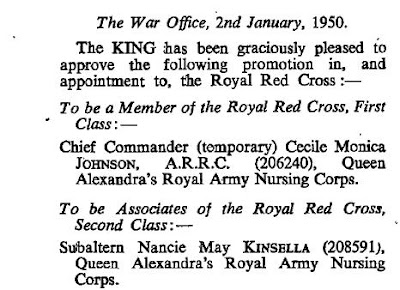
She was also mentioned in Despatches for the same service and was awarded the Associate Royal Red Cross medal, which is awarded to nurses for acts of bravery or exceptional devotion to duty. This award was in the January supplement to the London Gazette, issue 38797, of December 30, 1949.
It appears that she remained in the Service and completed her time in the Reserve of Officers in 1956 as we can see below from the London Gazette, issue 40758, of April 17, 1956. In 1956, Nancie Kinsella was appointed the Matron at the at the Peter McCallum Hospital and the ‘Nancie Kinsella Patient Library’ there is named in her honour.
Because Australia had the Imperial Honours System before 1975 all Australian recipients are listed in the London Gazette, so if your ancestor or relative received a C.B.E (Commander of the British Empire) or an O.B.E (Officer of the British Empire) or, like Nancie Kinsella, a M.B.E (Member of the British Empire) or even a higher honour such as a Knighthood then they will be listed in the London Gazette.
The notice above was in the London Gazette, issue 45678, of June 3, 1972. Cr Thwaites was awarded an O.B.E for his services to Local Government. Cr Thwaites was a Cranbourne Shire Councillor from 1958 to the 1980s.
Sir Sidney Sewell received his Knighthood in 1945 and it was listed in the London Gazette, issue 37119, of June 8, the same year. Sidney Sewell was a pioneer in the treatment of tuberculosis, founded the Association of Physicians of Australasia in 1930, lived at Roads End, Beaumont Road in Berwick and built the Tudor shops in High Street. The notice is also interesting for the use of the term 'Dominions' as it has been many years since Australian was referred to in that way.
Other things you would find listed in the London Gazette include bankruptcies, naturalisations, patents, military honours, promotions and appointments and public service appointments. And, best of all, the entire 340 plus years of the Gazette are now digitised, searchable and free to print off. I would advise doing an Advanced search where you have the option of searching a phrase or limiting by dates. It is an amazing resource if your ancestors are from the United Kingdom or like Nancie Kinsella involved with a British Military unit.
Monday, 13 February 2012
The Vyner Brooke
Tuesday, February 14 2012 is the 70th anniversary of the sinking of the steam ship Vyner Brooke. Sixty five Australian nurses and over 100 civilians were evacuated from Singapore three days before the fall of Malaya on the Vyner Brooke. The boat was bombed by the Japanese and sank in the Banka Strait on February 14 1942. Twelve nurses drowned, thirty two nurses survived the sinking and became prisoners of war, with eight dying in captivity. Another twenty two also survived and were washed ashore on Radji Beach on Banka Island where they joined a number of civilians and service men from other sunken vessels. Japanese troops bayoneted the men to death and marched the women into the water where they were machine gunned to death. The only survivor was Sister Vivian Bullwinkel and a British soldier. Sister Bullwinkel was later taken prisoner and survived the War.
There are two Casey Cardinia connections to this tragedy. One of the nurses who did not survive the sinking of the Vyner Brooke was Sister Kathleen Kinsella. Sister Kinsella was the daughter of Michael Kinsella and Susan Lockens of Cora Lynn. Michael Kinsella had selected 60 acres of land on the north side of the Main Drain at Cora Lynn in1900 and the family moved there in 1905. Kathleen was born on March 18, 1904 at South Yarra and she started school at Koo-Wee-Rup North (or Five Mile) and then in 1912 Kathleen, her sister Nancie (born 1900) and brother Arthur (born 1898) switched to Cora Lynn State School, where she stayed until 1918. There were also two other brothers Daniel (born 1894) and Norman (1895).
After leaving school, Kathleen trained as a nurse and was working at the Heidelberg Military Hospital when she joined the Army on August 4 in 1941. She was assigned to the 2/13th Australian General Hospital, the 2/4th Casualty Clearing Station unit. The 13th Australian General Hospital left Melbourne on September 2, 1941 and arrived in Singapore on September 15. In November it relocated to Malaya. As the fighting in the area increased the casualties grew and by December the hospital had 945 beds in operation and was acting as a Casualty Clearing Station and was the most forward surgical unit in the army’s medical organisation. As the Japanese advanced the Hospital had to withdraw to Singapore where by the end of January 1942 it had established a 700 bed hospital. The medical staff had to cope with bombings and blackouts but eventually it was too dangerous to operate and the nurses were evacuated on three ships, the last to leave being the Vyner Brooke on February 12. Sister Kinsella is commemorated on the Cora Lynn War Memorial.
One of the twenty four nurses who survived the war and the many years in captivity was Sister Wilma Oram who was born in Glenorchy in 1916. In 1947 she married Alan Young who had also been a Prisoner of War and they lived on a dairy farm at Cardinia. They had four children together and as well as running the farm, Mrs Young was very active in Veteran affairs. You can read her inspirational story in her biography A woman’s War: the exceptional life of Wilma Oram Young, AM by Barbara Angell. Another account of the women’s ordeal as Prisoners of War can be found in White Coolies by Betty Jeffrey, which was published in 1954, and is based on the diary she kept whilst in captivity.
This post is to commemorate the bravery, the sense of adventure and sense of duty of the Australian Service personnel, including Kathleen Kinsella and Wilma Oram Young, and their brave nursing colleagues on the Vyner Brooke.
Credits: the photographs of Sister Kinsella are from the Australian War memorial site, www.awm.gov.au. The information about the Vyner Brooke and the 2/13th Australian General Hospital is also from the Australian War Memorial site. An account of the Radji Beach massacre and its aftermath can be found in On Radji Beach by Ian Shaw and there is a very interesting ABC DVD on Sister Bullwinkel, Vivian Bullwinkel: an Australian heroine. Finally, a thank you to Lynne Bradley of the Narre Warren & District Family History Group for telling me about the Vyner Brooke anniversary and the connection to Kathleen Kinsella.
There are two Casey Cardinia connections to this tragedy. One of the nurses who did not survive the sinking of the Vyner Brooke was Sister Kathleen Kinsella. Sister Kinsella was the daughter of Michael Kinsella and Susan Lockens of Cora Lynn. Michael Kinsella had selected 60 acres of land on the north side of the Main Drain at Cora Lynn in1900 and the family moved there in 1905. Kathleen was born on March 18, 1904 at South Yarra and she started school at Koo-Wee-Rup North (or Five Mile) and then in 1912 Kathleen, her sister Nancie (born 1900) and brother Arthur (born 1898) switched to Cora Lynn State School, where she stayed until 1918. There were also two other brothers Daniel (born 1894) and Norman (1895).
After leaving school, Kathleen trained as a nurse and was working at the Heidelberg Military Hospital when she joined the Army on August 4 in 1941. She was assigned to the 2/13th Australian General Hospital, the 2/4th Casualty Clearing Station unit. The 13th Australian General Hospital left Melbourne on September 2, 1941 and arrived in Singapore on September 15. In November it relocated to Malaya. As the fighting in the area increased the casualties grew and by December the hospital had 945 beds in operation and was acting as a Casualty Clearing Station and was the most forward surgical unit in the army’s medical organisation. As the Japanese advanced the Hospital had to withdraw to Singapore where by the end of January 1942 it had established a 700 bed hospital. The medical staff had to cope with bombings and blackouts but eventually it was too dangerous to operate and the nurses were evacuated on three ships, the last to leave being the Vyner Brooke on February 12. Sister Kinsella is commemorated on the Cora Lynn War Memorial.
One of the twenty four nurses who survived the war and the many years in captivity was Sister Wilma Oram who was born in Glenorchy in 1916. In 1947 she married Alan Young who had also been a Prisoner of War and they lived on a dairy farm at Cardinia. They had four children together and as well as running the farm, Mrs Young was very active in Veteran affairs. You can read her inspirational story in her biography A woman’s War: the exceptional life of Wilma Oram Young, AM by Barbara Angell. Another account of the women’s ordeal as Prisoners of War can be found in White Coolies by Betty Jeffrey, which was published in 1954, and is based on the diary she kept whilst in captivity.This post is to commemorate the bravery, the sense of adventure and sense of duty of the Australian Service personnel, including Kathleen Kinsella and Wilma Oram Young, and their brave nursing colleagues on the Vyner Brooke.
Credits: the photographs of Sister Kinsella are from the Australian War memorial site, www.awm.gov.au. The information about the Vyner Brooke and the 2/13th Australian General Hospital is also from the Australian War Memorial site. An account of the Radji Beach massacre and its aftermath can be found in On Radji Beach by Ian Shaw and there is a very interesting ABC DVD on Sister Bullwinkel, Vivian Bullwinkel: an Australian heroine. Finally, a thank you to Lynne Bradley of the Narre Warren & District Family History Group for telling me about the Vyner Brooke anniversary and the connection to Kathleen Kinsella.
Friday, 27 January 2012
Construction of the Endeavour Hills Leisure Centre
The Endeavour Hills Leisure Centre was officially opened on November 11, 1990 by the Mayor of the City of Berwick, Cr John Pandazopoulos. The building was designed by the Architectural firm of Millar Sainsbery and Mulcair and built by the Norman Lothian Corporation at a cost of around $4 million. Here are a series of construction shots, which also give some great views of the developing suburb of Endeavour Hills.


This is a panorama of the Endeavour Hills Library, Community Centre and Leisure Centre, most likely taken around 1990 when the Leisure Centre opened.


This is the commemorative brochure produced for the Opening and, below, is a plan of the Complex, taken from the brochure.

This is a panorama of the Endeavour Hills Library, Community Centre and Leisure Centre, most likely taken around 1990 when the Leisure Centre opened.
Tuesday, 24 January 2012
Cranbourne War Memorial
There had been discussions from at least 1920 onwards as to the most fitting memorial to honour the men from the Cranbourne area who served in the First World War. Early suggestions were for the construction of a Soldiers Memorial Hall. An article in the South Bourke and Mornington Journal on November 11, 1920 reported on a Cranbourne Shire meeting. The Mechanics' Hall committee suggested the erection of a building which would provide accomodation for Lodges and other community groups as well as having a Library and a Billiard room. This would provide a place for 'boys to go for recreation at night'. Some objection was made to having a Mechanics' Institute as a memorial to soldiers, though apparently that had been done in other places. Another sticking point seemed to be that a new hall would be in competition to the existing Shire Hall - so this issue was put aside for a few years - in fact it wasn't until 1929 that a meeting decided to erect a memorial in the form of an obelisk.
Perhaps due to the Depression, things moved slowly and in June 1938 I found another reference from The Argus regarding the war memorial, see below.
The Memorial was erected in June 1939, as another article in The Argus reported, see below.

The Memorial was officially unveiled on August 27, 1939, ironically only about a week before Australia was once more at War, as it was on September 3 that the Prime Minister, Robert Menzies, announced we were at war with Germany. The picture, above, is from the Cranbourne Shire Historical Society collection.
Perhaps due to the Depression, things moved slowly and in June 1938 I found another reference from The Argus regarding the war memorial, see below.
The Memorial was erected in June 1939, as another article in The Argus reported, see below.
The Argus Saturday, June 10, 1939, page 4
http://nla.gov.au/nla.news-article12137410
The Memorial was officially unveiled on August 27, 1939, ironically only about a week before Australia was once more at War, as it was on September 3 that the Prime Minister, Robert Menzies, announced we were at war with Germany. The picture, above, is from the Cranbourne Shire Historical Society collection.
The Argus Tuesday August 29 1939, page 10
http://nla.gov.au/nla.news-article11234657

http://nla.gov.au/nla.news-article11234657

As you can see by the picture of the unveiling the the War Memorial, plus the one of the Shire Offices, above, the obelisk was originally located close to the corner of Sladen Street and the South Gippsland Highway. It was later hit by a car and moved at some time, possibly 1953, further west along Sladen Street, as seen in this 1988 picture, below. It was relocated again to its current location in Greg Clydesdale Square in 1991.
Monday, 23 January 2012
Shire of Cranbourne Offices
In the last post we looked at the Shire of Cranbourne 1875 Municipal Offices. With a number of extensions these Offices served their purpose for nearly one hundred years, however an increasing population led to a demand for increased Council services which led to increased staff - so by the early1970s the original buildings were no longer adequate. In July 1974 it was decided to not only retain the 1875 building but to build new Council Offices, further along Sladen Street. Plans were drawn up by the Architectural firm of Leith Barrett & Partners and the tender of H.C.F Constructions was accepted at the July 9, 1976 Council Meeting to construct the 2874 square metre building at a cost of $1,377, 238.00. With landscaping, fit-out and furnishings the total cost was about $1.86 million.

The Foundation Stone was laid by the Shire President, Cr Ern Marriott on November 26, 1976. Cr Marriott is pictured above (left) with Mr H. Sleigh of H.C.F Constructions. Council staff began working at the new building on January 16, 1978 and the first Council meeting was held on February 24, 1978. It was officially opened by the Governor of Victoria, Sir Henry Winneke on April 22, 1978. The foundation stone picture comes from the commemorative booklet produced for the official opening.

With Local Government Reforms in 1994, the Shire of Cranbourne and its successor, the short lived City of Cranbourne (which was proclaimed on April 22, 1994) was no more - part of it went to the new City of Casey and the other part to the new Cardinia Shire (both came into being on December 15, 1994). The building was no longer used for Council purposes and is now occupied by Cranbourne Community Health Services.

The Foundation Stone was laid by the Shire President, Cr Ern Marriott on November 26, 1976. Cr Marriott is pictured above (left) with Mr H. Sleigh of H.C.F Constructions. Council staff began working at the new building on January 16, 1978 and the first Council meeting was held on February 24, 1978. It was officially opened by the Governor of Victoria, Sir Henry Winneke on April 22, 1978. The foundation stone picture comes from the commemorative booklet produced for the official opening.

Above and below - views of the building.
With Local Government Reforms in 1994, the Shire of Cranbourne and its successor, the short lived City of Cranbourne (which was proclaimed on April 22, 1994) was no more - part of it went to the new City of Casey and the other part to the new Cardinia Shire (both came into being on December 15, 1994). The building was no longer used for Council purposes and is now occupied by Cranbourne Community Health Services.
Shire of Cranbourne Municipal Buildings
In the last post we looked at the opening of the City of Berwick Civic Centre at Narre Warren so continuing on with the Municipal buildings theme, today we will look at the Shire of Cranbourne Municipal Offices. William Lyall laid the foundation stone of the first Shire of Cranbourne Offices on March 6, 1875. The first Council meeting was held there on September 18, 1875. The suite of buildings consisted of the Shire Hall, Court House and Post Office.
This is the Post Office end of the building. The clock was installed in 1891.
An interior shot of the Shire Hall, maybe taken in the 1920s.
Another view of the buildings, it is actually one of my favourite photographs - hard to believe this is the intersection of Sladen Street and High Street/South Gippsland Highway. If you stood there now, you would probably get run over by a truck. The photograph was taken sometime after June 1939 which was when the War Memorial obelisk was erected. You can see the obelisk in front, right of the building.The building was extended in 1961/1962 and again in 1970/1971, however this was a building constructed when the Shire of Cranbourne had a population of around 1,000 and by 1976 the Shire population was 25,830 so effectively the Shire was out growing the building. A new building was opened in 1978, which will be the subject of our next post. The 1875 buildings were saved after a spirited campaign by members of the Cranbourne Shire Historical Society, community members and Mr Herb Thomas, publisher of the Pakenham Gazette, and at the time President of the Berwick Pakenham Historical Society.
Thursday, 5 January 2012
Civic Centre at Narre Warren
In the last post we looked at the formation of the City of Berwick in 1973. In 1978 a new Municipal Office, the Civic Centre, was built on land donated by the Overland Corporation, the developer of the Fountain Gate Shopping Centre. The building was designed and constructed by Jennings Industries and the completed cost, including building, fit-out, furnishings and associated road and landscaping works, came to $2,978,000.

The Civic Centre was officially opened on Friday, December 8 1978 by the Governor of Victoria, Sir Henry Winneke. The Mayor was Cr Keith Wishart.
This is such a great photograph, above. An informal shot of the Governor and the Mayor on the occasion of the Civic Centre opening.
The official brochure produced for the opening. This is entrance taken from the east or the Narre Warren Library side.
This photograph is from the first floor of the Civic Centre, showing the crowd at the official opening. It's looking across to what is now the Max Pawsey Reserve.

The Civic Centre was officially opened on Friday, December 8 1978 by the Governor of Victoria, Sir Henry Winneke. The Mayor was Cr Keith Wishart.
This is such a great photograph, above. An informal shot of the Governor and the Mayor on the occasion of the Civic Centre opening.
The official brochure produced for the opening. This is entrance taken from the east or the Narre Warren Library side.
This photograph is from the first floor of the Civic Centre, showing the crowd at the official opening. It's looking across to what is now the Max Pawsey Reserve.
Subscribe to:
Posts (Atom)


