Friday, 29 November 2019

Memorial to Sidney Webb in Narre Warren

In the last post I looked at the Mornington Hotel in Narre Warren - it's a bit of  a mystery, as I can find very little information about it. Here's another story with a bit of  a mystery - the creator of the  memorial to Sidney Webb (1844 - 1920)  at Narre Warren. When I was reading about the Hotel in Early days of Berwick (published 1948, updated 1959) I came across this about Sidney Webb The beautiful oak trees which he planted on the sides of the Princes Highway at Narre Warren stand as a living emblem to his memory. A tablet erected to his memory at the intersection of the North Narre Warren Road and Prince's Highway and unveiled by Sir George Knox in February 1955, at which the Shire President, Cr C. Harris, presided. The tablet bears the inscription -
Honoring
SIDNEY JOHN WEBB
who planted this row of 
Oak Trees in the year 1890.
The trees as young seedlings came from the Nobelius Nursery at Emerald, a pioneer family of nursery men now in its fourth generation. Mr J. Nobelius of Narre Warren is a member of this well-known family. Mr Smith, the man who designed the memorial was present at the unveiling. He also designed that well-known memorial near the Shrine of Remembrance in St Kilda Road, 'The Man with the Donkey'


The Sidney Webb memorial, unveiled Sunday, February 20, 1955 by Sir George Knox. You can see one of Sidney's oak trees in the background.

There was a report in the Pakenham Gazette of February 25, 1955 about the opening and we will quote from this to add a bit more detail about the occasion  - In a simple but impressive ceremony in the presence if about 200 district residents, a memorial to the late Mr Sidney John Webb was unveiled at Narre Warren last Sunday afternoon. An unobtrusive, yet pleasing memorial at the junction of Prince's Highway and Webb St., it is set amidst an even more impressive and lasting memorial - the magnificent row of oak trees which Mr Webb planted 55 years ago.  Mr Pat Sweeney, President of the Progress Association spoke, followed by the Shire President, Cr C. Harris. Cr Harris mentioned the battle that the Shire had with the Country Roads Board to save the trees when the Highway was widened. [The trees on the south side have since been removed.] The Federal Member, Mr R. Lindsay then spoke and he was followed by Sir George Knox. Sir George spoke about the outstanding qualities of Mr Webb who generally had the record of an outstanding citizen, with a vision into the future. In unveiling the monument Sir George said he did so to the Glory of God and in honour and memory of Sidney John Webb, who planted this row of oak trees in the year 1890. May his memory and all he worked for and achieved be a guide and inspiration to those who come after him. Sidney Webb's son, Harry, responded on behalf of the family and then all present were entertained at afternoon tea in the Narre Warren Hall.

Sir George also mentions the designer of the memorial Mr Smith, who was responsible  for that wonderful memorial in Melbourne, "The Man with the Donkey." He was pleased to see Mr Smith present that day. 

The 'Man with the Donkey' monument, designed by Wallace Anderson and unveiled June 20, 1936.
Image: Photographer: Rose Stereograph Co., State Library of Victoria  H32492/5212.

The 'Man with the Donkey', was  John Simpson Kirkpatrick, known as Jack Simpson, who rescued many wounded soldiers and carted them back to medical help on Gallipoli. You can read his Australian Dictionary of Biography (ADB) entry, here.

The mystery is that the 'Man with the Donkey' monument  was designed by Wallace Anderson (1888 - 1975, read his ADB entry, here) and not Mr Smith, so why is it attributed to Mr Smith and who is he? I do not know, but here are three scenarios - 
1. There is more than one 'Man with a Donkey' monument at the Shrine, one designed by Anderson and one by Smith.  I don't believe that is the case.
2. The book and the newspaper both made a mistake attributing the monument to Mr Smith. That is possible but even if the newspaper account is incorrect, then surely that mistake would not have been repeated four years later in 1959 when the second edition of Early  Days of Berwick was published? Or did the book use the Pakenham Gazette as the source? More than possible given that Herb Thomas, the publisher of the Gazette was a founding member of the Historical Society of the Berwick Shire (in 1962) along with Norman Beaumont, an author of Early Days of Berwick. 
3. Mr Smith had a role in the design of the monument. We know that Wallace Anderson was the sculptor and the statue was cast in bronze in Italy. Did Mr Smith design the granite base? The Sidney Webb monument looks plain but it does have some carved detail at the top - the initials SJW - Sidney John Webb, thus Mr Smith has skill in stone carving. I cannot, however,  find any newspaper reports about  the 'Man with the Donkey' monument which mention Mr Smith. However, keep reading as some evidence has come to light on this matter.


The top of the Sidney John Webb monument showing  his initials, S.J.W. 
Image: cropped from the photo at the top of this post.

Whether or not Mr Smith had a role in the design of the 'Man with the Donkey' monument he did design the Sidney Webb memorial, but who was he? The book and the newspaper refer to him only as 'Mr Smith' not even a first initial. I have done some research on Trove, and have not found any evidence as to the identity of  Mr Smith, so I would be happy if anyone could tell me.

I wrote this in November 2019 and in January 2020 - part of the Mr Smith mystery was solved. I borrowed a book called Real Life Portrait: The life of Wallace Anderson Australian War Artist by Roderic Anderson (Big Sky Publishing, 2010) Roderic is Wallace's son. On page 297 Roderic writes Wallace received a few good commissions, working on them in partnership with Alec Hall who designed all the stonework and Bill Smith who made it. So this gives us Mr Smith's first name, Bill, and the fact that he was stone mason and worked with Wallace Anderson. This leads me believe that it was Bill Smith who did carve the stone base of the 'Man with the Donkey' statue.  There was another mention of Bill Smith on page 298 of the  book - Though further out of town than he would have chosen if he had more money to spend on it Wallace liked the house in Surrey Hills and he wasn't cut off from his family and friends. Peter and Ruth Newbury, Les and Mary Bowles, Arthur and Amy Lawrence and Bill Smith and his wife often drove out there.  So now we have discovered something else about Bill Smith - he was married. 

Now I knew his first name I looked at the Probate records on the Public Records Office of Victoria website, www.prov.vic.gov.au. and came across a William Smith, occupation Master Mason, who died on March 29, 1961. His address was Footscray. I then checked the Footscray Cemetery records and there was a 95 year old William Smith who was buried on April 4, 1961. Also in the grave was a Jean Alves Smith, buried October 13, 1936 aged 63 and an Isabella Smith who was buried May 22, 1943, aged 42.  I then went to the Electoral rolls and in 1926 William Smith, stonemason, was at 111 Cowper Street, Footscray,  and Jean Alves Smith was at 109 Cowper Street. In 1931 there was a William Smith, occupation mason, at 11 Greig Street, Footscray and also at the same address was an Isabella Smith. In 1954 William Smith, occupation stone mason, was at 113 Cowper Street in Footscray.  Isabella was the daughter of William Smith and Jane Alves according to the Indexes to the Victorian Births, Deaths and Marriages. So, this confirms to me that the William Smith buried at Footscray was the stone mason. Was he the Bill Smith, stone mason, who created the Sidney Webb memorial? The obvious flaw in my argument is that would an 89 year have been capable of creating this  monument in 1955? I do not know. So we have progressed a  little further and can now at least give our Mr Smith a first name - Bill. But, once again if you have any information on the life of Bill Smith, I would love to hear from you.


Advertisement for the dance held to raise money for the Sidney Webb memorial.
Dandenong Journal, July 7, 1954. http://nla.gov.au/nla.news-article218510769

The memorial was funded by the Narre Warren & District Progress Association.  They spent a few months in 1954 arguing with the Shire of Berwick and the Country Roads Board to have the memorial erected in their preferred location. An article in the Dandenong Journal of July 29, 1954, quoting Cr Rae said that he understood the memorial was already completed, inscribed and ready to place in position. Unfortunately it gives us no details about the artist.  I have created  a list of newspaper articles on Trove, on the monument, you can access it here. They are from the Dandenong Journal and only go up to 1954, so they are just about the planning and fundraising for the Memorial.

Acknowledgement
Even though I borrowed the Wallace Anderson book, I did not actually read it, however my friend and fellow historian, Isaac Hermann, did read the book (it is unindexed) and found the two references to Bill Smith, so I am very grateful to him for helping solve the mystery of Mr Smith.

Trove list
I have also created a list on Trove, of articles on the 'Man with the Donkey' monument. You can access it here

Friday, 22 November 2019

Mornington Hotel at Narre Warren

In 1855, Thomas and Eliza Walton took up land at Narre Warren - 414 acres. Fountain Gate Shopping Centre now occupies some of this land. The Waltons built the Holly Green homestead and occupied the land until 1868, when they moved onto 1,500 acres on the  Tarago River, however they still owned the property and leased it out. Around 1881, Sidney Webb purchased Holly Green. You can read more about Sidney Webb and his contribution to the development of Narre Warren, here.

In the book Early Days of  Berwick they mention a Hotel on Walton's land - At Narre Warren, also in Mr Walton's time, there was the old Mornington Hotel kept by Mr J. Gardiner on the corner of the Highway and North Narre Warren Roads. It was later kept by Mr John Payne but eventually dismantled by the late Mr Webb who afterwards owned the property for many years. The  site of the old hotel is marked by the present Narre Warren Fallen Soldier's Memorial Arch (1)

So, what do we know about the Mornington Hotel? Not very much at all. The Shire of Berwick Rate Books are missing up to 1874; the 1875 and 1876 ones are a  bit patchy, but we do find John Payne in the 1877/1878 Rate Books, listed as 'House & Land' at Narre Warren. He doesn't appear again until 1879/1880, then he is listed again in 1880/1881. In the 1881/1882 Rate Books he is listed  as a Publican. He does not appear in the Rate books again, so I presume this is the time the Hotel closed.


Entry from the Shire of Berwick Rate Books, 1881/1882 - showing John Payne's listing in Narre Warren and his occupation as Publican.


There was a John Payne, a publican who died October 14, 1903, he was from Collingwood. A John  Payne had the Wheatsheaf Hotel in Brunswick Street in the 1880s and later the National Hotel in Victoria Street. Is this the same John Payne who operated the Mornington Hotel? I cannot tell you. As for the other licensee, J. Gardiner, I have no information about him. Is he connected to Captain Robert Gardiner, early Berwick landowner? That is another thing I do not know.

If you have any information about the Hotel, Mr Gardiner or Mr Payne, I would love to hear from you.

Footnote
(1)  Early Days of Berwick and its surrounding districts, compiled by Norman E. Beaumont, James F. Curran and R.H. Hughes (3rd edition published by Rotary, 1979), p. 8. The book was originally published in 1948.

Thursday, 7 November 2019

Cranbourne Railway Station photographs from the Public Records Office of Victoria

The Public Records Office of Victoria (PROV) have a collection of photographs produced by the Victorian Railways, Public Transport Corporation and other agencies which they collectively call the  Photographic Collection: Railway Negatives - you can access it here (or www.prov.vic.gov.au > Explore the collection  > Photographic collections > Public Transport Photo collection) 

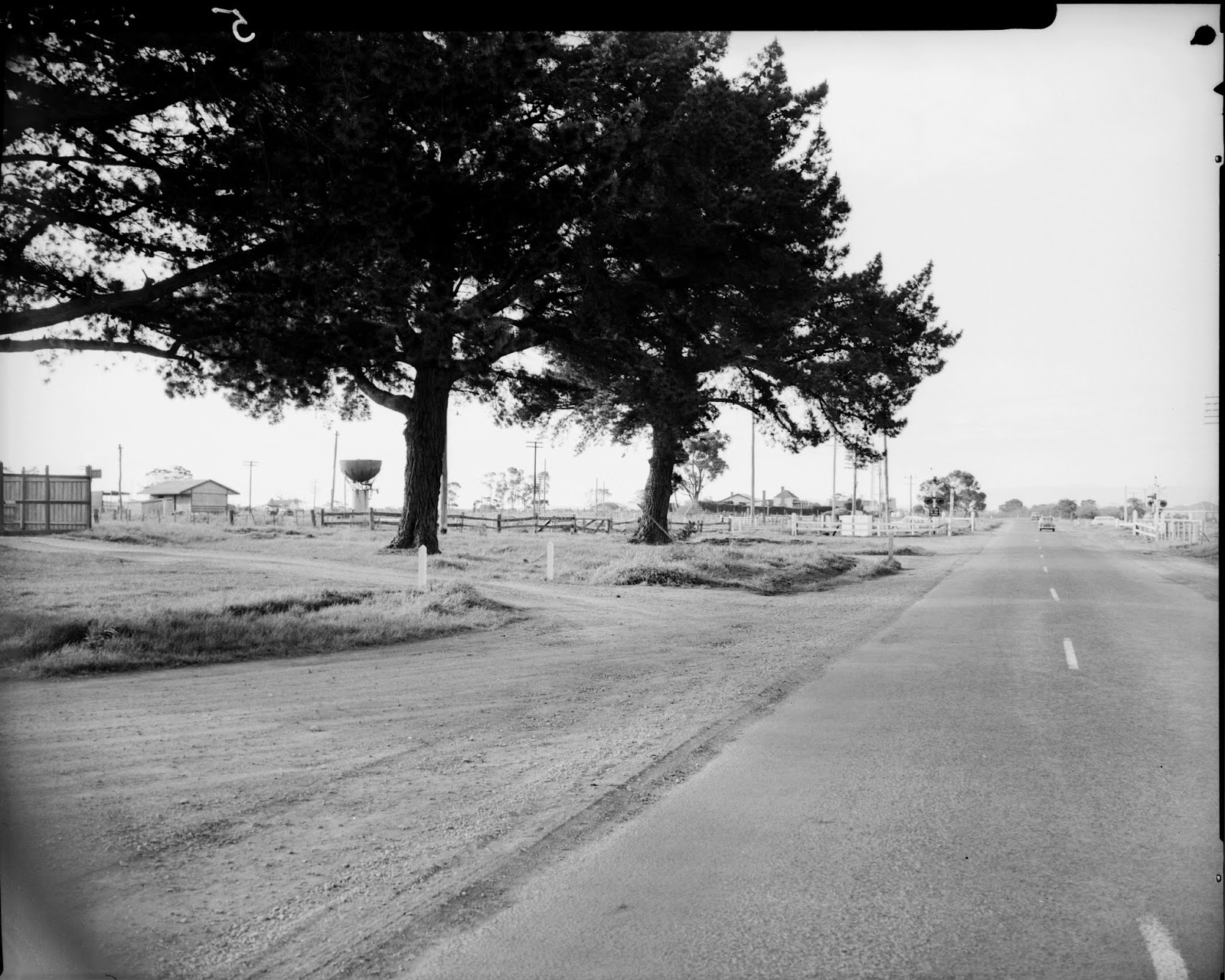
Here are the photographs showing the Cranbourne Railway Station, most likely from the 1950s or 1960s, when Cranbourne was still a country town. To see photographs of Pakenham from this collection, click here. To see photographs of Berwick from this collection, click here


Cranbourne, South Gippsland Highway level crossing, R class steam locomotive departing left side including derm and trailer
PROV -  Photographic Collection: Railway Negatives: Alpha-numeric Systems (VPRS12800)
H 5222a b/w signals


Cranbourne, South Gippsland Highway Level Crossing
PROV -  Photographic Collection: Railway Negatives: Alpha-numeric Systems (VPRS12800)
H 5223 B/W Signals


Cranbourne, South Gippsland Highway Level Crossing
 PROV -  Photographic Collection: Railway Negatives: Alpha-numeric Systems (VPRS12800)
H 5224 B/W Signals


View of Down End Cranbourne Station showing Water Tank 
[the next station in this direction was Clyde]
 PROV -  Photographic Collection: Railway Negatives: Alpha-numeric Systems (VPRS12800)
H 5227 B/W Station


View of Down End Cranbourne Station showing Water Tank.
[the next station in this direction was Clyde]
 PROV -  Photographic Collection: Railway Negatives: Alpha-numeric Systems (VPRS12800) H 5225 B/W Station

To see photographs of Pakenham from this collection, click here. To see photographs of Berwick from this collection, click here.

Pakenham Railway Station photographs from the Public Records Office of Victoria

The Public Records Office of Victoria (PROV) have a collection of photographs produced by the Victorian Railways, Public Transport Corporation and other agencies which they collectively call the  Photographic Collection: Railway Negatives - you can access it here (or www.prov.vic.gov.au > Explore the collection  > Photographic collections > Public Transport Photo collection) 

Here are the photographs showing the Pakenham Railway Station, most likely from the 1950s or 1960s, when Pakenham was still a country town. To see photographs of Cranbourne from this collection, click here. To see photographs of Berwick from this collection, click here


Pakenham Up End Level Crossing and Signal Bridge Flex. 
[This is the Main Street level crossing]
PROV -  Photographic Collection: Railway Negatives: Alpha-numeric Systems (VPRS12800)  S1376


 Pakenham Up Home Signal Flex
[looking west]
PROV -  Photographic Collection: Railway Negatives: Alpha-numeric Systems (VPRS12800)  S1378


Pakenham Down End Signal Bridge Flex
 [looking East - next station would be Nar Nar Goon]
PROV -  Photographic Collection: Railway Negatives: Alpha-numeric Systems (VPRS12800)  S1377


To see photographs of Cranbourne from this collection, click here. To see photographs of Berwick from this collection, click here

Berwick Railway Station photographs from the Public Records Office of Victoria

The Public Records Office of Victoria (PROV) have a collection of photographs produced by the Victorian Railways, Public Transport Corporation and other agencies which they collectively call the  Photographic Collection: Railway Negatives - you can access it here (or www.prov.vic.gov.au > Explore the collection  > Photographic collections > Public Transport Photo collection) 

Here are the photographs showing the Berwick Railway Station, most likely from the 1950s or 1960s, when Berwick was still a country town. To see photographs of Cranbourne from this collection, click here. To see photographs of Pakenham from this collection, click here


Berwick Station looking in Down Direction. 
PROV Photographic Collection: Railway Negatives: Alpha-numeric Systems (VPRS12800) H 4934 B/W Station


 Berwick Station Reconstruction Flex        
PROV Photographic Collection: Railway Negatives: Alpha-numeric Systems (VPRS12800) S 1380


 Berwick Island Platform Construction Down Side Flex
[Next station would be Beaconsfield. Is this 1956 when the line was duplicated between Berwick and Officer? https://vicsig.net/infrastructure/location/Berwick]
PROV Photographic Collection: Railway Negatives: Alpha-numeric Systems (VPRS12800) S 1381

To see photographs of Cranbourne from this collection, click here. To see photographs of Pakenham from this collection, click here

Thursday, 31 October 2019

University of Melbourne Digitised Map Collection

The University of Melbourne has a collection of maps, some of which they have digitised and are available on-line at https://digitised-collections.unimelb.edu.au/handle/11343/19 As you might expect from an Institution which started in 1853 - their collection includes both historic and more modern maps - there is the Ronald and Pamela Walker collection of maps of Asia Minor, 1511 - 1774, interesting in themselves and for students of Asian history, but there are also maps for people interested in local history.

There are over 260 maps of Melbourne including Melbourne and Metropolitan Board of Works Plans, Sands and McDougall maps from 1868 to 1899, which show how Melbourne developed in that time.  Of interest to the Casey Cardinia region is the fact that the Melway Street Directory has been digitised from 1966 until 1999. These maps chart the change of this region from farmland to suburbia. The first five editions of the Melway are also available on the Melway Street Directoyr website - https://melwayed1.melway.com.au/

The State Library of Victoria also has street directories digitised from 1912 to 1952 - they don't, however,  cover the Casey Cardinia area - the closest we get is to Oakleigh or Frankston - even Dandenong must have been considered country then. Find these Street directories here - under their 'Popular Digitised Collections'

http://handle.slv.vic.gov.au/10381/98883


The collection also includes some historic maps of Victoria - including this one, below, from 1851.


Victoria or Port Phillip, published by John Tallis & Co., 1851

Excerpt from a 1851 map showing our area - the Great Marsh is the Koo Wee Rup Swamp, north of that is Mt Ararat - the first Europeans who occupied this land were John Dore and Michael Hennessey, who took up the Mount Ararat Run, of 1,900 acres, at Nar Nar Goon  in 1844.  Rutherford is Rutherford Inlet - which goes to Warneet and Cannon's Creek. It was named after Thomas Rutherford who took up the Bourbinandera Run,  also known as Rutherfords for obvious reasons, in 1842. Jamieson is named for Robert Jamieson, who along with Samuel Rawson, took up the Yallock Run (on the Yallock Creek) in 1839. Further around the Bay, Anderson was at the Bass River. 

Saturday, 14 September 2019

Harkaway by Llywelyn Lucas

I was kindly given this poem by Robyn Browne, whose father had it amongst his papers.  It was typed out and at the end of the poem was written Queensland - Llywelyn Lucas, February 1st 1928. I have discovered more about the author, which you can read after you read the poem.

Harkaway

O Harkaway is far away,
And Harkaway is fair,
The green hills run to meet the trees,
And a child plays there!

O hills run up and hills run down
To meet the Dandenongs
And Harkaway is far and fair
And there a child belongs.

Don’t you remember how the fox
Yelped in the hedge at night
And Narre Warren hid in mist?
And Berwick out of sight?

Don’t you remember magic lakes
With islands of treetops,
And dewdrops scented in the sun
Sliding to bigger drops?

All down the rusty fencing-wire,
And bunnies with white tails
Bobbing among the barley and
The cuckoos at their scales?

(Ah, mournful, lovely, bad cuckoos!
Long since must you be dead;
Yet on and on, and on and on
Your scales go in my head!

And in my heart – age-old, and lost,
The mournful, mournful cry,
Asking and asking endlessly
O where? O where? O why?

Do you remember lilac time,
When lilacs purple and white,
Maddened us with the scent of them
And the young life delight?

Of course you do! And so do I,
And how the cows of sums
Wouldn’t come out: and won’t do, yet!
Not even using thumbs!

How good the hung-up lunches smelt,
Of sandwiches and sauce!
Do you remember “swapping taws”?
You do; you do, of course.

Remember how the “milk: went by,
With brakes that squawked and squealed,
And how the bellbirds clinked and chimed
Like mad at Beaconsfield.

And all along Kardinia Creek
The Christmas bush grew thick,
The bellbirds raced you out of sight
If you weren’t quick.

Do you remember Muddy Creek,
And that pot-holey track
That went beyond the Finger Posts
To people at the Back?

O Harkaway! O Harkaway!
How fair you were, how fair!
The silver huntsman on the hills.
And a horn winding there.

A winding horn, a challenge horn,
Away! Away! ah do!
O Hark! Away! the hunt is up!....
How faint I answer you.

The hunt of life, at dawn, is up,
Away, away we go.
Envisioned eyes, quick-coming breath,
Ho, tally, tallyho!

The hunt is up, the hunt, the hunt!A
Do we look back? Not we!
Ahead the toppling Mountains wait;
Below, the crashing sea!

The deep blue tides of Western Port,
Hard by Port Phillip Bay;
The silver sand’s a laughing lure-
Away! away! away!

A magic horn, a merry horn,
The echo’s never sped…..
No! I shall not go back again-
That kiddie might be dead.
..........................................................................................................................

Who was Llywelyn Lucas?   Beryl Llywelyn Lucas was born in 1898 to  Albert Llewellyn Lucas and Mary Janet Mackie. Sadly, her father who was the Presbyterian Minister at Bright, passed away on October 14, 1897 due to diabetes, before she was born. They had one other child, Keith Mackie Lucas, who had was born in  1897 in Bright. Albert Lucas' father, Edward, was the Town Clerk of Brighton from 1874 until his death in 1900.


Llywelyn Lucas
Australian Woman's Mirror October 4, 1927

Llywelyn was written up in the Australian Woman's Mirror October 4, 1927. The article (read it here) was written by Bernice May, and I will quote from it here.  Llywelyn was introduced as a writer of lyrical poetry. She is first and foremost a poet, and after that a joyous Australian girl with the Australian's abiding sense of humor. Mary Lucas was a nurse and she was living at Harkaway when her daughter was born. Llywelyn was educated at Presbyterian Ladies College and she wanted to study medicine after school 'but the war stepped and I went to the School of Horticulture, Burnley, Victoria, to learn gardening instead. Mother - more like a sister than a mother - took up the work with me, and we soon had charge of a big garden in Melbourne, with two men working under us. All through the war and after we worked.'

After the War, Llywelyn had a breakdown in health  and 'I had to have a holiday... and with two other girls as impecunious as myself, I went to England.' While she was away her poetry was published in The Bulletin and she tramped through Italy and France and her account of this trip was published in the Sydney Mail.

Miss Lucas writes of things with the skill of one who, though so young, has touched many different occupations and spheres of life. In a recent letter to me she said ' I once tried motor-driving at Miss Anderson's girl's garage in Melbourne.'

Her brother Keith who served in World War One, trained as a Veterinary Surgeon and took up practice in Brisbane. Llywelyn and her mother gave up their gardening business and also moved to Brisbane. Llywelyn worked at his practice for a while and continued her writing. Bernice May quotes Llywelyn again 'being assistant to a Vet. and writing verse, don't seem to go together, but I make them fit somehow.' During this time she was published in The Bulletin, Australasian and the Sydney Mirror.  

Miss Lucas has her ambitions, like all girls. She wants to write real poetry; and publish it, also some books that will make people laugh and cry, and perhaps a play that will make them think. (Australian Woman's Mirror October 4, 1927, read it here)

There are many examples of Llywelyn's works that you can read on Trove, which were published in various newspapers -  poetry, plays, short stories and articles on poets and poetry. She also had some collections published -  The Garden, in 1938; On Wings, in 1944; Aphorisms of Llywelyn, in 1964; Brown Boronia: a collection of sixty-six poems, in 1966.  In 1968, Lost kinship and other poems : a memorial to Llywelyn Lucas selected by Edith M. England was published with various poets paying tribute to Llywelyn.


Wedding notice of May Mackie to Albert Lucas
The Australasian, March 14, 1896  http://nla.gov.au/nla.news-article139722839

We will now have a look at the Harkaway connection which was through Llywelyn's mother. As you can see from the marriage notice, above,  Mary was the daughter of James Mackie and Gideon Burnett Adamson of Kalimna, Harkaway.  Other children in the family were Margaret Thompson (born 1856 at South Yarra), Archibald Walter (1858 South Yarra), James Thompson (1860 St Kilda), William Alexander  (1864 South Yarra*), Helen Agnes (1867 Deniliquin) and Llywelyn's mother, Mary Janet, born in 1873 at Deniliquin.

According to Early Days of Berwick (first published in 1948) The pine and other trees along Harkaway Road were planted by Cr W.G. a'Beckett and Miss Mackie of Berwick, at one time  a resident of Harkaway, and her late brother, Archie.  James, another brother of this family, was a member of the staff of the bank at Jerilderie when it was held up by the Kelly Gang.  The only other reference in Early Days of Berwick to the Mackie family was The Mackie family occupied Kalimna, so named from the Aboriginal word meaning "lovely or beautiful," where it commands a magnificent view. Mrs and Mrs Mackie beautified it by planting trees from many parts of the world. The magnificent view was alluded to more than once by Llywelyn in her Harkaway poem.

It appears that Mary Lucas moved backed home to her parent's house after the death of her husband as that is where Llywelyn was born. In August 1915, at the age of 18 years and 10 months,  Keith enlisted in the AIF (his service number was 9315) and his address and that of his mother, who was his next of kin, was Kalmina, Harkaway. Keith had attended Berwick Grammar School, under Edward Vieusseux and is on their Honor Roll (Berwick Shire News February 9, 1916).  In 1924 and 1925 the family were listed in the Electoral Rolls at Hethersett, Burwood Road, Burwood. 1926 was obviously the year they moved to Brisbane as their address was Kadinia, Kitchener Road in Ascot.  It is interesting that they called their property Kadinia, which in spite of the spelling must relate to the Cardinia Creek, which runs through Berwick.

The only other family information I have is this - Keith married Marjorie Hollinshead, who was a dancing teacher,  on November 21, 1932. Marjorie also lived in Kitchener Road in Ascot and she had collaborated with Llywelyn in 1929 in the production of  an all-Australian play for children - Sun God's Secret - Llywelyn being the playwright and Marjorie the choreographer.  (Sunday Mail, November 24, 1929).  In 1933,  Mary Janet Lucas was killed after being hit by a train. In 1936,  Llywelyn was listed in the Electoral Roll as a writer and her address was Flinders, near Ipswich. Llywelyn died in 1967 and Keith died in 1987.

I have created a list of newspaper articles on Trove, relating to the life of Llywelyn Lucas and her family and her works, you can access it, here. All the articles referenced here are on the list.


* I have taken this information from a Family Tree on Ancestry, they have no sources listed. I know he existed as he died in 1939, I just haven't found  an authorative source of his birth.