Showing posts with label Berwick Quarry. Show all posts

Monday, 26 August 2019

Excursion to Berwick Quarry by the Victorian Field Naturalist's Club in 1916

The Victorian Naturalist, v. xxxiii, n. 389, May 4, 1916 had this report of an excursion by the Club in April 1916 to Wilson's Quarry at Berwick.  The article describes the visit and the various fossils obtained on the day. It is transcribed below.


The Victorian Naturalist, v. xxxiii, n. 389, May 4, 1916


Wilson Quarry, Berwick, 1906

Excursion to Berwick Quarry
Though Berwick is within a reasonable distance of Melbourne, and in the early days of the Club was frequently visited by members in search of insects and plants, the visit on Saturday afternoon, 8th April, was the first arranged for the purpose of studying the geological features of Wilson's Quarry and the physiography of the district. The quarry, which is within a  short distance of the station, is situated on the south-western slope of One-Tree Hill. It has been worked for many years, and is well known to palaeobotanists as it is to geologists, for the many species of fossil leaves which have been obtained there from time to time.  

The north and east faces form  a section which is typical of a high level lead - the sides of the old valley. The infilling rows of basalt - two main ones and several minor ones - the underlying lignitiferous clay - representing the forest grown, immediately preceding volcanic activity - a leaf-bed, and a band of rounded and subangular fragments resting on palaeozoic slates and shales, showing the exact relation of the basalt to the underlying bedrock, and the sequence of evemts during the Miocene volcanic activity.

Having examined the section the party preceded to  a face that Mr Wilson had kindly cleared so that members members might more readily inspect the leaf-bed. Many valuable fossil specimeds were obtained, and Mr F. Chapman has kindly permitted me to use the list of identifications made by him. Later in the afternoon the party ascended One-Tree Hill - a viewpoint from which one may see the main physiographical features of  the district. The general trend of the old stream, both north and south, was indicated by the lateral streams - Narre Warren and Cardinia Creeks- that have cut their way back through the palaeozoic sediments at the edge of the basalt. To the north the couse of the old stream was shown to be ditectly towards the Lysterfield wind-gap, and it was explained that the flats at the head of Dandenong Creek and the Lilydale basalt were directly connected with it. To the south its course was traced on to the pene-plain, and the effect of an east and west fault of large displacement was indicated by  the somewhat steeper slopes of the north. From the hill members had the pleasure of witnessing a glorious sunset, which fitly terminated the day's observations.

The plant remains found in the pipe and carbonaceous clay were as follow: - (?) Nephelites quercifolia, Deane; Tristanites augustifolia, Deane ; Eucalpytus, cf. Hootmanni, Ettingshausen ; E., cf Hermani, Deane;  E. Kitsoni, Deane ; Atherosperma Berwickense, Deane ; Mollinedia helicoiodes, Deane; M. praelongipes, Deane ; M., cf. Muelleri, Deane, previously recorded from Pitfield Plains; cf. Hedycarya, sp ; Lomatia Bosistooides, Deane ; L. dubia, Deane ; L. perspicua, Deane; Fagus Luehmanni, Deane ; F. Muelleri, Ettingshausen ; F., cf.  Risdoniana, Ettingshausen : F (?) sp. nov. ; cf. Poacites australis, Ettingshausen ; also rhizomes and stems, seeds (Carpolithes, spp.), and fragments of (?) conifers. Mr Searle obtained a particularly fine specimen in the end stem of a conifer. -
 R.A. KEBLE.

The Berwick Quarry is now Wilson Botanic Park. Wilson Botanic Park Berwick is one of the southern hemisphere's premier fossil flora locations. Significant Macrofossil Flora Fossils dating back 22 million years where found in the park in 1902 by Australia's foremost Paleobotanist Henry Deane. Many of these represent some of the earliest examples of rainforest in the drying environment in Southern Australia. https://www.casey.vic.gov.au/plant-collections-wilson-botanic-park-berwick

Henry Deane (1847 - 1924) was a civil engineer, specializing in railways, as well as a Botanist. You can read about him in the Australian Dictionary of Biography, here. The other botanist referenced in the list of plants above was Costantin von Ettingshausen (1826 - 1897) The Australian National Herbarium Biographical Notes (see here) say that Ettingshausen was one of the first to try to identify the Australian fossil flora.

Wednesday, 7 May 2014

Quarries and Sand mines

This is a series of quarry photographs - taken in the 1960s and 1970s. Basalt quarries were north of the Princes Highway in Berwick and Harkaway and sand quarries were south of the Princes Highway in Lyndhurst and Cranbourne.


This is the basalt quarry where King Road becomes Robinson Road in Harkaway. It was taken December 1963.            
                                                               

These are the two basalt quarries south of A'Beckett road and west of Harkaway Road in Harkaway. The photo was taken in January 1978.


This is the basalt quarry in Noack Road in Harkaway and one of the A'Beckett Road quarries can also be seen.  Photo was taken in April 1978. I don't know when they started quarrying in Harkaway - the earliest reference I can find on Trove is from the Dandenong Advertiser of September 23, 1915. 

This is a report received at the Berwick Shire Council meeting held September 18, 1915. 
Dandenong Advertiser of September 23, 1915.    http://nla.gov.au/nla.news-article88661295


This is Wilson Quarry in Berwick - another basalt quarry. You can read all about the history of the Wilson Quarry here. The quarry opened in 1859. It is now Wilson Botanic Park.  Photograph taken December 1963.


This is a quarry in Hallam, taken in January 1970. That is General Motors Holden Factory on the left and the Freeway now passes between GMH and the Quarry. The Gippsland Railway line is south of GMH and the quarry. The section of this railway line between Oakleigh and Bunyip opened October 1877. You can read more about this line here. I have no information about this quarry, but I suspect it was a sand mine.


Taken in January 1972 this is the Lyndhurst/Hampton Park sand quarry. It is now the 'Hallam Road landfill'. The South Gippsland Highway runs along the left of the photograph. At the bottom right corner is part of the Cranbourne Golf Club.


This is the sand mine either side of Thompson's Road in Cranbourne. Photograph was taken January 1970. The road on the left of the photo is Narre Warren - Cranbourne Road. They still mine sand on the south side of Thompson Road. Apart from Cranbourne there are still sand mines in other parts of the region, especially around Lang Lang and Yannathan.


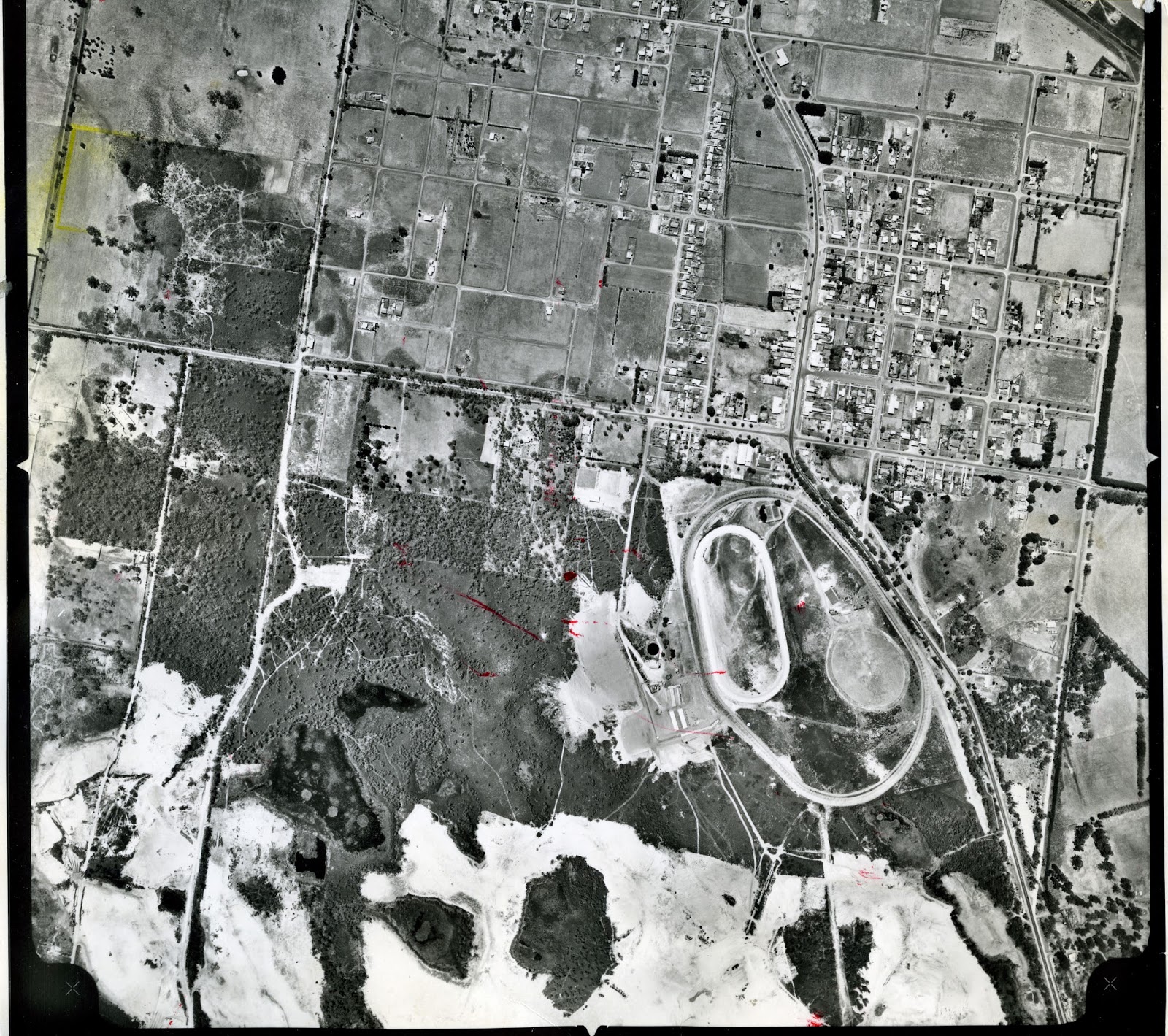
This aerial is from February 1964. These are the sand pits below the racecourse at Cranbourne, some of which now form the Botanic Gardens. Just to the south of the racecourse, where Earlston Circuit is now, was the Earlston Sand Mine, who had their own railway siding, from around the mid 1930s.  I believe there was also a line that went from the sand pits to Camms Road level crossing to service the  Cranbourne Sand Company, from the mid 1920s.


The South Bourke and Mornington Journal of September 6, 1917 had an article about 'A new Industry for Cranbourne'.  If you can;'t read the article, above, click on this link http://nla.gov.au/nla.news-article66192688 and it will take you to the article on Trove. Sand mining has thus been an industry in Cranbourne for nearly 100 years. 

Tuesday, 31 March 2009

Berwick Quarry and the Wilson family

The Back-to Berwick Quarry Re-union was held on Sunday, March 29th 2009 at Wilson Botanic Park in Berwick. Past quarry workers met to reminisce and there were guided tours of the Wilson Botanic Park. A plaque, commemorating 150 years since quarrying commenced on the site, was unveiled by Les McDonald and Margaret Rossell. Les worked at the Quarry from 1947 to 1967 and Margaret is the President of the Friends of Wilson Botanic Park. Well known Shire of Berwick/City of Casey identity, Neil Lucas, was the M.C. on the day.

View of the Back-to Berwick Quarry from the top of the Amphitheatre.

The quarry was on land owned by the Wilson Brothers, William (1830-1907) and James (1833-1910), who purchased around 630 acres from the Crown in 1854. This land was bounded by the Princes Highway, Lyall Road, Hessel Road in the west to Harkaway in the North. Their sister, Anne (1827-1909) house kept for them. Initially they lived in tents until they built a small one room house, which was later extended and became Quarry Hills. The brothers grew wheat, potatoes and later went into dairying. When William married Euphemia Brisbane in 1859 the land was split diagonally with William’s land fronting the Princes Highway and James’s land facing Harkaway Road. James married Anne Lindsay in 1858 and Anne Wilson married James Buchanan, M.L.C., in 1859.

The basalt quarry at Berwick opened in 1859 when William Wilson gave contractors the right to remove stone. However the quarry expanded after 1874, with the building of the Gippsland railway line to Sale as it provided ballast for the line. Once the line was completed in 1877 William’s son, William Jnr (1860-1936) (pictured right) saw an opportunity to carry on the quarry, so he leased the quarry from his father and quarried stone for road making. William Jnr would drive one loaded dray carrying approximately two cubic yards or 2½ Imperial tons and lead another horse and loaded dray when he delivered the stone to local Councils. He established two crushing plants driven by a Marshall Steam engine. A spur line to the Berwick Railway Station was established in 1890.The rail trucks could convey ten cubic yards of rock and the railway allowed the product to be conveyed anywhere in Gippsland for the re-ballasting of the railway lines and road building. The quarry closed at the end of the First World War and the plant and the railway line was sold to a Cranbourne sand company. The Berwick Shire occasionally obtained stone from the quarry and had installed a small crushing plant for this purpose. In the late 1930s the quarry was leased by George and Ted Daniel. The Daniel brothers had been working a quarry at Lysterfield and when they took over at Berwick they installed a diesel powered crusher plant with a weekly output of 500 cubic yards of crushed rock. Daniel Brothers supplied the Shires of Berwick and Cranbourne. Due to various factors, by the late 1940s more capital was required and the quarry was sold to Bayview Quarries. Roy Ross, the owner of Bayview, installed an electric plant which crushed up to 1,000 cubic yards per day. In 1966, Bayview sold its interests to Boral, who operated the quarry under the company Albion Reid P/L.

During all this time the quarry itself was owned by members of the Wilson family and when it closed in 1978 the owner, George Wilson (1918-2003) and his wife Fay, (nee Duff) donated the 50 acre quarry site to the residents of Berwick for use a public park. The park was to be named Wilson Park in memory of George’s father, also called George (1867-1943) and his grandfather, James. Other land was purchased by the Council from the Andrews family who were descendents of William Jnr and his wife, who was also his first cousin, Annie Buchanan.

Aerial of the Berwick Quarry, before the development of the Wilson Botanic Park.

Work on the Park commenced in 1988, and the City of Berwick aimed to beautify the landscape, provide a place for relaxation and recreation and to create a botanic park with a collection of plants for botanic study. The final plan included an inner and outer trail loop one which focussed on the lakes and the other on the magnificent views, with all the trails being accessible to unassisted wheelchair users. After much work the one hundred acre (40 hectare) Park was officially opened on July 26th, 1992, by the Governor General Bill Hayden. Other features in the Park include a children's playground, a lookout tower, bird hide and Amphitheatre. There is an active Friends group, the Friends of Wilson Botanic Park, who support the Park in many ways - from staffing the visitors centre, fund raising, acting as tour guides, undertaking planting , watering, weeding and other plant handling activities. The Friends were also responsible for the organisation of the Back-to Berwick Quarry Reunion.

Anniversary Lake, Wilson Botanic Park.