Showing posts with label Hallam Hotel. Show all posts

Monday, 5 June 2017

Hallam Hotel

William and Mary Hallam purchased the 50 acres (20 hectares) of land  in 1856 on the corner of the Gippsland Road (Princes Highway) and Hallam Road. They established a store and a Post Office and the store was 'the genesis of the hotel' as Jean Uhl says in her book  Call back Yesterday: Eumemmerring Parish. I do not know when the Hallams were granted the licence but there is an article in the South Bourke and Mornington Journal of May 21, 1879  when Mr W. Hallam of Eumemmerring was charged in the Dandenong Police Court with 'not having a light outside his licenced house' (you can read the article here) so it was clearly operating as a hotel then. The Hallam Hotel website says it started in 1872 and this seems to be the general consensus from newspapers articles published on the history of the hotel in 1970s and 1980s, and I am not saying that this date is incorrect, but I can't find any evidence to support it.

The Hallams sold their land to Edmund Uren, in 1885.  This is confirmed by the following two articles in the South Bourke and Mornington Journal of March 11, 1885.


South Bourke and Mornington Journal   March 11, 1885

Deborah Stephan, in her booklet, Hallam 1830-1930, wrote this about Edmund Uren, who had purchased Hallam's property for 2,100 pounds - Uren was a Cornishman who arrived in Australia in 1856 and went into copper mining on the Buninyong district (Ballarat). He served three years on the Borough Council, one year as Mayor of Buninyong and three years as a member of the Ballarat Mining Board. On November 24 1886 Uren applied for a certificate authorising the issue of a victuallar's licence for premises situate at Eumemmerring, 'containing six rooms exclusive of those required for the use of my family and servants'. In June 1892 he described himself as the licensed victualler of Hallam's Hotel, Hallam Road near Dandenong, when conveying the property to his wife Elizabeth.

I don't know why  he had to apply for a victuallers licence as he already had one, but I suspect that he might have rebuilt the building as by 1886 the original premises would have been close to 30 years old.  You can see in the newspaper report, above, that the hotel was referred to as the Eumemmerring Hotel - Jean Uhl says that the hotel had  a variety of names including Hallam's Eumemmerring Hotel, Uren's Hallam Hotel, Uren's Hotel Eumemmerring and Hallam's Road Hotel.

Edmund Uren died in July 1892 and his wife, Elizabeth,  took over the licence. Elizabeth operated the hotel until June 1898 when  'Miss Clarkson was installed there' as the South Bourke and Mornington Journal said.  Ada Jane Clarkson owned the Hotel until March 1913. It then  had a succession of licensees including Eliza Bonnell, Sarah Wright and Mary Thomas who took over in 1921.


Hallam Hotel, before the 1930s remodelling

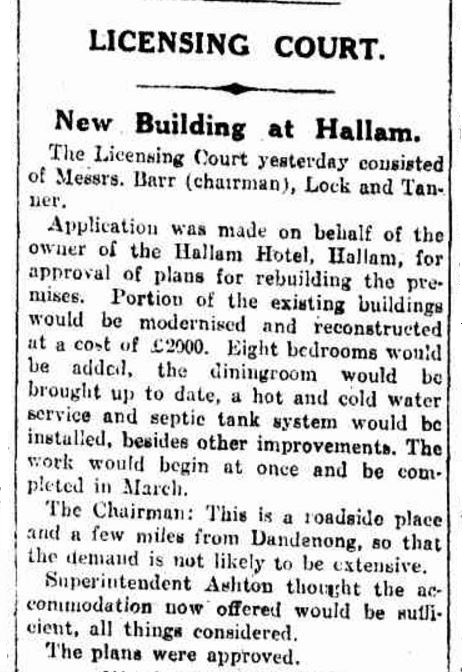
The Hotel started it's life as a one storey building and The Age reported on October 28, 1930 that existing building was to be modernised and extended.


The Age October 28 1930

The new hotel was opened in March the next year as the the Dandenong Journal of March 12, 1931 reported The new hotel has been completed; a handsome two story building, which has taken the place of the old hostel of the overlanding days.


Dandenong Journal March 12, 1931 


The Hallam Hotel in 1986


References: 
Hallam 1830-1930 by Deborah Stephan  (City of Casey Historical Pamphlet 2)
Call back yesterday: Eumemmering Parish by Jean Uhl  (Lowden Publishing 1972).

Friday, 12 July 2013

Squizzy Taylor Myths

Let me start this by saying that I consider Squizzy Taylor to be nothing more than a common criminal and I think that his criminal lifestyle should not be glamorised, as it seems to be at the moment. However, over the years I have been asked if Taylor ever spent time in this area and have been told of possible sightings - so in this post I intend to try to work out fact from fiction.

First myth: Squizzy Taylor's sister, Mrs Bufford, ran the Hallam Hotel and he was a frequent visitor there. (Click here for an account of this)  According to a report in The Argus of July 12, 1927 Elsie Bufford took over as licensee of the hotel in July 1927. Previous to this she had been at the Commercial Hotel in Yea, and a report in the Alexandra and Yea Standard said Mrs Bufford sold this hotel in  February 1927. Squizzy Taylor died October 27, 1927, so he may have been a frequent visitor for the three months before he died, but she wasn't his sister.  According to the Indexes to the Births, Deaths and Marriages, Leslie 'Squizzy' Taylor had three sisters and four brothers - one of his sisters, Irene,  died as an infant; Gladys married Leslie Mouldey and Alice married Alfred Wiggin. His parents are listed as Benjamin Isaiah Taylor and Rose Jones. Elsie Bufford was born in Corowa in 1892 to Dougal McDonald and Maria Green. She married George William Bufford in 1916, it was obviously not a happy marriage as an article in the The Argus of April 14, 1937 (reproduced below) shows she was granted a divorce from her husband on the grounds of desertion.


Elsie held the Hallam Hotel licence until October 1933. I am not sure where she went after that but she was at the Colbinabbin Hotel from at least 1936 until August 1938.  She married Reginald Skews in 1938 and died in Red Cliffs in 1956. So the myth is that Taylor visited the Hallam Hotel because the licensee, Mrs Bufford, was his sister. Mrs Bufford was not his sister and she only had the Hotel for three months before he was killed, so I am saying that this is a myth and has no basis in fact!

Second myth: Squizzy Taylor attended the races at Nar Nar Goon and Garfield. According to the book by Hugh Anderson The rise and fall of Squizzy Taylor:  a larrikin crook, Taylor was a keen race goer and started his 'legitimate' working  life as a apprentice jockey. Garfield held races from 1902 to 1933 and there were races at Nar Nar Goon until 1942. Both towns were on the train line, so access was easy. So, this myth is plausible.

Third myth: Squizzy Taylor frequented Cannons Creek. Why first reaction to this is 'Why would he bother?' Today, of course, this area is a pleasant town but in the 1920s, and before, it was really nothing but coastal scrub - the first land sales in the area didn't take place (according to the Shire of Cranbourne Rate books) until 1930, three years after Taylor died, so at the time there would have been nothing but a few fishing shacks, the holiday house of Sir Aaron Danks and the house of the fisherman, Nicola Nicolella. There were no shops and no hotel, it was around seventy kilometres from Melbourne and past Cranbourne the roads would have been dirt tracks. It was a long way from the bright lights and social activity of Taylor's inner Melbourne haunts. Anderson has reports of him in Frankston (which was a holiday destination in the 1920s)  and St Kilda, so there were plenty of closer places to go to the beach.  I am saying that, once again, this is a myth and has no basis in fact.

Fourth myth:  Squizzy Taylor had a hide out in North Garfield.  There is a property in North Garfield Road that is currently on the market and this connection is one of the 'selling points'. Once again, my reaction is 'Why would he bother?' In the 1920s North Garfield was pretty remote, the property that is for sale is 5 kilometres north of the highway and about the same distance again into the township and about 85 kilometres from the inner suburbs, Taylor's usual haunts.

Apparently, Taylor was on the run from police from around mid 1921 until September 1922. According to Hugh Anderson it was impossible to say where Leslie Taylor spent all his time during those months, but fantastic stories were current throughout his Pimpernel period of him being seen, here, there and everywhere, in many disguises as a quick change artist. Anderson said he may have spent time  in the cellars beneath the old Bijou Theatre, then a flat in East Melbourne and in the summer he lived in St Kilda. He was also nearly caught during a robbery in Elsternwick during this time. Taylor wrote various letters to the newspapers at the time to taunt the police. It takes both money and connections to be able to hide out from the Police for over  a year and  for Taylor, his sources for both would be found amongst his supporters in the inner city. Garfield was a small town, strangers would have been noticed, and as Taylor carried out at least one robbery during this time, it would seem that he didn't have a years supply of money under the bed to maintain his lifestyle and there are more targets to rob in the city rather then Garfield.

Another rumour I have heard connected to Garfield is that a female acquaintance of his grew marijuana on the hide out property and took the train to town periodically to sell it, on his behalf. It seems like an awfully long supply chain - it was nearly ten kilometres to the Station, along some fairly quiet roads; Taylor had both enemies and the police looking out for him all the time, it just sounds like a woman would be fairly vulnerable to being captured or attacked by either parties. So the myth is that Taylor had a hide out in North Garfield. I am saying that this is just  myth and has no basis in fact.

If you are a Taylor supporter, then I am happy for you to present facts to prove that I am wrong!

Thursday, 18 September 2008

Hallam - Part 2 - Community builders

In our second post on Hallam, we will look at some of the earliest settlers in the area who lived and worked in the town and helped build the Hallam community (to read the other two posts, click here and here) These families included the Andrews family, the Hallam family and the Frawley family. John and Bridget Andrews settled on 118 acres (about 48 hectares) of the south side of what is now the Princes Highway, in 1854. John and his brother James had been sentenced to transportation and seven years hard labour for stealing two sacks of wheat, two hives of bees and owning a dog, thought to be used for poaching. They served their time in Tasmania and then arrived in Melbourne, where they had a market garden at Brighton. John married Bridget Tracy in 1841. They had eight children. After John died in 1879 the farm passed to his eldest son Thomas, who sold it to his siblings Elizabeth and Frank. Bridget lived with her daughter Elizabeth until her death in 1890 at 75 years of age. Elizabeth run the farm operating a dairy and sold her butter and eggs at the Dandenong market, which she transported on her cart, pulled by Tim, her black pony (pictured below). She died in 1934, aged 85, ending the eighty year Andrews connection to Hallam. Elizabeth is pictured in 1924, above left, with her great-niece Marie Dempsey. Frank and his wife Margaret also had a house on the farm, which is pictured below. Frank was only 39 when he died in 1893.

Elizabeth Andrew's cart, pulled by Old Tim.


John and Bridget Andrews sold land to the Education Board for School No.244, which began as Eumemmering Denominational School, then became a State School, changed its name to Hallam’s Road in 1906 and to Hallam in 1923.Which brings us to the Hallam family, after whom the suburb was named. William and Mary Hallam purchased the 50 acres (20 hectares) in 1856 between the Andrews farm and Hallam Road.They established a store and a Post Office and eventually operated a 'licensed house' which they sold, with their land to Edmund U'ren, in 1885. Edmund operated the premises as a Hotel until his death in 1892, when his wife Elizabeth took over. This Hotel has also being known as Hallam's Road Hotel, Uren's Hotel, Hallam's Eumemmering Hotel and various other combinations of those names which once again reflects the fluidity of the early place names. You can read about the Hallam Hotel, here.


An early photograph of the Hallam Hotel, taken sometime before 1931 when it was modernised and extended.

Another early family was the Frawley family, remembered in the area by Frawley Road. Mary Frawley acquired 60 acres (about 24 hectares) in 1857 on the north side of the Highway. It then passed to her son James, who died in 1906 aged 76. James was married to Roseanna Cosgrave (though she is sometimes listed as Rose) and they had eleven children. After the death of James, the Shire of Berwick Rate Books list the land as being owned by his widow and their son Jeremiah. Jeremiah farmed with his sister Rose and they both remained unmarried. In 1909 the land is listed as being owned by William (another son) and Jeremiah. Rosanna died in 1914, aged 76. Jeremiah retained his ten acres (4 hectares) until 1934 and William sold his remaining land in 1943, 86 years after the Frawley family first arrived in the area.

The house owned by Frank and Margaret Andrews.


Sources :
A small farm at Hallam : the Andrews 1854-1934, complied by Deborah Stephan, from information written and provided by Marie Carson (nee Dempsey). (City of Casey Historical pamphlet 1) Marie is pictured at top with her great aunt. The photographs are from this booklet.
Hallam 1830-1930  by Deborah Stephan. (City of Casey Historical Pamphlet 2)
Call back yesterday: Eumemmering Parish by Jean Uhl (Lowden Publishing 1972).