Showing posts with label Harkaway. Show all posts

Monday, 10 January 2022

The Bell still ringing - Church Bell at Harkaway

The Lutheran Church of Harkaway is long gone, with the remains of the building finally being dismantled in 1912, (find out more at: http://caseycardinialinkstoourpast.blogspot.com/2016/12/harkaway-lutheran-chuch.html), but the Church Bell still remains. It stands alone in its tower in Hessel Road Harkaway, opposite the Harkaway Cemetery, and it still plays an important part in the local community

“The bell was imported from Germany at a cost of 16 pounds and once erected was christened "Concordia" by Pastor Herlitz. The Lutheran community built the first school and church on the site as the government of the time would not provide either a church or a school…... The bell is still rung each New Year's Eve, and whenever there is a funeral it tolls when the approaching cemetery hearse is sighted, ceasing when the funeral cortege is inside the cemetery.” (Berwick Cemetery Trust - A short history of the Harkaway Cemetery.  https://bhct.net.au/harkaway-cemetery/)

The bell was initially erected near the church building in 1869, with the timbers for the original tower coming from the property of the late Wilhelm Aurisch, a prominent Harkaway land-owner.  The tower was later demolished (long after the church had gone), in 1935 and a new bell tower erected on the same site, with new wood also coming from the Aurisch property.  (Early Days of Berwick and its surrounding districts, compiled by Norman E. Beaumont etc, pages 84-86)


(Early Days of Berwick and its surrounding districts)

Sometime between 1935 and 1993 (date unknown), Hessel Road was realigned on Cemetery Corner, necessitating the move of the Bell tower.  It was moved only a short distance to its current location and additional works have included adding parking spaces adjacent to the reserve in which it now stands.

“The new tower, resembling the original, has a gable protecting the original bell and its brass bearings and timber cross bracing bolted between the main supports.” The plot on which the bell now stands, is surrounded by a hawthorne hedge, with additional Italian cypresses and elms.  It is 0.093 hectares and the land and bell are now managed by the City of Casey( formerly City of Berwick).   (Heritage of the City of Berwick 1993)  

(Heritage of the City of Berwick 1993) 

 The Bell stills ring on New Year’s Eve.  To satisfy our curiosity, developed over many years of hearing the bell ring at midnight, my family and I went to the bell on New Year’s Eve and were delighted to find a small group of 40 people, including local residents and curious visitors.  A small introduction was given, one of the key holders unlocked the bell and just before midnight, some test peals were done.  We counted down to the stroke of midnight and then the bell was rung in earnest.  We all then had the chance to ring the bell, before stopping to sing Auld Lang Syne together and share best wishes. 

 
Play to hear the bell ringing just after midnight 01.01.22
 
It was amazing to revisit that history in person, but also to be part of this ongoing tradition.


Saturday, 14 September 2019

Harkaway by Llywelyn Lucas

I was kindly given this poem by Robyn Browne, whose father had it amongst his papers.  It was typed out and at the end of the poem was written Queensland - Llywelyn Lucas, February 1st 1928. I have discovered more about the author, which you can read after you read the poem.

Harkaway

O Harkaway is far away,
And Harkaway is fair,
The green hills run to meet the trees,
And a child plays there!

O hills run up and hills run down
To meet the Dandenongs
And Harkaway is far and fair
And there a child belongs.

Don’t you remember how the fox
Yelped in the hedge at night
And Narre Warren hid in mist?
And Berwick out of sight?

Don’t you remember magic lakes
With islands of treetops,
And dewdrops scented in the sun
Sliding to bigger drops?

All down the rusty fencing-wire,
And bunnies with white tails
Bobbing among the barley and
The cuckoos at their scales?

(Ah, mournful, lovely, bad cuckoos!
Long since must you be dead;
Yet on and on, and on and on
Your scales go in my head!

And in my heart – age-old, and lost,
The mournful, mournful cry,
Asking and asking endlessly
O where? O where? O why?

Do you remember lilac time,
When lilacs purple and white,
Maddened us with the scent of them
And the young life delight?

Of course you do! And so do I,
And how the cows of sums
Wouldn’t come out: and won’t do, yet!
Not even using thumbs!

How good the hung-up lunches smelt,
Of sandwiches and sauce!
Do you remember “swapping taws”?
You do; you do, of course.

Remember how the “milk: went by,
With brakes that squawked and squealed,
And how the bellbirds clinked and chimed
Like mad at Beaconsfield.

And all along Kardinia Creek
The Christmas bush grew thick,
The bellbirds raced you out of sight
If you weren’t quick.

Do you remember Muddy Creek,
And that pot-holey track
That went beyond the Finger Posts
To people at the Back?

O Harkaway! O Harkaway!
How fair you were, how fair!
The silver huntsman on the hills.
And a horn winding there.

A winding horn, a challenge horn,
Away! Away! ah do!
O Hark! Away! the hunt is up!....
How faint I answer you.

The hunt of life, at dawn, is up,
Away, away we go.
Envisioned eyes, quick-coming breath,
Ho, tally, tallyho!

The hunt is up, the hunt, the hunt!A
Do we look back? Not we!
Ahead the toppling Mountains wait;
Below, the crashing sea!

The deep blue tides of Western Port,
Hard by Port Phillip Bay;
The silver sand’s a laughing lure-
Away! away! away!

A magic horn, a merry horn,
The echo’s never sped…..
No! I shall not go back again-
That kiddie might be dead.
..........................................................................................................................

Who was Llywelyn Lucas?   Beryl Llywelyn Lucas was born in 1898 to  Albert Llewellyn Lucas and Mary Janet Mackie. Sadly, her father who was the Presbyterian Minister at Bright, passed away on October 14, 1897 due to diabetes, before she was born. They had one other child, Keith Mackie Lucas, who had was born in  1897 in Bright. Albert Lucas' father, Edward, was the Town Clerk of Brighton from 1874 until his death in 1900.


Llywelyn Lucas
Australian Woman's Mirror October 4, 1927

Llywelyn was written up in the Australian Woman's Mirror October 4, 1927. The article (read it here) was written by Bernice May, and I will quote from it here.  Llywelyn was introduced as a writer of lyrical poetry. She is first and foremost a poet, and after that a joyous Australian girl with the Australian's abiding sense of humor. Mary Lucas was a nurse and she was living at Harkaway when her daughter was born. Llywelyn was educated at Presbyterian Ladies College and she wanted to study medicine after school 'but the war stepped and I went to the School of Horticulture, Burnley, Victoria, to learn gardening instead. Mother - more like a sister than a mother - took up the work with me, and we soon had charge of a big garden in Melbourne, with two men working under us. All through the war and after we worked.'

After the War, Llywelyn had a breakdown in health  and 'I had to have a holiday... and with two other girls as impecunious as myself, I went to England.' While she was away her poetry was published in The Bulletin and she tramped through Italy and France and her account of this trip was published in the Sydney Mail.

Miss Lucas writes of things with the skill of one who, though so young, has touched many different occupations and spheres of life. In a recent letter to me she said ' I once tried motor-driving at Miss Anderson's girl's garage in Melbourne.'

Her brother Keith who served in World War One, trained as a Veterinary Surgeon and took up practice in Brisbane. Llywelyn and her mother gave up their gardening business and also moved to Brisbane. Llywelyn worked at his practice for a while and continued her writing. Bernice May quotes Llywelyn again 'being assistant to a Vet. and writing verse, don't seem to go together, but I make them fit somehow.' During this time she was published in The Bulletin, Australasian and the Sydney Mirror.  

Miss Lucas has her ambitions, like all girls. She wants to write real poetry; and publish it, also some books that will make people laugh and cry, and perhaps a play that will make them think. (Australian Woman's Mirror October 4, 1927, read it here)

There are many examples of Llywelyn's works that you can read on Trove, which were published in various newspapers -  poetry, plays, short stories and articles on poets and poetry. She also had some collections published -  The Garden, in 1938; On Wings, in 1944; Aphorisms of Llywelyn, in 1964; Brown Boronia: a collection of sixty-six poems, in 1966.  In 1968, Lost kinship and other poems : a memorial to Llywelyn Lucas selected by Edith M. England was published with various poets paying tribute to Llywelyn.


Wedding notice of May Mackie to Albert Lucas
The Australasian, March 14, 1896  http://nla.gov.au/nla.news-article139722839

We will now have a look at the Harkaway connection which was through Llywelyn's mother. As you can see from the marriage notice, above,  Mary was the daughter of James Mackie and Gideon Burnett Adamson of Kalimna, Harkaway.  Other children in the family were Margaret Thompson (born 1856 at South Yarra), Archibald Walter (1858 South Yarra), James Thompson (1860 St Kilda), William Alexander  (1864 South Yarra*), Helen Agnes (1867 Deniliquin) and Llywelyn's mother, Mary Janet, born in 1873 at Deniliquin.

According to Early Days of Berwick (first published in 1948) The pine and other trees along Harkaway Road were planted by Cr W.G. a'Beckett and Miss Mackie of Berwick, at one time  a resident of Harkaway, and her late brother, Archie.  James, another brother of this family, was a member of the staff of the bank at Jerilderie when it was held up by the Kelly Gang.  The only other reference in Early Days of Berwick to the Mackie family was The Mackie family occupied Kalimna, so named from the Aboriginal word meaning "lovely or beautiful," where it commands a magnificent view. Mrs and Mrs Mackie beautified it by planting trees from many parts of the world. The magnificent view was alluded to more than once by Llywelyn in her Harkaway poem.

It appears that Mary Lucas moved backed home to her parent's house after the death of her husband as that is where Llywelyn was born. In August 1915, at the age of 18 years and 10 months,  Keith enlisted in the AIF (his service number was 9315) and his address and that of his mother, who was his next of kin, was Kalmina, Harkaway. Keith had attended Berwick Grammar School, under Edward Vieusseux and is on their Honor Roll (Berwick Shire News February 9, 1916).  In 1924 and 1925 the family were listed in the Electoral Rolls at Hethersett, Burwood Road, Burwood. 1926 was obviously the year they moved to Brisbane as their address was Kadinia, Kitchener Road in Ascot.  It is interesting that they called their property Kadinia, which in spite of the spelling must relate to the Cardinia Creek, which runs through Berwick.

The only other family information I have is this - Keith married Marjorie Hollinshead, who was a dancing teacher,  on November 21, 1932. Marjorie also lived in Kitchener Road in Ascot and she had collaborated with Llywelyn in 1929 in the production of  an all-Australian play for children - Sun God's Secret - Llywelyn being the playwright and Marjorie the choreographer.  (Sunday Mail, November 24, 1929).  In 1933,  Mary Janet Lucas was killed after being hit by a train. In 1936,  Llywelyn was listed in the Electoral Roll as a writer and her address was Flinders, near Ipswich. Llywelyn died in 1967 and Keith died in 1987.

I have created a list of newspaper articles on Trove, relating to the life of Llywelyn Lucas and her family and her works, you can access it, here. All the articles referenced here are on the list.


* I have taken this information from a Family Tree on Ancestry, they have no sources listed. I know he existed as he died in 1939, I just haven't found  an authorative source of his birth.

Friday, 9 December 2016

Harkaway Lutheran Chuch

I wanted to find out about Lutheran Church at Harkaway so I started with one of my key resources for the history of the area  Early Days of Berwick and its surrounding districts and this (inter alia) is what the book said about the Church -
In 1869 it was decided to erect a school building. Under the guidance of builders Weise and Mayer, the settlers built a substantial weatherboard building more generally known as the German Church. On weekdays this served as a Church and on Sundays, a Church..... Because the school was  to be also used as a church, a bell was erected bear the building in 1869.....The earliest known Lutheran Pastor was Mattias Goethe, whose signature appears on the early marriage certificates. Then came Pastor Herlitz, who was suceeded by Pastor Schramm. Rev Hermann Herlitz was Pastor of the Lutheran Church at Melbourne and head of the Lutheran General Synod of Victoria.....At Harkaway during the Pastor's  absences the service swere conducted by  Dr G. Wanke. His son, the late Immanuel, acted as organist. (Early Days of Berwick, 3rd revised edition, 1979)


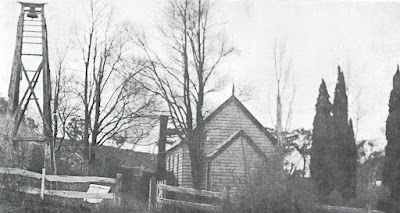
This photo of the Lutheran Church and bell tower is from Early Days of Berwick, 3rd revised edition, 1979.

This didn't tell me when the Church was demolished, neither did one of my other key resources In the Wake of the Pack Tracks, so I emailed Lyn Bradley, President of the Narre Warren & District Family History Group to see if the Group had any information on the Church and she sent me back a great document from 1935,  that they have in their Research Room. We don't know who wrote the article or where it was first published but it did tell us about the closure of  the Church  -   In later years due to many changes, the church in which the early settlers took such an active interest was closed. The organ was sold in 1912 and the building disposed of for removal -  so I assume the closure date was 1912 or a bit earlier and the building removed about the same time  - however there is more about the closing date below. The following is what the document had to say about the Church -

On December 11 1869 the local members of the Lutheran Church, desirous of erecting a church building secured a site having a frontage of 100 feet to Hessell's Road. The land was purchased  from the late Dr E.Wanke for the sum of 1 pound. Five trustees were elected, namely Messrs Louis Linsing, Ernest Hillbrick, John Fritzlaff, Heinrich Edebohis and Peter Erdman. As a result of a combined effort the church members erected a building which fulfilled the dual purpose of church and State school. By voluntary subscripion a bell was obtained, its weight being 210 lbs and its pleasing tone was the pride of the pioneers.  For many years Pastor Herliz (whose son, Dr Herliz, lives at Cheltenham) made the journey from Melbourne to conduct the services. He was very popular and the services were always well attended. In those days the late Mr I.G Wanke was one of those who presided at the organ.

The late Jacob Hessell conducted school for some time until transferred to the present school building.

On July 6 1882 five new trustees were appointed, Messrs Jacob Hessell, John Fritzlaff, Rudolph Halleur, August Dubburke and Rudolph Anderson. In later years due to many changes, the church in which the early settlers took such an active interest was closed. The organ was sold in 1912 and the building disposed of for removal. Two cypress trees that were planted many years ago by the late  Gottlob Aurisich,  are still growing on the site. At the  special request of the then two remaining pioneers, the  late  I.G Wanke and R Anderson, the bell was retained, and being close to the cemetery. it is tolled on the occasion of funerals, and is always rung on New Years Eve.  Those interested having passed away the site was developed into a 'no mans land'. Consequently, on  on February 25, 1935 a public meeting was held in the local hall. Cr D Boyd presiding, and those members of the Lutheran Church who attended appointed three trustees for the site Messrs H.I Wanke, J.W Nicol and H. C Weist. Mr Wanke is chairman and Mr Weist secretary and treasurer. On Saturday last, June 8. the new trustees entered into possession to carry out out their duties

Emulating John Batman, who had 100 years ago turned the turf with  a twig on the bank of the Merri Creek, the chairman turned the turf on the site, but with a spade, and each trustee planted a tree to commemorate the occasion. The bell was removed, and the dangerous tower pulled down  after a service of more than 60 years. Thanks to the generous spirit of Mr Nicol and several other enthusiasts, material and labour is to be provided for a new tower for the bell which, it is hoped, will ring out the old and welcome in the New Year for many years to come.  

The Bell Tower was officially opened on December 28 1935.


This is a report on the election of the Church Trustees as reported in the document, above.
Dandenong Journal March 7 1935

We have found this snippet of information in the Berwick Shire Council report in the Pakenham Gazette in 1917 (see below) which refers to the 'old Lutheran Church'  so this presents two possibilities - the Church building was still there in 1917 and hadn't been removed or else the site was locally known as the 'old Lutheran Church' even though the building did not exist.  


Pakenham Gazette June 8 1917

To throw another possibility into the mix the Narre Warren & District Family History Group also have a copy of  the Harkaway Cemetery: a brief history* in which an historic overview of Harkaway was written by Val Exell on September 29, 2000.  Mrs Exell writes this about the Church - On this site the belfry and the Lutheran Church were built in 1869, the bell coming from Germany. Until destroyed by fire the building was used for school on weekdays and Church on Sundays and closed in 1912. So the 1912 closure date is confirmed but Mrs Exell says the building was burnt down and not 'disposed of for removal'  

In the end whether the Church building was burnt down or removed (or possibly both) it doesn't really matter but I was a bit surprised that the Church closed as early as 1912 given the prevalence of the German ancestry amongst the Harkaway settlers, but the building was 43 years old by then and the Harkaway Hall was only three years old (it opened on June 9, 1909) so this would have been an alternate gathering place. 


This photo of the Church is from Oak Trees and Hedges:  a pictorial history of Narre Warren, Narre Warren North and Harkaway (published by the Berwick Pakenham Historical Society in 2002)

*Harkaway Cemetery: a brief history was created through a Work for the Dole program and published in 2001 by the Peninsula Training and Employment Program Inc.

Friday, 13 December 2013

Harkaway - Michael Drew photograph collection

Historian, Mr Max Thomson, has donated his collection of historic photographs to the State Library of Victoria. Amongst the photographs are these ones of the Harkaway Hall -  taken by Michael Drew (1873-1943). They were all on glass negatives. Mr Thomson is the author of Little Hills, a history of Narre Warren North, published in 1977 to celebrate the centenary of the Narre Warren North State School, No.1901. You can read about Michael Drew, here.

Harkaway Hall
Photographer: Michael Drew
State Library of Victoria Image H2012.171/462

The Hall looks finished on the outside, so perhaps these workmen were finishing off the interior. 

Harkaway Hall
Photographer: Michael Drew
State Library of Victoria  Image H2012.171/464

The Hall, completed and sign written, above.  The Hall was officially opened on June 9, 1909 by the Governor of Victoria, Sir Thomas Gibson Carmichael.  There is an account of the opening of the hall in the book Early Days of Berwick.   Mr James Curran, who wrote the chapter on Harkaway, reported that the Governor was escorted by a squadron of Australian Light Horse, the Narre Warren Troop, under the command of the late Lieutenant Alan Henry. The Troop also served as a Guard of Honour. 

An account of the opening of the Harkaway Hall by the Governor of Victoria, 
Sir Thomas Gibson-Carmichael, on June 9, 1909
Punch June 18, 1909


The Governor, being escorted by the Narre Warren Light Horse Regiment, to the Harkway Hall opening.
Photographer: Michael Drew
State Library of Victoria Image H2012.171/457


Opening of the Harkaway Hall, June 9, 1909.
Photographer: Michael Drew
State Library of Victoria Image H2012.171/460

The photograph, above, was taken at the opening of the hall on June 9, 1909. Mr Curran also wrote that the people associated with the establishment of the Hall were Mr G.O.Lyon, Mr W. Warby, Mr Drew, Cr W. G. A'Beckett, Cr Kerr, Cr Barr and Mesdames R. Kelly, W.H. Jarrett, E. Wanke, Miss Mackie and Miss Troupe. Perhaps some of these people are in this photograph.

Monday, 11 February 2013

The Grange, Harkaway

The Grange was built  for the Honourable William Arthur Callandar A'Beckett, M.L.C., J.P. (1833-1901) in 1862 or 1866 (depending on sources). It was designed by local architect George Washington Robinson. The house had views over Port Phillip Bay and was off A'Beckett Road, even though the original entrance was from Halleur Road as A'Beckett Road was made after The Grange was built.  A'Beckett married Emma Mills in 1855 and one of their daughters, Emma Minnie (1858-1936), who was an artist married fellow artist, Arthur Merric Boyd (1862-1940).  In 1948, The Grange  was purchased by Arthur and Minnie's son, the author, Martin A'Beckett Boyd (1893-1972) and his nephew, Arthur Boyd (1920-1999) painted murals in the house. Sadly, this grand house was sold in 1955 and then re-sold in 1963 to a Quarry.

On November 26, 1967  photographer, Richard Dunbar, took some photographs of The Grange and the murals and his widow, Margaret has kindly allowed us to reproduce them here. This is a rare opportunity to see the murals, in situ. 


Peter Freeman, the author of Brick Homes of Berwick* saw The Grange before it was demolished and wrote (possibly circa 1963)  It is now owned by the quarry - which owns the whole property, and it is slowly being surrounded by overburden, cracked by heavy blasting work and is bound to be demolished in the near future. It is  a tragic end to a beautiful and historic house. I do not know the exact date The Grange was demolished, but as it was standing in November 1967, then 1968 would be  a likely date. We have a 1970 aerial photograph in the collection and it has certainly been demolished then.


Along with the photographs was this, undated, newspaper article from The Age, written by Geoff Maslin,  about the murals.  In the article, Melbourne Art dealer, Joseph Brown, says that when they removed the murals steel frames had to be made to fit around each section of the four walls and a mobile crane and a semi-trailer were needed to cart them away. At the time the article was written (circa 1990) the murals were being stored at a Canberra warehouse by the National Gallery.

*Brick homes of Berwick by Peter Freeman. We have a photocopy of this typed manuscript in the Archive, it is undated, but written possibly circa 1963.  Mr Freeman looks at The Grange and other early brick homes of Berwick, Harkaway and Narre Warren North.

Thursday, 31 January 2013

German settlers at Harkaway

Many of Harkaway’s first European settlers were German Lutherans and in this post we look at some of these families. As we will discover many of these families were connected not only by their faith but by inter- marriage. Most of this information comes from Early Days of Berwick (henceforth referred to as Early Days)  and Early Settlers of the Casey Cardinia District. According to  Early Days the first of these settlers was Johann Gottlieb Scholz (1807-1884) and his wife Eleanor (nee Fellenberg 1807-1887). The couple and their eight children had arrived in South Australia in 1838, where their last child was born. They settled in Harkaway in 1844. The next year, John Martin Friedrich Fritzlaff came to the area, left to try his fortune on the gold fields and was apparently successful as he retuned, with his wife Johanna (nee Reiger 1825-1917) and purchased land with Wilhelm Wiese, a carpenter and builder, in 1855.  Fritzlaff established the first Post Office and store in Harkaway.


State Library of Victoria image Image H36420/11. Labelled 'The 1st house in Harkaway' 
Photographer E.J Frazer. 

Also around 1855 Gustav Koenig (1817-1887) arrived and ran a dairy farm. Koenig gave his name to Koenig Road, which was anglicised to King Road around the First World War, due to anti-German sentiment. His first wife, Charlotte (nee Weidenberg) died on the voyage out to Australia and his second wife Henrietta (nee Finger) died in 1863, aged 37, having given birth to nine children in the thirteen years of their marriage. Joseph Walsdorf (1803-1881) was another early settler. He and his wife Agnes Schmitt (1810-1889) lived ‘on the gully at the back of Harkaway’, according to Early Days. Their daughter, Christina married Henry Edebohl (1826-1904). He was a road contractor, bridge builder and a farmer and the source of the name Edebohls Road.

Henry Bruhn (1816-1908) brought 120 acres in Harkaway in 1856, which he farmed with his wife Caroline (nee Hubner 1833-1917) Also in the same year Carl Metzenthein (1815-1901)  bought land on the bank of the Cardinia Creek at Harkaway. Carl had seven children from his first wife, Auguste Schultz (or Scholts) and another four by his second wife Johannes Weniger. Reinhold (1846-1909) the son of the first marriage was a boot maker in Berwick and according to the story in Early Days, in 1869 evangelist, Mr A.J Hamill, called in to have his boot repaired as he was walking back to Prahran after preaching in Pakenham. Mr Hamill began to preach the gospel and at a later visit he baptised Reinhold and his wife Elisabeth (nee Meyer) in the Cardinia Creek and they congregation grew and became the Church of Christ.


State Library of Victoria Image H36420/9. Labelled 'Post Office Harkaway. 
Photographer E.J Frazer.

J.F Wilhelm Aurisch (1826-1911) was married to Caroline Tschirner (1835-1871) the daughter of Harkaway pioneers Gottfried and Rosina Tschirner who built the original farmhouse at Rowallan Farm in Harkaway.  Wilhelm’s brother Johann Gottlob Aurisch (1817-1898) also arrived  in 1854 and they each purchased part of the original 640 acres purchased by Dr Wanke in 1853 (more of the Wanke family later). Johann was married to Dorothea Scholz, the daughter of original settlers Johann and Eleanor Scholz. Another Aurisch brother, Carl (1818-1901) also came to Harkaway, with his wife Christine (nee Wolfe). They had four children.

John Jacob Meyer (1808-1882) arrived in Australia in 1852 with his second wife Sabine (nee Schwarz) who sadly died the next year. His son Benjamin, from his first marriage, had attended the Academy of Hofyl in Switzerland, an experimental school established by Gottlieb Fellenberg, the father of Eleanor Scholz. Benjamin was a builder who built many local houses and in 1868 married Auguste Metzenthin, the daughter of Carl and Auguste and the sister of Reinhold. Reinhold in the same year married Elisabeth Meyer, the half sister of Benjamin.

Ernst Gottlob Wanke (1823-1897) was a medical student who had nearly finished his degree when he came to Australia as a ships doctor. Like many others, he deserted from the ship in Melbourne and went to the gold fields, before buying land in Harkaway in 1853.He was known as Dr Wanke and according to Early Days, his medical knowledge was of great value to the Harkaway settlers. Dr Wanke also donated land for the Church and the school and served on the Cemetery Trust. Ernst Wanke Road is named after him. His first wife and child had died in Germany and he came out with his second wife, Pauline (nee Schurmann 1822-1904). They had one son, Immanuel (1856-1934) who married Bertha Aurisch, the daughter of Wilhelm and Caroline Aurisch.


State Library of Victoria Image H36420/13. Labelled 'Wanke's dairy farm, Harkaway'
Photographer E.J Frazer. 

Dr Wanke’s brother, Johann Gottlieb Wanke (1814-1889) also came to Harkaway.  He was married to Helena Muller and they had five children. Their daughter, Caroline married another local settler, Peter Erdmann (1827-1872) who arrived in 1853 and had land in A’Beckett Road in Narre Warren North and was one of the original trustees for the Harkaway Lutheran Church. Ida Erdmann, a daughter of Peter and Caroline, married Charles Weist (1859-1941) who had  a block of land near the Harkaway cemetery.

Halleur Road is named after Rudolf Halleur (1826-1912, or von Halleur as Early Days calls him.) He arrived in Australia in 1852, deserted his ship and went to the gold fields, then settled in Harkaway in 1858.  He married Johanna Scholz (1838-1932) another daughter of Johann and Eleanor. He was a sail maker by trade and turned this skill into making harnesses and boots. Rudolf and Johanna had nine children.

Johann Hillbrich (or Hillbrick, 1814-1899) purchased land in Hessel Road in 1855, where the family operated a dairy farm. This property was then passed onto son, Ernst (1842-1914) and then to his son Stanley, who farmed the land until 1959 when it was sold out of the family. It is now part of Timbarra Estate. Johann was married to Maria Wagner (1821-1888) and they had ten children.

Hessel Road was named for Jacob Hessel (1833-1904) the inaugural teacher at the Harkaway State School when the Harkaway Lutheran School was taken over by the Education Department in 1876. The Lutheran School had started in 1856 with Traugott Friedrich Warmbrunn (1803-1885) as the original teacher, though it is believed that Eleanor Scholtz taught local children before that. Warmbrunn was very active in the Lutheran community, but his teaching career was hampered by his lack of English, so he had to resign, however he remained in Harkaway. The next teacher was Carl Hubner, who took over in 1857. Once again, his poor English meant he had to resign, which he did in 1861. Jacob Hessel started at the school in 1862 and was there until 1883.


State Library of Victoria  Image H36420/10. Labelled 'State School Harkaway'. 
Photographer E.J Frazer. 

Other German Harkaway settlers included Gustav Warmbrunn (1836-1912), the son of the teacher, who lived near the School in the 1860s according to Early Days. He was married to Wilhelmina Scholz, another daughter of the original pioneers, Johann and Eleanor. Wilhelmina (1840-1928) gave birth to eleven children. Lotha Schmidt had a vine yard and winery in Harkaway. August  Dubberke (known as Martin, 1843-1926) settled in Victoria in 1864 and farmed at Harkaway. He was married to Augusta (c.1845-1913), daughter of Johann and Helena Wanke.  Carl Ernst August Fleer (1832-1904) was a baker and also had a small farm at Harkaway. He was married to Emma Metzenthin (1841-1927) another daughter of Carl and Auguste. Peter Rumph (1820-1895) and his wife Catherine (nee Chenmel 1831-1879) purchased their land in 1854. He was a builder and helped build the Berwick Inn. Another settler with a connection to the Berwick Inn is Wilhelm Braun (c. 1827-1919) also known as William Brown. He married Ellen Barry (c. 1836-1918) in 1855 and they had eight children.. He arrived in Berwick in 1854, worked on local farms and was also a builder and brick maker. His bricks were used in the newer parts of the Hotel, the two storey sections added in 1877 and 1887.