Showing posts with label Eumemmerring. Show all posts

Monday, 24 October 2022

Off to the Eumemmerring Races

Written by Michelle McLean. 

Whilst exploring other aspects of local history, I came across a reference to the Eumemmering races and my curiosity took over.  

The Eumemmering Races are mentioned in many local histories and there are newspaper articles in the South Bourke and Mornington Journal from the era, which report the race results and other snippets.  (available on Trove)

The Eumemmering races were held at a track adjacent to the Eumemmering Hotel, which was located on the same site that the Prince Mark Hotel now occupies – the corner of Princes Highway and Power Road.

The Eumemmerring Hotel was “just one mile east of Dandenong” and became famous not only for “its readiness to quench the thirst, but also because of the adjacent racecourse.”  The course was laid out on 70 acres and was known locally as “Hennessy’s course”.   Hennessy was Michael Hennessy, the publican of the Eumemmerring Hotel who along with Henry Wilson, was the race starter on the Eumemmerring Races program. Hennessy also took on the role of Treasurer for the races.   (Call back yesterday, pg. 43)

The hotel and race course were likely located in the middle of this image, where the Eumemmerring Creek intersects with the Gipps Land Road. SLV, 820 BJE 1837- EUMEMERRING 1854

From what I can discover, the racetrack was known to have been running in 1851, when Victoria suffered the Black Thursday bushfires on 6th February. “From Bullock tracks to bitumen” (pg. 72) noted that “men had gathered for a race meeting, when fire swept down on the course, driving the sportsmen back to defend their respective homes.  So fierce was the fire that the Hotel was practically the only building left standing the in neighbourhood.”  

Knowing that it was already a popular course at that time, we can assume it had already been running for a number of years at that stage, so its likely creation and use for public race meetings likely date back to the 1840s, if not earlier.

A zoomed out map, red dot marks the likely location of the racecourse and hotel. SLV, 820 BJE 1837- EUMEMERRING 1854. Access the higher quality digital map through the State Library Victoria's catalogue 

Other notable Eumemmering Races reports included:

Race meeting -  June 5, 1878.  The Maiden Plate and the District Race was won by the same mare “Victoria”, owned by GK Dunbar, beating his rival JK Dunbar’s bay “The Demon”.  ("Reminiscences of early Dandenong, pg. 97)

Race meetings were well advertised in the adjacent hotel as well as the two local newspapers: The Dandenong Advertiser and The South Bourke and Mornington Journal.   

Boxing Day races were a regular fixture, and race meetings were also periodically organised for other holidays, including St Patrick’s Day.  The race meet moved to VRC rules somewhere between 1885 and 1888 (with Michael Hennessy calling the shots on that).

A regular visitor to the races was Member of Parliament for Cranbourne, Dr. Louis Lawrence Smith MD, who not only placed bets but advertised his services on the side. This included regular half page ads on the front of the South Bourke and Mornington Journal.

Michael Hennessy died in August 1889 and his estate was not great, indicating that he did not make a fortune from the races or his hotel. The estate valued a total of 944.0.0 pounds.

The racetrack was also used for more than horse racing. For terrier coursing with rabbits was run, with handbills being printed to publicise the event to local residents and racecourse visitors.  (Call back yesterday., pg. 45)

Even with the passing of Michael Hennessy, the races continued, with records of them still being held in 1910.  

First sign of wholesale change came when the Lace Factory from William A. Smith was built on what is now Princes Highway, just north of Eumemmering Creek in 1951.  It was moved from the UK after the original factory was bombed in World War 2.  When new factories were being constructed in the area in 1957, a construction worker dug up  a sovereign and two half-sovereign coins minted in 1900, which a local identified as being some of those lost by a rider during a race, with only a few coins recovered at the time.

The races were finally stopped somewhere before the 1950s, as reported by one reader in the Dandenong Journal in 1957, due to “the ringing-in of horses and ponies under any name but their own registered ones.”  This reader’s reminiscences prompted them to author this poem. 

Anonymous (Call back yesterday pg. 90-91).

The Dandenong area had a number of courses operating in the 1800’s, including closer to the Dandenong township and at Bangholme. Now however, the closest tracks are Sandown (course opened in 1965) , Cranbourne (first meet in 1867, in the same location as the current racecourse) and Pakenham (Pakenham Racing Club formed in 1875).  (Country.racing.com)


References

From Bullock tracks to bitumen: a brief history of the Shire of Berwick.  Historical Society of Berwick Shire: Pakenham, 1962.

G.F.R  (George Fenton Roultson) Reminiscences of the Early Days of Dandenong.  Dandenong & District Historical Society: Pakenham, 1935.

Trove, 2022. [online] National Library of Australia. https://trove.nla.gov.au

Uhl, Jean “Call back yesterday: Eumemmering Parish. Lowden Publishing: Kilmore (Vic), 1972.

Victoria Racing Club, 2022. Home. [online] Country Racing Victoria. https://country.racing.com/

Images

Plan of portions marked in the parishes of Dandenong and Eumem-merring in the counties of Bourke and Mornington [cartographic material] / copied by Horace Sampson, Surveyor General’s Office 2nd November 1854. (1854). [Map]. [Surveyor General’s Office]. http://handle.slv.vic.gov.au/10381/100387 

Uhl, Jean “Call back yesterday: Eumemmering Parish. Lowden Publishing: Kilmore (Vic), 1972.

Friday, 4 May 2018

Grassmere becomes Doveton

The suburb of Doveton was established in the mid 1950s by the Housing Commission to provide housing for the employees of the 'Big Three' Industrial companies, International Harvester Company (established 1952), H.J Heinz (1955) and General Motors Holden (1956).

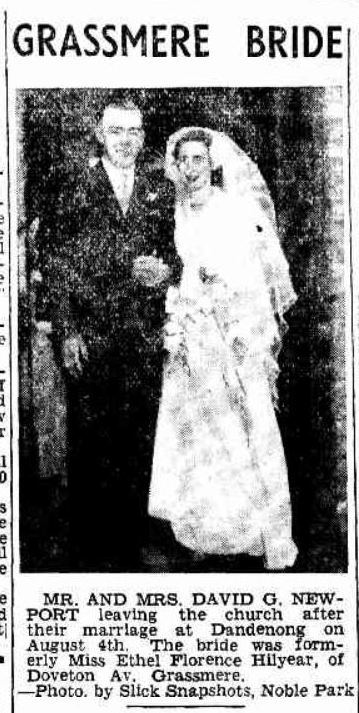
The area was originally known as Dandenong or Eumemmerring or more especially Grassmere after Thomas Herbert Power's estate. It was called Grassmere well into the 1950s, and renamed Doveton after John and Margaret Doveton in 1953 or 1954 who had given their name to Doveton Avenue (where their house was located). The use of the name in Doveton Avenue preceded the use of the name as a suburb as we can see from this wedding report, below, from the Dandenong Journal of  April 22, 1951. The photo  shows Miss Ethel Florence Hilyear of Doveton Avenue, Grassemere and her groom, Mr David Newport.


Dandenong Journal April 22, 1951

Another article in the Dandenong Journal of October 24, 1951 (see below) talks about General Motors Holden feeling that Eumemmerring as an address is 'unwieldly', although apparenttly International Harvester thought it was a 'thundering nice name'. The Journal asked if anyone knew the origin of the name and a further article in the Journal said the name was Irish. Not sure about that - most sources seem to say that it is of Aboriginal origin and means 'we are pleased to agree with you' or on a related theme, a word expressing pleasure or agreement.


Dandenong Journal, October 24, 1951.


Dandenong Journal November 21, 1951


Dandenong Journal April 29, 1953

According to an article in paper (see above) the name of Doveton was agreed to by the Shire of Berwick in April 1953 after  a request from the Hallam Progress Association. This decision preceded the establishment of the Housing Commission project at what was then called Dandenong East.

The Age September 27, 1954.

The Doveton Housing Commission Estate was announced in September 1954.

Dandenong Journal October 13, 1954

It seems that the formal adoption of the name Doveton for the Housing Commission Estate was in October 1954, according to the report in the Dandenong Journal, above. The area had been known as Dandenong East. It does appear that the year 1954 was the year the name Grassmere was finally abandoned for the area east of Doveton.  The modern day suburb of Eumemmerring was gazetted on May 20, 1981. As a matter of interest Doveton is a variation of the name Dufton which means ‘Farmstead where doves are kept’ in dovecotes.

Monday, 16 December 2013

William A. Smith lace factory in Doveton

Lace Street in Eumemmerring is the only  reminder of the William A. Smith lace factory which operated there from 1949 to the 1980s.  When the factory was built it was in Power Road, however Power Road was later diverted around the Eumemmerring Creek and the small section of it, south of the Creek, was renamed Lace Street (see aerial photograph below). The factory was in an area which has gone through many changes of name - initially Eumemmerring, then Dandenong, from 1954 called Doveton and from 1981 called Eumemmerring (again)

This article was  in, of all papers, the Kalgoorlie Times of March 30 1948 and is about the establishment of the lace factory. It also appeared word for word in the Burnie Advocate.  

Maria Harding, in her book, Doveton: a brief history says that the factory was built in 1949 and started operations that year. Two managers houses were also built at this time.  Mrs Harding writes that this factory made handkerchiefs, napery and veils, no doubt using the products imported from the English factory. In 1953, another factory was built alongside the original one and this factory manufactured lace. A third managers residence was also built and eighty four people were employed. The factory operated until the 1980s when it closed as it could no longer compete with cheaper imports. The factory, which was on the west side of Lace Street was sold and has been demolished as have the three houses.

The employees of the lace factory in 1951.

There was an article in the Women's Weekly of April 22, 1959 entitled Dandenong: a symbol of industrial strength. This article looked at various factories in the Dandenong,  including the lace factory. They interviewed William Smith and he claims that his factory was the first in Dandenong. It goes on to say that at his 300 year old walnut desk, brought from England, Mr Smith sighed ' for the old days at Dandenong (1947) when not a light could be seen for miles at night'.  "Look at the bustle now', he said. A heavy stream of traffic packed the four-lane highway in from of the factory.


This picture accompanied the Women's Weekly article about Dandenong and shows some of the lace factory employees.
Women's Weekly of April 22, 1959    http://nla.gov.au/nla.news-article48077502


This is a 1963 aerial of Doveton / Eumemmerring. Click on photo to enlarge it. That's the tree-lined  Eumemmerring Creek, snaking through from top right to bottom left and just to the right of the Creek, at the bottom, you can see Lace Street and the two factories on the western side, along with the three Manager's houses. Further north, the two ovals are Robinson Reserve and L.S. Reid oval. The intersection middle top is that of Frawley Road/Paperbark Street with Power Road. Follow Power Road to the bottom of the photo and it intersects with the Highway.  Power Road was diverted at this end as it would have been too expensive to build a bridge to take heavy trucks*. 

 *William Smith in an interview with Maria Harding

Tuesday, 2 October 2012

Aerial photos of Doveton, Eumemmerring, Hampton Park and Dandenong

These aerial photographs were taken on March 3, 1970. The label says they were taken at  a 'height of 1,500 feet generally, down to 1,000 feet'. That is 450 metres down to 300 metres.  All the photographs have 'Eummemmerring Bypass from end of Mulgrave Bypass to South Gippsland Highway" on the back.  I presume that they were taken along the route of the proposed road between Stud Road and the Princes Highway East, which would act as a by-pass to the City of Dandenong. This work started in 1969 and was finished in 1972. The photographs are from the Shire of Berwick and have been annotated on the front  at some stage by a Council employee. 


This is the Princes Highway at Hallam/Eumemmerring, showing Kays Avenue at the bottom right and the General Motors Plant in the centre of the photograph. The South Gippsland freeway now runs to the left of  Kays Avenue and the right of General Motors. It's page 91 of the Melway Street Directory.


Kays Avenue is in the centre, the Princes Highway bi-sects the photograph, Doveton Avenue is to the right and  you can see the General Motors factory, centre left. 


Looking west (or towards Dandenong) up the Prince Highway. Kays Avenue is just below centre right.


This is looking south, over Eumemmerring and  General Motors to Hallam/Hampton Park. Kidds Road is at the bottom, right. General Motors Holden is at the centre, towards the top of the photograph. Florence Street is in the centre. It doesn't exist in the Melway anymore.


Another view across towards General Motors Holden.  Power Road is bottom right.


This is the South Gippsland Highway and Pound Road intersection at Hampton Park, looking north to General Motors Holden factory. It's page 96 of the Melway Street Directory.


The same intersection as above, the corner of the South Gippsland Highway and Pound Road. If you have been along here recently you would know that there have been some massive changes since this photograph was taken. To see another aerial photograph of this area, click here.

 This is Gladstone Road in Dandenong, looking towards where it intersects with Brady Road and further on Halton Road.  It's Map 81 of the Melway Street Directory.