


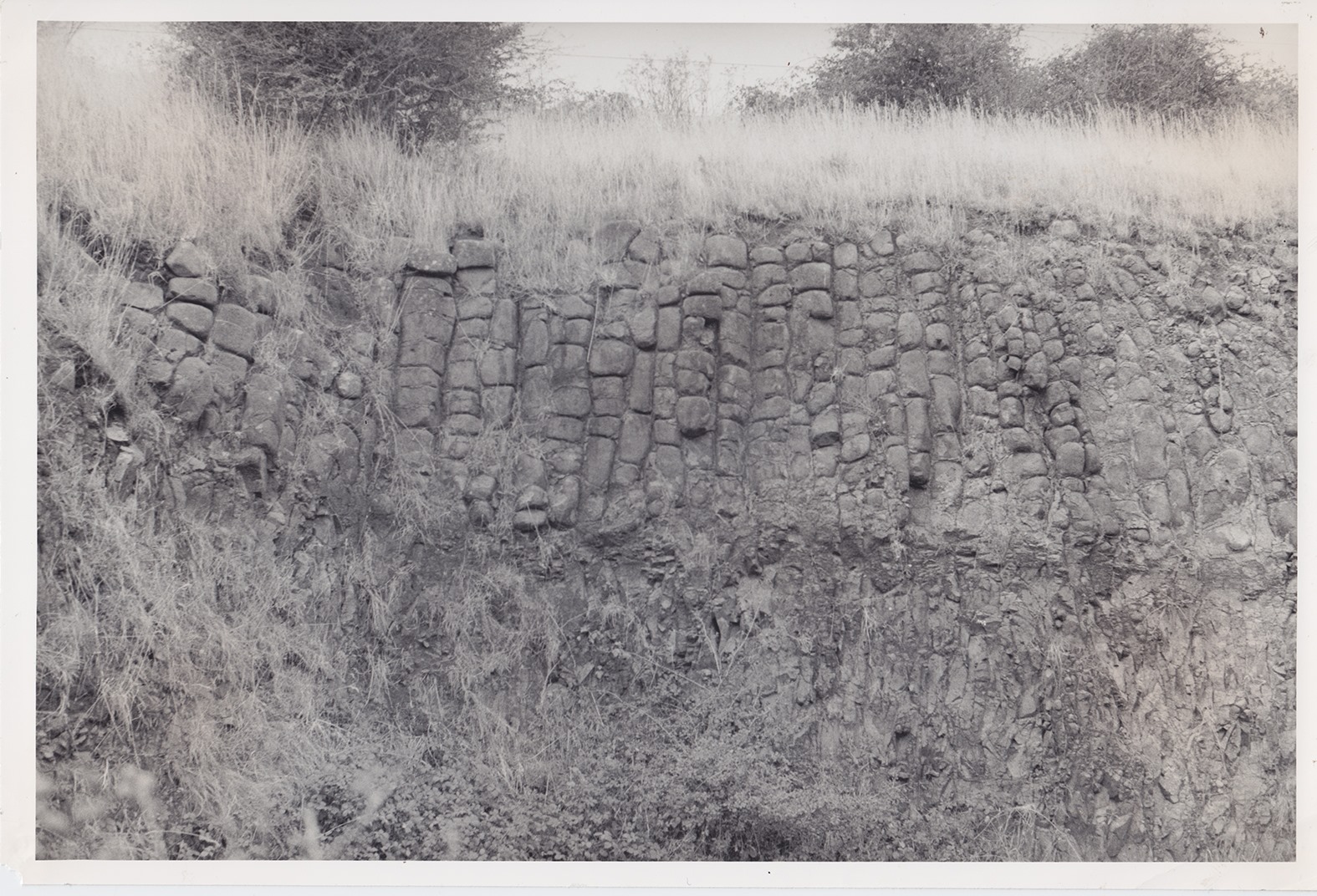
Columnar Basalt, north of A'Beckett Road, 1960
Image: Little Hills 1839-1977 compiled by Max Thomson
Information from Little Hills 1839-1977 compiled by Max Thomson on behalf of the State School No.1901 Centenary Committee (Narre Warren North State School Centenary Committee, 1977) pages 45 & 46.
Mr Thomson wrote this about the basalt columns -
On the north side of a'Beckett Road was once a fine example of columnar basalt. The late Mr Crsobie Morrison a well known field naturalist and also editor of "Wild Life and Outdoors' visited the area in 1943. An illustrated article appeared in the magazine later.
Mr Morrison wrote as follows: "On a peaceful dairy farm we found a hole in the hillside by a clump of gum trees and wild cherry, and a wall remaining in parts as true as any mason ever dressed a stone. At the end of the wall was a pillar - an absolutely regular six-sided pillar built in sections as any pillar might be: part of it still standing in its original position, but other sections which fitted accurately and were dressed to the same regular outline lay strewn about the floor of the depression"
"The remains of the wall were particulary striking. The rectangular stone which composed it were enormous; probably it would require half a dozen men to lift one of them. And instead of being laid horizontally, their greatest dimension was vertical. Between them was a mortar almost as hard as the rocks themselves. Whoever said that these were ancient ruins could scarcely be blamed for his conclusion.The similarity to human handiwork is most convincing."
"In spite of their convincing resemblance to the handiwork of man these relics, it seem are examples of Natures' craftsmanship. The rock of which they are composed was once molten lava pouring from some ancient volcano long extinct."
"Their form is sufficient evidence in itself that this was once a thick lava flow, which extended over Narre Warren North and away beyond Berwick."
"Then there is the puzzling 'mortar'. This does not seem to be a general feature of columnar basalt formations. In the case of these ruins it is probably due to the weathering and cementation over very long ages."
"The Sydenham Organ Pipes are a comparatively recent formation - they belong to the Newer Basalt series in Victoria, or Pleistocene age. The Narre Warren North example is Older Basalt, of the Lower Tertiary. Much more time has elapsed here to permit the washing of minerals into cracks between the columns, and the deposition of the minerals out of solution to form a secondary rock that serves as a 'mortar.' It is just what was needed to give the final touch of realism to the spectacular natural phenomenon."
Basalt columns at Bayview Quarry, 1954.
Image courtesy of Narre Warren & District Family History Group, Max Thomson collection.
Original caption: Columnar basalt at old Bayview quarry on the west slope of Bayview Hill 1954.
Information from Early Days of Berwick, 3rd edition, pages 101 & 102
The book Early Days of Berwick, first published in 1948, has this to say about the columnar basalt -
To geologists, and also of general interest, is the spectacular natural phenomenon which occurs in Cr. George Rae's property, of columnar basalt. This was the subject of a very interesting illustrated article on "Wild Life' magazine of June 1943 , by Mr Crosbie Morrison. "Dr A.V.G James, the recognised authority on the volcanic rock formations of Victoria, sets out that the rock of which this is composed was once molten lava pouring from some ancient volcano, long extinct. Volcanic lavas, on cooling, assume many different forms, and sometimes the flow of lava has remained intact and very thick. The evidence is that this was once a thick lava flow which extended over Narre Warren and away beyond Berwick. As it cooled it formed a solid crust above, beneath, and at the sides and ends of the mass. Solid rock being a poor conductor of heat, the interior cools slowly, once the initial crust has been formed. The outer crust, as it cools, tends to contract, but is not flexible. As it contracts, something has to give way, and the rock, being fine grained and homogeneous, the stresses are distributed evenly through it, so that when it finally gives way, the cracks occur at regular distances in every direction, the final result being, when all the rock is hardened and cooled, a series of hexagonal columns, not all vertical, but extending from the periphery of the molten mass and meeting at the centre."
The Narre Warren North example belongs to the older basalt series of formation in Victoria of the Lower Tertiary Age. The same formation occurs at the Giant's Causeway, Northern Ireland, the Tesselated Pavement and Organ Pipes of Southern Tasmania, and the Organ Pipes of Sydenham, Victoria - thus Narre Warren North has a formation of uncommon interest.
Information from Volcanoes: An Introduction to Systematic Geomorphology Volume 6 by Cliff Ollier (Australian National University, 1969) Available on-line at https://openresearch-repository.anu.edu.au/bitstream/1885/115134/2/b1032284x.pdf
The only other reference I could find regarding Columnar Basalt in the Narre Warren area, was this photograph from the book, above. I don't believe these are the same columns as in the photo above - so there must have been more than one example of the phenomenon in the area. Do any still remain?

When were they destroyed?
Mr Thomson's book, published in 1977, says there was once a fine example of columnar basalt. The photo in his book is dated 1960, so the destruction date range would be sometime between 1960 and 1977. What of the example published in Mr Ollier's book in 1969? I don't know if they still exist, but I doubt it, or when they were destroyed.
The book Early Days of Berwick, first published in 1948, has this to say about the columnar basalt -
To geologists, and also of general interest, is the spectacular natural phenomenon which occurs in Cr. George Rae's property, of columnar basalt. This was the subject of a very interesting illustrated article on "Wild Life' magazine of June 1943 , by Mr Crosbie Morrison. "Dr A.V.G James, the recognised authority on the volcanic rock formations of Victoria, sets out that the rock of which this is composed was once molten lava pouring from some ancient volcano, long extinct. Volcanic lavas, on cooling, assume many different forms, and sometimes the flow of lava has remained intact and very thick. The evidence is that this was once a thick lava flow which extended over Narre Warren and away beyond Berwick. As it cooled it formed a solid crust above, beneath, and at the sides and ends of the mass. Solid rock being a poor conductor of heat, the interior cools slowly, once the initial crust has been formed. The outer crust, as it cools, tends to contract, but is not flexible. As it contracts, something has to give way, and the rock, being fine grained and homogeneous, the stresses are distributed evenly through it, so that when it finally gives way, the cracks occur at regular distances in every direction, the final result being, when all the rock is hardened and cooled, a series of hexagonal columns, not all vertical, but extending from the periphery of the molten mass and meeting at the centre."
The Narre Warren North example belongs to the older basalt series of formation in Victoria of the Lower Tertiary Age. The same formation occurs at the Giant's Causeway, Northern Ireland, the Tesselated Pavement and Organ Pipes of Southern Tasmania, and the Organ Pipes of Sydenham, Victoria - thus Narre Warren North has a formation of uncommon interest.
Information from Volcanoes: An Introduction to Systematic Geomorphology Volume 6 by Cliff Ollier (Australian National University, 1969) Available on-line at https://openresearch-repository.anu.edu.au/bitstream/1885/115134/2/b1032284x.pdf
The only other reference I could find regarding Columnar Basalt in the Narre Warren area, was this photograph from the book, above. I don't believe these are the same columns as in the photo above - so there must have been more than one example of the phenomenon in the area. Do any still remain?

The top photo is captioned 'Lava Flow at Narre Warren, Victoria, showing lower colonnade with vertical columns, a central entablature, with curved columns and an upper scoriaccous zone without columns (A.A. Baker)' The photo at the bottom is The Giant's Causeway, Northern Ireland, as mentioned in the Early Days of Berwick article.
Image: Volcanoes: An Introduction to Systematic Geomorphology Volume 6 by Cliff Ollier
When were they destroyed?
Mr Thomson's book, published in 1977, says there was once a fine example of columnar basalt. The photo in his book is dated 1960, so the destruction date range would be sometime between 1960 and 1977. What of the example published in Mr Ollier's book in 1969? I don't know if they still exist, but I doubt it, or when they were destroyed.


