Showing posts with label Koalas. Show all posts

Monday, 15 March 2021

Koalas at Yannathan

In the last post, which was about a report of a trip taken from Berwick to Yannathan in 1887 (see here), the unnamed writer of the report said that Yannathan was 'swarming' with koalas or bears as they were called - At Yannathan my business was completed and left me a day to look about the locality. The place swarms with "bears.'' In nearly every other tree they are to be seen. The name "bear" quite intimidates the "new chum," but no need of fear, for they are truly harmless beasts living on the gum leaves, and I am told are rapidly killing the gum trees as effectually as if they had been "rung" (1).

Six years later there was another account of koalas at Yannathan, this one painting a far bleaker picture of their numbers. This was a letter published in the Weekly Times on July 1, 1893, addressed to Uncle Ben the editor of the children's section.
A Bear. — Yannathan.
Dear Uncle Ben,
This is my first letter to you. I am going to tell you a story about a bear. One morning early about three o'clock when my sisters were in bed they heard something scratching. They thought at first that it was the rats, but soon they knew that it was too loud for them. They looked down towards the window where the noise came from. Seeing a shadow like a man's hand, they got out of bed, went to the window and looked out. Then they saw a bear which had climbed up the wall and was trying to hold onto the window, but could not. Mother, who was in another room, heard them laughing. She asked what was the matter, and they told her, so she got up and went outside, and took the bear off the window and put him on the ground. In the morning when we got up it was in a pear tree in the garden. The bears that are about here are quite harmless. They are very scarce, but when we first came into Yannathan there was a great number.
I remain, your affectionate niece, Sarah Aitken, aged eleven years and  eight months (2).


The Koala or 'Australian Bear'
Australian Bear, c. 1880-1890. State Library of Victoria Image H29682/3

The cause of the decline in koala numbers in Yannathan can be attributed, mainly, to habitat loss due to the clearing of land for farming.  Dr Niel Gunson in his book The Good Country: Cranbourne Shire writes that early settlement in the Yannathan district started on the western boundary in 1875 and by 1878 all the dense forest country had been selected (3). Clearing at Yannathan began as soon as the settlers could undertake the work,  it has been said of this thick bush country (paperbark, tea tree, blackwood, silver wattle, musk tree and clematis) that 'when cleared it proved to be the best land in Gippsland' (4). 

The koala was also killed for 'sport'. There was a report in March 1882 about a fishing and hunting trip to the Bass [River] district which mentioned the amount of sport they were going to have! Ducks, swan,
hare, native bears, 'possoms and fish were to be got without the least exertion (5).  Given that the koala was also called the 'Australian sloth' it is no wonder that they could be got without the least exertion. 

The koala was also a component of the fur trade, not, however, the high-end garment segment of the market. This is part of a report from 1880 -  Another numerous marsupial is the native bear, or Australian sloth, possessing a short matted wool, and a thick pelt unamenable to softening influences. These inoffensive creatures are most tenacious of life, and when they are killed, sorely test the patience of the skinner. The best of the skins are made into carriage rugs, but the majority are only fit for mats (6). 


The 'Australian Native Bear' was considered cute enough to feature in this postcard from c. 1908, even if some people still thought they were only fit to become a mat.
Australian Native Bear. Study by Muir. State Library of Victoria Image H42748/12

In Victoria, koalas gained some protection in December 1898, when they were deemed to be native game and thus protected (7).  This gave them year round protection, though this was objected to by the Fur Buyers' Association who thought koalas should only have protection for part of the year. As a matter of interest in 1899 the Fur Buyers' Association spokesman, Mr Coles said that last year on the London market a total  of 176,000 skins were offered. New South Wales sent 134,000 and Victoria and Queensland 51, 600. This showed that there was not such a slaughter going on here as there was in New South Wales (8).  The Government did not alter the year round protection for koalas and in 1938 strengthened their protection by including injuring and molesting the animals as well as destroying them within the scope of the bill (9). 

Of course protection from slaughter did not protect the koala from habitat loss, and one solution for this was to re-locate koalas from one area to another such as in the 1930s from French Island to Quail Island.  Quail Island is at the northern end of Western Port Bay - I have written about the Quail Island koalas, here.

Footnotes
(1) South Bourke & Mornington Journal, June 8, 1887, see here.
(2) Weekly Times July 1, 1893, see here.
(3) Gunson, Niel The Good Country: Cranbourne Shire (Cheshire, 1968), p. 112.
(4) Gunson, op. cit., p. 114
(5) South Bourke & Mornington Journal, March 15 1882, see here.
(6) The Argus, December 9 1880, see here.
(7) Victoria Government Gazette, December 9, 1898, p. 4238,  http://gazette.slv.vic.gov.au/images/1898/V/general/109.pdf 
(8) The Herald, July 11 1899, see here. The Fur Buyers' Association was also referred to as the Furred Skin Buyers' Association (The Herald, July 3, 1899, see here) I am not sure which is correct, and it doesn't really matter now, 120 years later, however I do like to be historically accurate.
(9) The Argus, December 14, 1938, see here.

Wednesday, 14 March 2018

Quail Island

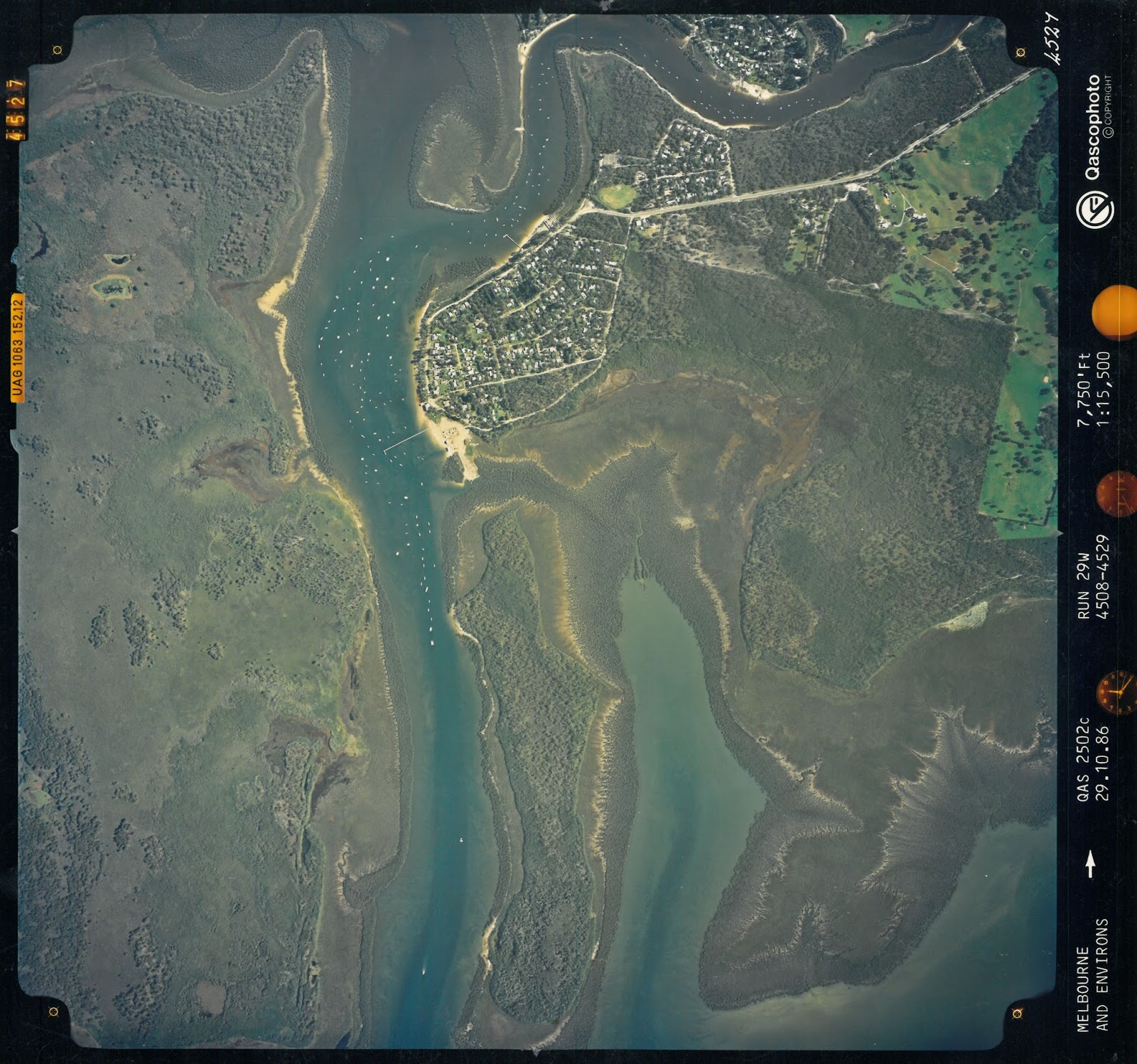
Quail Island is situated at the northern end of Western Port Bay across Rutherford Inlet from Warneet. Adjacent to Quail Island is Chinaman Island. You can see Quail Island on the left of the aerial, below, and Chinaman Island in the centre under the Warneet township. Cannons Creek is at the top of aerial.


Aerial from October 19, 1986. Quail Island on the left of the aerial, below, and Chinaman Island in the centre under the Warneet township. Cannons Creek is at the top of aerial. Towards the top of Quail Island you can see a dam, so that would have been in the vicinity of the house that was once on the Island and destroyed in the 1898 bush fires.


Quail Island was so named due to the number of quail in the island. Chinaman Island was named because Chinese fishermen were said to live on this island and they fished for the type of fish eaten by the Chinese, dried them and sent them to China. Quail Island was originally used as a pastoral run - one of the earlier lease holders appear to be Henry Greer and James Wheatley as the following advertisement appeared in The Age of May 25, 1864.

The Age  May 25, 1864

I presume that in the end James Wheatley took over the lease as in August 1864 he offered a portion of Quail Island to the Acclimatisation Society for them to run stock. Whether Wheatley's offer was accepted or someone else took over the lease, the Island was used to stock game  as Quail Island was 'temporarily reserved for Acclimatization purposes' on April 16, 1866. A report in The Age of August 14, 1867 said that 'nine black Indian partridges and seven Cape partridges had been sent down to Quail Island, for liberation'


State Government Gazette April 24, 1866

This advertisement (below) regarding the sale of Quail Island give us some idea of development on Quail Island as by July 1868 the Island had a 'good three roomed house and sheep yards' and was connected to the main land by a bridge. The house was destroyed in a bush fire in 1898. You can see one of the 'permanent lagoon' or dams in the aerial photo at the top of the post. Graham Patterson, in his Coastal guide, quotes an article from The Argus of November 1, 1865 relating the story of the housekeeper on the Quail Island Station and her misadventure in returning home from Cranbourne one day. It's well worth a read, which you can do, here.


The Argus July 7, 1868

As best as I can I have traced the  lease hold holders or owners of Quail Island - it is part of the Parish of Sherwood and was part of the Cranbourne Shire. The first time I could see Quail island itemised in the Rate Books was 1877/1878 when Alexander Hunter was listed. Hunter also had the Balla Balla run at this time. The Island had been advertised for sale in September 1878 (see advert here) so he may have purchased it around then.  Alexander Hunter had Quail Island until 1884/1885. Donald Tolmie is listed in the Rate Books from 1885/1886 until 1887/1888. From 1888/1889 Charles De Arth (also called De Ath) is listed n the Rate Books until at Quail Island until 1889/1900, the next year his name is crossed out and in July 1901 this notice (see below) appeared in South Bourke and Mornington Journal, reporting on the proceeding of the Cranbourne Police Court. After De Arth, James Ridley had the Quail Island lease until 1912/1913 when Francis Callanan took it over. By then it was listed as 2000 acres although it had been variously listed as being of 3,000 or 4,000 acres - perhaps by this time they could accurately measure the island. Callanan was at the island until 1915/1916 when the Rate Books have the annotation 'Abandon' and 'Reverted to the Crown'


South Bourke and Mornington Journal July 3, 1901

In 1908, the Department of Agriculture inspected Quail Island to see if it was suitable for closer settlement or  a labour colony, but in the end both options did not go ahead  for various reasons including distance from the Cranbourne Railway Station. After Francis Callanan abandoned the Quail Island lease I can find no other lease holders and as it did not become  a labour colony or was taken up for closer settlement I presume that it was unoccupied. In March 1928 it was proclaimed a 'Sanctuary for native game.' The next time we hear of Quail Island is when koalas are transferred there from French Island.


State Government Gazette March 21, 1928


The Argus of January 15, 1930 reported that transference of koalas from French Island to Quail Island has began. Many families of koalas were captured and transferred in boats over the five mile strait between the two islands.  The residents of French Island complained that koalas were present in such large numbers that they denuded every gum tree within reach and they asked for permission to thin them out by shooting or alternatively have them removed. As koalas are protected the second option was chosen.

A report in The Herald in May 1932 also spoke about the koalas being removed, so the process of removal to Quail Island and neighbouring Chinaman Island was still taking place. This article (which you can read here) talks about Mr R.H. Bennetts, from the Department of Fisheries and Game as 'the welfare officer for the little migrants' so this must be the same R. Bennetts who took the photograph, below.


Koalas being placed in boxes to be transported from French Island to Quail Island, 1930. 
Photographer: R. Bennetts


Another photo taken at the same time by, Mr Bennetts, of the koalas and the boxes they were transported in from French to Quail Island. 

In April 1933, The Age reported (read article here) that 200 koalas had already been transferred and that it was recommended that another 150 - 200 also be transferred as gums on French Island were suffering from blight but that Quail Island had an adequate food supply. A later report published in the Argus in June 1933 (read it here) said there were only 1,000 koalas left in Victoria and that eventually the only populations  would be on the Western Port Islands.

However, fast forward ten years to 1943 and there were various reports and letters in the papers about the health of the koalas on Quail Island. They were either starving due to lack of feed or else they were in a state of good health. In March 1944 The Age reported  (read it here) that the Chief Inspector of Fisheries and Game recommended the transfer of a number of koalas from the Western Port Islands in the coming months. Amongst the places suggested as new homes for the koala was the Wombat State Forest, Brisbane Ranges and Healesville. 

There is an interesting film on YouTube, Koalas removed from Quail island,  filmed  around 1944, about the removal of the koalas to near Trentham. You can view it here   https://www.youtube.com/watch?v=2IEhbC6M7EA


Koala in crate which is being transferred from French Island to Quail Island
Argus newspaper collection of  photographs, State Library of Victoria Image H2004.100/1011

There must still have been koalas on Quail Island in 1960 as the 'Regulations for the care, protection and management at the Chinaman Island and Quail Island Koala Reserves' was gazetted in August 1960.


State Government Gazette   August 24, 1960.


There was talk in the early 1960s of turning Quail Island into a jetport but, as you know that never happened. Quail island is now a Nature Conservation Reserve and some of the waters around it are part of the Yaringa Marine National Park. Quail Island and Watson Inlet are also of State Geomorphological Significance - you can read about this here - http://vro.agriculture.vic.gov.au/dpi/vro/portregn.nsf/pages/port_lf_sig_sites_watson

I have created  a list of newspaper articles connected to Quail Island, on Trove. You can access the list, here.