Showing posts with label Pakenham. Show all posts

Tuesday, 22 December 2020

Patrick O'Halloran's General Store at Pakenham


I bought this postcard the other day of Patrick O'Halloran's store in 'Old Town', Pakenham. The 'old town' was the town on the Gippsland Road (Princes Highway) near the Toomuc Creek. New Pakenham or Pakenham East was the town that developed around the railway station from 1877. I don't know when the store opened; Patrick is listed in the Electoral Rolls of 1903 as a grocer and that is the first reference I can find. His father, John, is listed in the Shire of Berwick Rate books at Pakenham from 1885/1886 as owning 'house and land, Henty's subdivision'. According to the 1884 Rate books, Thomas Henty owned 4,421 acres of land, being Lots 1, 2, 8, 11 to 20, 46 to 46, so John must have purchased some of this land after it was subdivided.


Thomas Henty's land sale
South Bourke & Mornington Journal, November 25, 1885   https://trove.nla.gov.au/newspaper/page/6745862

Patrick is not listed in the Rate Books until 1914/1915 and he then has '23 acres William's subdivision'. I am unsure where that was. Part of the problem with tracking the family through both the Rate books and the Electoral Rolls is that their surname is sometimes listed as Halloran and sometimes as O'Halloran. What we do know is that Patrick's store was on Gippsland Road or the Princes Highway and this is where the photograph on the postcard was taken.
  

Patrick was one of the advertisers in the first edition of the Berwick Shire News of September 8, 1909. The newspaper was the forerunner of the Pakenham Gazette.
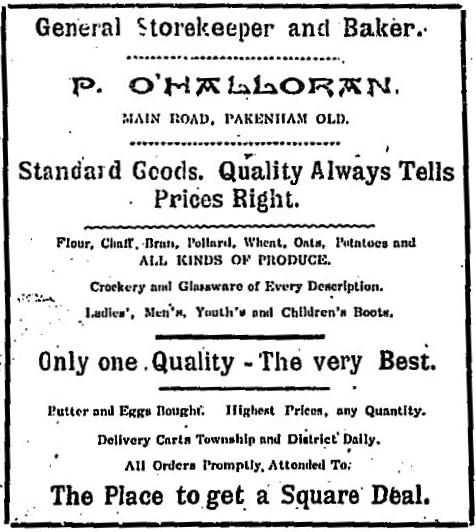

Patrick's last advertisement when his store was located in 'old Pakenham.'
Pakenham Gazette November 19, 1920

In November 1920, Patrick left old Pakenham for new Pakenham and removed to new premises in Main Street, next to the Post Office.


Patrick advertising his move to Main Street, Pakenham East.
Pakenham Gazette November 26, 1920.

In August 1927, Patrick sold his business to Mr Jackson of Korumburra. 


South Bourke & Mornington Journal August 18, 1927   https://trove.nla.gov.au/newspaper/article/214589156


Mr Jackson's first advertisement.
Pakenham Gazette September 2, 1927.

Patrick was the son of John Halloran and Johanna Scanlon, who had married in 1873. They had nine children, the first two were registered at Berwick and the last seven at Pakenham, which gives us some idea when the family moved to Pakenham.  The children were -  Mary Ann (1875 - 1966, married Charles Maltby in 1915), John (1877 - 1955), Johanna (1878 - 1954, married Syndney John Donahoo in 1920), Michael Patrick (1880 - 1943), Timothy (1881, Killed in Action in France July 1916), Stephen (1883 - 1957), Dominick (1884 - 1958), William (1886 - 1891), Thomas (1887 - 1964). John died April 19, 1922 aged 78 and Johanna April 18, 1934 (1)

This is part of John's obituary which was published in the Pakenham Gazatte of  April 21, 1922 - The deceased gentleman, who was a native of County Clare, Ireland, was an old and much respected resident of this district, where he had lived for about 40 years, and he will be sadly missed by many friends. He was for many years connected with the Railway Department and on his retirement form service he settled in Pakenham. He always took a keen interest in public matters and was a great lover of sport, especially football.

Patrick, our store keeper was Michael Patrick. He married Jane Elizabeth Dillon and 1907 and they had two children, James and Marie. He died on May 18, 1943 at the age of 62 and Jane died on July 1, 1949, also aged 62 (2)

The Pakenham Gazette of May 21, 1943 published the following obituary of Patrick - 
Prominent Pakenham Man Accidentally Killed
District saddened by death of Mr. M. P. Halloran
A gloom was cast over the whole district last Tuesday afternoon, when it was learnt that Mr Michael Patrick Halloran had been killed by the falling of a limb of  a tree at  his property, Gembrook road, Pakenham.

Mr Halloran had gone to cut down a tree which had been partly burnt through, and apparently it came down unexpectedly and one of the limbs struck him on the head. Death must have been instantaneous.
Discovery of the sad event was made by Mr Halloran’s daughter (Miss Marie Halloran) who on noticing that sound of chopping had ceased and that one of her father’s dogs  which followed him everywhere had returned to the house without him, went to discover if anything unforeseen had happened.

Mr Halloran was born at Pakenham 62 years ago and had spent practically the whole of his life in the district. For a number of years he conducted a general store at Old Pakenham and later established at Pakenham East the business which is now conducted by Messrs J. J. Jackson and Sons, who purchased it from him some 17 years ago.

On his retirement from business Mr Halloran erected a residence at his orchard property on Gembrook road and continued to reside there up to the time of his death. 

As a young man he was prominently associated with most of the sporting activities of the town as well as generously supporting all movements for the progress of the district.

In business affairs and in public and private life Mr Halloran was known far and wide as a man of high principle – upright in all his dealings and ever ready to assist any in need of a helping hand. These sterling qualities and his bright and cheerful nature won for him many deep and lasting friendships; and with his death the district has lost one who will be greatly missed.

The heartfelt sympathy of the whole community goes out to the sorrowing widow, son and daughter, also to Mr Halloran’s brothers and sisters at this sad time.

The funeral, which was very largely attended, took place at Pakenham Cemetery yesterday morning, following Requiem Mass at St Patrick’s Church. Mr Halloran’s nephew (Rev. Father L. Halloran), assisted by Rev Father Sullivan, officiated at the Church and at the graveside. The coffin bearers were Messrs P. Brown, W. Stone, B. Bourke and R. Miers, and the pall-bearers Messrs W. and B. Doherty, J. and T. Carney, Milo Bourke, P. Clarke, T. Fuller and M. Mullane.

Footnotes
(1) Family information comes from the Indexes to the Victorian Births, Deaths and Marriages https://www.bdm.vic.gov.au/research-and-family-history/search-your-family-history  You can read Timothy's story on the website A Century After the Guns Fell Silent: Remembering the Pakenham District's WWI Diggers 1914-1918, here https://www.pakenhamww1.com/halloran-timothy
John's death notice was in The Argus, April 21, 1922, see here. Johanna's death notice was in The Argus, April 19, 1934, see here.
(2) Jane's death notice was in The Argus, July 2 1949, see here.

Thursday, 7 November 2019

Pakenham Railway Station photographs from the Public Records Office of Victoria

The Public Records Office of Victoria (PROV) have a collection of photographs produced by the Victorian Railways, Public Transport Corporation and other agencies which they collectively call the  Photographic Collection: Railway Negatives - you can access it here (or www.prov.vic.gov.au > Explore the collection  > Photographic collections > Public Transport Photo collection) 

Here are the photographs showing the Pakenham Railway Station, most likely from the 1950s or 1960s, when Pakenham was still a country town. To see photographs of Cranbourne from this collection, click here. To see photographs of Berwick from this collection, click here


Pakenham Up End Level Crossing and Signal Bridge Flex. 
[This is the Main Street level crossing]
PROV -  Photographic Collection: Railway Negatives: Alpha-numeric Systems (VPRS12800)  S1376


 Pakenham Up Home Signal Flex
[looking west]
PROV -  Photographic Collection: Railway Negatives: Alpha-numeric Systems (VPRS12800)  S1378


Pakenham Down End Signal Bridge Flex
 [looking East - next station would be Nar Nar Goon]
PROV -  Photographic Collection: Railway Negatives: Alpha-numeric Systems (VPRS12800)  S1377


To see photographs of Cranbourne from this collection, click here. To see photographs of Berwick from this collection, click here

Friday, 14 June 2019

Fraser's Hotel at Pakenham

Michael Kelly established a hotel in Pakenham, on the west side of the Toomuc Creek in 1869. From 1881, the hotel was operated by Eliza and Alexander Fraser.

We can find out something about the Frasers from a Licence renewal hearing that took place in December 1882 at the Berwick Court and was reported in the South Bourke and Mornington Journal on December 13, 1882.  Mrs Fraser had applied for the renewal of her licence for her hotel and billiard table. This was opposed by Sergeant McWilliams on the grounds that her house was so badly kept that it disturbed the quiet of the neighborhood, and that she had got a husband living with her, therefore was not a responsible person to hold a publicans' license, as she might be called away by her husband at any moment. She had also been fined for Sunday trading. Her hearing was postponed until January 5, 1883 and this was also reported in the South Bourke and Mornington Journal of January 10, 1883.  At this hearing, Sergeant McWilliams said that the problems at the hotel were getting worse and that two months ago there was a drunken man lying outside covered with blood, apparently having been in a fight. Mrs. Fraser interfered, when Mr Fraser kicked her and gave her a blow in the face. 

The Sergeant went on to give other evidence against Mrs Fraser - Some time ago, about 17th May, 1882, he was on duty in Berwick about nine or ten o'clock, when he was met by Mrs. Fraser in a great state of excitement, who rushed into his arms, exclaiming that she had run away from her husband, as she thought he was going to kill her. At his persuasions, on that occasion, she, after some trouble, returned home. Shortly after that she telegraphed down for the witness to come up to her hotel for the purpose of protecting her against the cruelties of her husband, which witness did. Afterwards she took out a summons before Mr. F. Call in Melbourne, binding her husband over to keep the peace towards her. He also said the outside buildings were in a very dilapidated condition, and what with its being surrounded by pigs and geese and other animals, it was in a most disgusting and beastly state.

Mrs Fraser's lawyer, Mr Gillott, appeared for her and answered some of the allegations and that she was dependent on the profits of the hotel for the support of herself and three children. Other information presented  about Mrs Fraser included  She had held a publican's licence for thirteen years; eleven years in Melbourne at the Inverness, Royal George, and Kirks Bazaar Hotels. There were twelve rooms in the Pakenham Hotel - Michael Kelly, the owner of the hotel, sworn, stated that if the license was granted he was prepared to put the hotel in proper order. The house had been continually licensed for the last fourteen years. The present applicant had been in it since 15th September 1881.  

Mr. Gillott made an able address, and after joining issue on all of the objections that had been raised, said the only tenable one was her unsatisfactory marital relations with her husband which was not
misconduct on her part but her misfortune for which she should not be deprived of her only source of livelihood and thrown upon the world with only a few sticks of furniture to sell to enable her to commence life afresh. The Court granted her licence to keep the hotel for another year on the condition that it was better conducted and the building put in order. For some reason  the licence for the billiard table was not granted. The next few years the licence was renewed without an issue and at a hearing in June 1886, the licence was formally transferred from Alexander's name to Eliza's name.


Fraser's Hotel was part of allotment 1 & 2, Section 2, to the left (or west) of the Toomuc Creek. You can see Bourke's La Trobe Inn (also called Bourke's Hotel) on the other side of the creek.
The Township of Pakenham, County of Mornington. H. Permein, Assist. Surveyor ; lithographed at the Public Lands Office, Melbourne, April 22nd, 1858 by T. Ham. Victoria. Public Lands Office
State Library of Victoria - see the full map here -  http://handle.slv.vic.gov.au/10381/100195


Eliza Fraser (nee Mulcahy) died July 31, 1890 at the age of 43. Her Will lists her property - that piece of land at Pakenham being part of allotment 1& 2, Section 2, Parish of Pakenham on which is erected a weather-board house containing seven rooms, and kitchen and bedrooms detached containing 3 rooms and the said land containing one acre. Also all that piece or parcel of land situate at Pakenham containing half acre or thereabouts. The value of the land was £890 and the total estate including personal property was valued at £915. The Estate was left to her three sons -  John James Ward, Arthur Ward and Alexander Fraser. Eliza had married Arthur Ward in 1869 and he died May 26, 1874. She married Alexander Fraser in 1878 - the year they moved to Pakenham - more of which below.  Her executors were her son, John James Ward, Patrick Kennedy and John Dwyer.

John Dwyer took over as licensee of the hotel after Eliza’s death, according to a Berwick Licensing Court hearing, held on December 5, 1890.  The 1889/1890 Rate books list Eliza as the owner of the hotel, for some reasons in the previous three years she is not listed and in 1885/1886 she listed as renting the building from Michael Kelly, which means it was sometime in that date range that she purchased the building from Mr Kelly.  I am unsure what happened after that - a property was listed in Eliza Fraser's name (either as Estate of or Executors of) up to the 1894/1895 Rate books, the address being Lot 1 Staughtons sub-division - I think that is possibly 'the parcel of land situate in Pakenham' that was listed in the Will, and not the Hotel. The 1895/1896 Rate Books has this property listed as being owned by Mrs F. Allen, occupation Housekeeper. In the 1897/1898 Rates her occupation has been gentrified to 'Lady' - she has the property up to 1905, but that's as far as I went looking.  I cannot find John Dwyer listed in the Rate Books, so I have no information about other owners of the hotel property or the fate of the building.

Before we finish up we will have a look at  Eliza's children - her first son, John James Ward,  was born 1872 in Ballarat. He married Ellen Gertrude Rice in 1891 and, sadly, died  April 12 1893 in his 21st year. Ellen applied for Probate on July 21, 1893 and  the following information was listed - he was a grocer from Pakenham and they had two children - Bernard - 18 months old and John James - 2 months old. Ellen was living in Cowwar at the time.


John's death notice
The Age April 13, 1893

Eliza's middle son, Arthur Ward, was born in 1874 in Ballarat. Arthur enlisted in the First World War, on November 19, 1915 at the age of 42 (Service number 20154).  His address was a miner and he lived at Donnybrook in Western Australia. Arthur Died of Wounds on April 17, 1918. His Next of Kin was his sister-in-law, Ellen Hawes of Cowwarr. Ellen had married Edgar Hawes in 1897. Arthur is listed on the Honor Board at St Patrick's Catholic School in Pakenham, see here.  There is more information on the St Patrick's Honor Board and other Great War Memorials in the Pakenham District on Patrick Ferry's website - A Century After the Guns Fell Silent Remembering the Pakenham District's WWI Diggers 1914-1918 http://www.pakenhamww1.com


Reference to Arthur Ward's death - 'native of Pakenham' - buried at Vignacourt in France
Commonwealth War Graves Commission; London, United Kingdom; The War Graves Of The British Empire, Hem Farm, Hem-Monacu Suzanne Communal, Suzanne Military, Herbecourt British, Frise Communal, France. 


Death notice of Ellen - John's wife and Arthur's sister -in-law
The Argus November 15, 1955

Eliza's last son, Alexander Fraser,  was born in  Pakenham in 1879. This means that the Frasers were in Pakenham at least two years before they took over the licence of the Hotel in 1881, so I did some more research and found an article about an Insolvency case brought against Alexander Fraser, farmer, of Pakenham. The article tell us that Alexander and Eliza had purchased 165 acres each in June 1878 and that my wife was possessed of and carried on business in the Royal George Hotel, Elizabeth street - so this confirms that this couple are the same ones that held the hotel licence. You can read the full report, here, in The Herald, June 9, 1880. I presume Alexander being declared bankrupt was the catalyst for Eliza Fraser going back into the hotel business. I don't know what happened to Alexander Fraser - either the father or the son -  in the end.

I have created a list of newspaper articles on Trove on Eliza Fraser and her hotel and family, you can access it here.

Tuesday, 9 October 2018

Who was Pakenham named after?

I have seen four possible suggestions for the source of the name Pakenham.

In the Wake of the Pack Tracks suggests Pakenham is named after Major General Sir Edward Michael Pakenham (1778 - 1815) who served with the Duke of Wellington in the Peninsula War and was killed in 1815 at the Battle of New Orleans.


Major General Sir Edward Michael Pakenham (1778-1815)
Image: National Parks Service https://www.nps.gov/people/edward-pakenham.htm


Les Blake, in his book, Place names of Victoria (Rigby 1977) suggests that Pakenham was named for “General Pakenham who served in the Crimean War”. This is Lieutenant-Colonel Edward William Pakenham (1819 -1854) who was killed at Inkermann during the Crimean War. The Lieutenant Colonel was the son of Sir Hercules Pakenham who was the brother of Major General Sir Edward Michael Pakenham.


Lieutenant-Colonel Edward William Pakenham (1819-1854)
Image: Hampshire Country Council

The third suggestion is from Place Names of Australia by A.W. Reed (Reed 1973) Mr Reed suggests that the town was named for Catherine Pakenham, who was the wife of the Duke of Wellington. Catherine (1773 - 1831) married the Duke of Wellington in 1806. They had two sons, Arthur born in 1807 and Charles in 1808.


Catherine Pakenham, the Duchess of Wellington (1773-1831)
Catherine ('Kitty') Pakenham, Duchess of Wellington by Sir Thomas Lawrence 1814 
Wellington Collection, Stratfield Saye House 

From Bullock Tracks to Bitumen: a brief history of the Shire of Berwick (Historical Society of Berwick, 1962) has this to say about the origin of the name – when Captain Clark was surveying the area, his cousin, a Naval officer named Pakenham, visited him. The two men agreed that the place should be named Pakenham, after their grandfather, Rev. Pakenham a Dublin minister. This is the Very Reverend Henry Pakenham (1787 - 1863)  who was Dean of St Patrick’s Cathedral, Dublin from 1843-1863.

Very Reverend Henry Pakenham (1878-1863)
Henry Pakenham's image on St Patrick's Cathedral, Dublin.


Henry Pakenham's obituary in the Sydney paper The Empire March 16, 1864

The Duchess of Wellington  and the Very Reverend Henry Pakenham were siblings of Major General Sir Edward Pakenham and Sir Hercules Pakenham. Their father was the second Baron Longford and their nephew was Lieutenant-Colonel Edward William Pakenham.  Blake also suggests that the area was once called Longford. Pakenham was originally based around the Princes Highway and Toomuc Creek and the town that developed around the Railway Station from 1877 was known as Pakenham East. It was still referred to as Pakenham East until the early 1970s.

Here's a partial family tree to help explain the relationships
Edward Michael Pakenham - 2nd Baron Longford, suceeded to the Title in 1776, a Peerage of Ireland. He had the following children, that are of interest to us 
  • Catherine, Duchess of Wellington (1773-1831)
  • Major General Sir Edward Michael (1778-1815)
  • Sir Hercules (1781-1850) - the father of Lieutenant Colonel Edward William (1819-1854)
  • Very Reverend Henry (1787-1863)
I believe (and some people disagree with me) the most likely candidate is Lieutenant-Colonel Edward William Pakenham who was killed during the Crimean War as Victoria and Melbourne have other place names with a Crimean connection including the towns of St Arnaud and Sebastapol and the suburb of Balaclava. St Kilda has streets with a Crimean War connection - Inkerman Road, Crimea Street, Redan Street, Alma Road and Odessa Street. Clarendon Street, Codrington Street and Lyons Street in Cranbourne are also connected to Crimean War personalities.  See my blog post on Cranbourne Street names, here.

Tuesday, 5 April 2016

Yakkerboo Festival turns 40!

The Yakkerboo Festival in Pakenham  is turning 40 - the Festival will be held on Sunday, April 17 and the theme is not suprisingly  - 'Living in the 70s'.  Thanks to Andrew Trotter, who has always been  a big supporter of this blog - we can trace the early days of the Festival. Andrew has spent a lot of time at the State Library of Victoria looking through the Pakenham Gazette newspapers and has supplied the following images connected to the early days of Yakkerboo. You can see  more pictures of other Yakkerboo Festivals here.

Image: Andrew Trotter from the Pakenham Gazette September 3, 1975

In the Pakenham Gazette of September 3, 1975 on page 9 there was this advertisement (above)   from the Shire of Pakenham for  a public meeting to be held on September 17 to elect a Committee to plan a 'Festival of Culture and Art'. 

Image:  Andrew Trotter  from Pakenham Gazette September 24, 1975 page 1

The Festival meeting was well attended by around 40 people representing more than 20 different organisations  including Rotary, Jaycees, Fire Brigade, Western Port Light Opera Society and the  Historical Society. 

Image:  Andrew Trotter  from the Pakenham Gazette October 15, 1975 

The next meeting  elected an executive of nine people - Deputy Shire Secretary, Ray Canobie, was elected Secretary - other committee members were Miss L. Cornwall, Cr Michael Bishop, Cr Keith Ewenson, and P.B Ronald. D.J Bourke, R. Utber., R. Walden and W. Grubb. Five sub-committees were established. According to the Pakenham Gazette report on October 15 the meeting failed to come up with a suitable name for the Festival. However there was general agreement that basically the theme of the activities should be district community involvement encompassing all ages, all towns and all walks of life . District residents were invited to submit  names for the competition and to devise an appropriate symbol.


Image:  Andrew Trotter from the Pakenham Gazette October 29, 1975 page 1

A further meeting was held and Mr Roy Walden was elected as the Chairman and other sub-committees were established. The competition for the name and the logo of the Festival attracted some good entries and the judging was to take place on November 7 1975. A report in the Pakenham Gazette of November 12 said the name Yakkerboo was selected and it was an Aboriginal word meaning 'Where the grass is green' The article did not say who suggested the name and no finality was reached in regard to an emblem.  Planning for the event took place over the next few months


Image: Andrew Trotter from the Pakeham Gazette March 27, 1976.

The emblem which was eventually selected was Mr Yakkerboo, shown above in this promotion for the Festival from the Pakenham Gazette of March 24, 1976.


Image: Andrew Trotter from the Pakeham Gazette March 27, 1976.

This article (above) from the  Pakenham Gazette of March 24, 1976 tells us some of the events that woulfd take place during the Yakkerboo Festival with the Street Parade to take place on Saturday, March 27 1976 at 11.00am. The floats started at the Recreation Reserve in Henry Street, went down John Street to Main Street and then ended up at the Pakenham Racecourse (this was before the Racecourse moved out of town to Tynong)


Image: Andrew Trotter from the  Pakenham Gazette January 21, 1976

This Festival Programme mentions the all important Queen of the Yakkerboo Festival. All the towns in the Pakenham Shire selected a 'Princess' to represent them and she would then be crowned at the Festival Ball held on Friday, March 5. Around 350 people attended the Ball held at the Pakenham High School. There were thirteen 'Princesses' but the winner was sixteen year old Sandra Burns from Officer. She was a Form Six (Year 12) student at Pakenham High and she won a trip to Tasmania and accommodation at the Wrest Point Casino. 


Image: Andrew Trotter from the Pakenham Gazette March 10, 1976

This is Sandra Burns the inaugural Queen of Yakkerboo, with local State politician, Robert Maclellan, M.L.A


Image: Andrew Trotter from the  Pakenham Gazette March 10, 1976

There were thirteen Princesses - and this photo shows (left to tight) Christine Brown (Pakenham Upper)  Julie Gow (Cora Lynn) Mary Hermans (Nar Nar Goon), Sandra, Helen Hermans (Garfield) and Kim Jones (Bunyip)  the other Princesses were Karen Davey, Mary Nicholas, Brigitte Swagemakers, Kerry Sinclair, Jan Crowley, Sandra Tomlins and Marty Smith.

Image: Andrew Trotter  from the Pakenham Gazette March 31, 1976.

The Street Parade held on March 27 1976 was a huge success with 60 floats and an estimated 3000 people in attendance. This is the Pakenham Jaycees exhibit - a five man bicycle team - with Ian Davie, Ted Sloan, Robert Noack, Russell Broadbent and Rick Annul. Russell Broadbent is now the Federal member for McMillan.

Image: Andrew Trotter  from the Pakenham Gazette March 31, 1976.

This is the Guides and Brownies float - 'Eight points of Guiding' which won the Best Community Organisation float'

Image: Andrew Trotter  from the Pakenham Gazette March 31, 1976.

Cockatoo Kindergarten float.

Congratulations to the Yakkerboo Festival for 40 successful years and hopefully 40 more to come!

Monday, 7 December 2015

Robinson's Grocery store at Pakenham

If you grew up in Pakenham or shopped at Pakenham in the 1950s to 1980s then chances are that you would have shopped at Robinsons Grocery shop or Robinson's 4 Square or Robinson's SSW -  so here is a look at the history of Robinsons in Pakenham.

Stanley Clarke Robinson was born in 1891 to Edward Walton and Emma (nee Basham) Robinson. In the 1914 Electoral Rolls they are listed at Leongatha - Edward is a ‘boot dealer’, Emma, home duties and Stanley is listed as a grocer. In 1914, Stanley married Mary Ellen Knox. As far as I can work out they had five children – Errol Gordon in  1916; Nancy Mary in 1918 (died age 5 in 1924); Joan died in 1922 (not sure when she was born); Jack Stanley in 1924 (died 1945) and Alan Edward  in 1927.
In 1924, they were still at Leongatha (according to the Electoral Rolls) - he was grocer and Mary Ellen’s occupation was Home duties. In the 1925 Electoral Rolls they are both listed at Main Street, Pakenham East (as it was known at the time)

We can fairly accurately pinpoint when they arrived in Pakenham in 1925 by a series of advertisements in the Pakenham Gazette.  


In the March 27, 1925 issue we have the McAfee Bros advertisement as usual.


The next week, April 3, 1925 we have this intriguing ad – ‘Watch this space’


One week later (April 10 1925)  we see that S.C Robinson has taken over McAfee Brothers and he is advertising ‘The House for Good Value’  - grocery, drapery, boots and shoes, produce and ironmongery. 


A small article from the Pakenham Gazette of April 3 1925 confirms the purchase, even though the information about Mr Robinson being ‘late of Sunbury’ does not tally with the Electoral Rolls, however is confirmed by his obituary in the Pakenham Gazette in 1957.


The Shire of  Berwick Rate Books (see above) show that Stanley Robinson leased a shop, grain store and house from David McAfee (or family members) from 1925 until 1949. In 1949 the properties were purchased in the names of Stanley, Mary Ellen and Errol Robinson.


S.C Robinson operated as a general store keeper until around 1953 when he started advertising his new gift shop (see the two advertisements, above)  At the same time (1953) E.G Robinson and A.E Robinson began advertising as General Merchants, so I presume that his sons took over the business and Stanley ‘retired’ to his gift shop. Around November 1958, E.G and A.E Robinson became a 4 Square Grocery Shop. They later became a SSW and then sold to Safeways.


Advertisement from the Pakenham Gazette 1953


Advertisement from the Pakenham Gazette November 1958


Stanley died on September 19, 1957. His obituary (reproduced left, from the Pakenham Gazette of September 20, 1957) confirms that he was an active member of the Presbyterian Church, as well as the Masonic Lodge. There is a  Memorial stained glass window at the Uniting Church in Pakenham, commemorating Mr Robinson, dated 1960, obviously placed there when the new Presbyterian Church was opened on October 1 1960. His son,  Errol, was the Session Clerk and Chairman of the Building Committee at the time of the construction of the new church. There is a report in the Pakenham Gazette of October 7 of the opening.  The dedication ceremony was on the Saturday and the furnishings were dedicated at the service the next day. The list in the Gazette includes the window in memory of Mr S.C Robinson and a pew in memory of Nancy Robinson. There is also a pew in memory of  Flight Sergeant Jack Robinson. 

Jack was the second of Stanley's sons to enlist to serve in World War two - Errol enlisted in the Air Force in August 1941 and was discharged in September 1945; Jack enlisted in February 1942 in the Army and then in 1943 he transferred to the Air Force. He died on January 19, 1945. He was a member of Beaufighter crew engaged in non-operational flight which crashed in a heavy snow storm in Lincoln in England. Alan enlisted in May 1945 and was discharged in January 1947.

Sadly, the day of the small owner operated grocery store is nearly over and this market segment has been taken over by the two big players, Coles and Woolworths, so there would be very few people who could these days list their occupation as 'grocer' like Stanley Robinson could.


This is Robinson's SSW store in Main Street, Pakenham - (circa late 1970s- early 1980s)  It was later taken over by Safeways and is now the IGA. Safeways (now Woolworths)  moved to its new building behind Main Street around 1984.

Wednesday, 4 February 2015

Pakenham Telephone Directory from 1973

In the last post I put up some pages for Cranbourne from an Interim Telephone Directory, produced when the new automatic exchanges were installed.  Click here to read this post. I have since been provided with some images from the Pakenham Gazette of June 20, 1973 showing the last days of the Pakenham Manual Exchange. The staff at the manual exchange consisted of fifteen 'girls' and the Officer-in-charge. Three of the staff were to be re-deployed and the rest retrenched. 


Last day of the manual telephone exchange at Pakenham, from the Pakenham Gazette of  June 20, 1973.  Featured in the photo are - Post Master Ray Wallis, Monitor Mrs S. Mitchell and some of the'girls' on the old exchange Mrs C. Nicholls, Mrs D. Stone, Mrs S. Cameron, Miss P. Methven and Mrs M. Lowe.  Image courtesy of  Andrew Trotter. 


Sunday is National STD day - that was Sunday June 24, 1973. This was the day telephone subscribers from Bayles, Beaconsfield Upper, Koo-Wee-Rup, Lang Lang, Nar Nar Goon, Nar Nar Goon North, Officer, Pakenham, Pakenham South, Pakenham Upper, The Gurdies and Yannathan South would be able to 'dial their own calls to many Victorian and Interstate centres just as easily as they dial local calls'.  Image courtesy of Andrew Trotter, from the Pakenham Gazette of June 20, 1973.


Here are the Pakenham pages from the Interim Telephone Directory produced in 1973 - about 1,000 subscribers in all. Click to enlarge images.


If you want to look at the pages from the Interim Telephone Directory for Cranbourne, click here

Monday, 25 August 2014

Bush Nursing Hospitals

The Bush Nursing Hospital Movement began in 1910 with the establishment of the Victorian Bush Nursing Association. At the time, the current medical system consisted of big hospitals such as the Royal Melbourne and St Vincents, which were run along charitable lines and whose role was to treat poor people, who could not afford to pay a Doctors fee.  There were also private hospitals which only the wealthy could afford. To help offset medical costs Friendly Societies or Lodges were established which people could join for a yearly fee. This gave them access to the Friendly Society doctor and access to medicine dispensed from the Friendly Society Dispensary. The problem arose when members of Friendly societies needed to be treated in Hospitals and thus most ended up in public hospitals, which were overcrowded, as most people could not afford private hospitals. There was also a growing move to nurse people in their own homes through what is now the Royal District Nursing Service.  People in the city and the suburbs could have a nurse visit them to help recover from confinements and general illness. This type of service took pressure off the public Hospitals. Lady Dudley, the wife of the Governor General, was aware of these visiting nurses and had also seen first hand the need for skilled nurses in the bush, so from these experiences came the idea of Bush Nursing Hospitals.

Lady Dudley spoke publicly of the need for nurses in the bush and a concert, with Dame Nellie Melba as the guest star, was organised to raise initial funds for the Bush Nursing Hospital Movement. This concert was held in November 1909 and Lady Casey’s mother, Mrs Charles Ryan (nee Alice Sumner), was one of the organisers.  An inaugural meeting was held in the December and the Draft Constitution for the Australian Order for District Nursing was drawn up. In the end, a nationwide system did not eventuate; however local areas took the idea on and began raising funds for their own Bush Nurse. The local community had to raise the money to fund the cost of the nurse’s salary, board, uniform and a ‘means of locomotion’. The salary was set by the Bush Nursing Association at the rate of around £80.00 per annum, the rate of pay for a hospital nurse with five or six years experience.

The first Victorian nurse was appointed to Beech Forest in March 1911 and other early appointments were Gunbower, Buchan and Panmure. Eventually some towns provided cottages for the nurses to provide accommodation for both the nurse and the patient. Koo-Wee-Rup was an early example of this where the original nurse, Nurse Homewood, started work in the bush nursing centre in July 1918; this was later replaced by a Soldiers’ Memorial Hospital.


Koo-Wee-Rup Hospital, 1923
Photograph: Koo-Wee-Rup Swamp Historical Society

Both Pakenham and Berwick had Bush Nursing Hospitals which are still remembered by many locals. Pakenham was established in 1926 in a house in Rogers Street with Sister Kerville in charge.  In the first year the hospital treated 110 medical and surgical cases and 45 midwifery cases.  In 1928, a new hospital was built on the Princes Highway and in 1929 a nurse’s quarters was opened.  The Hospital was funded by the Community, by subscriptions and patient fees. There were with 190 subscribers in the first year. The Pakenham Race Club was a large supporter of the Hospital holding annual Charity Days to support both the Pakenham and Koo-Wee-Rup Hospitals. The Hospital provided medical services to Pakenham and the surrounding areas until the early 1990s.


The official opening of the Pakenham and District Bush Nursing Hospital on Saturday, February 11, 1928. The Hospital was opened by the State Governor, Lord Somers. The local scouts formed a guard of honour. 
Photograph: North of the Line: a pictorial record compiled by the Berwick-Pakenham Historical Society.

The Berwick Bush Nursing Hospital was opened on March 9, 1940 in a building on the corner of Gloucester Avenue and Gibbs Street. This building had been used as a private hospital for the previous thirty years and, for the twenty years before that, as a Private School. Membership fees were set at £1.10 per annum for a married man, his wife and any children under 18; membership for a single person was 15 shillings and this allowed the subscriber to hospital admittance for half the regular fee. A new building was opened in 1953 and called the Dr Percy Langmore Block in honour of the Berwick Doctor who provided medical services to generations of Berwick folk from 1907 until he retired after World War Two. The Berwick Hospital was taken over by the St John of God Health Care group in 2003.


Berwick Bush Nursing Hospital.
Photograph: Bush Nursing in Berwick: the first fifty years by Eileen Williams (see below)

Sources and more information: