Showing posts with label Doveton. Show all posts

Monday, 3 February 2025

Myuna Farm: 40 years on!

Located in Doveton along Dandenong Creek, the Myuna Community Farm was established in the early 1980’s to support the growing local community. This article will focus more on Myuna Farm, but you can learn more about the establishment of Doveton here.

The farm itself is located on land previously owned by Thomas Carroll, a former Mayor of the City of Malvern. Whilst under his ownership in the early 1900s, the site operated as a dairy farm (Harding 1993:36). In 1932, the land changed hands and was sold to Arch McKinnon. Mr. McKinnon operated a pig farm and offered land for agistment (Harding 1993:36). He was also responsible for building the craftsman bungalow that still stands today. An exact date for the building's erection is unknown, however the bungalow is of architectural significance, built with red brick, a Dutch gabled roof, dormer windows and several farmhouse motifs including attic windows and external chimneys (Context Pty. Ltd. 1993:236).


Craftsman Bungalow, October 1993. Connected Libraries Local History Archive.


When the Ministry of Housing began purchasing land in Doveton during the 1950s, in anticipation of establishing housing estates for the thousands of workers employed at the International Harvestor Company, H. J. Heinz and General Motors Holden factories, land was set aside for a community farm development (Harding 1993:36). However, as noted by Maria Harding, community interest in the establishment of the promised community farm grew in 1982 (Harding 1993:36).

By 1984, the Myuna Farm was opened to the public by the Friends of Myuna Farm group. I was unable to find any information about why the name Myuna was chosen, however Maria Harding suggests that the word was thought to mean ‘place of clear water and trees’ (1993:5).

Only a year or so later, in 1985/86, the City of Berwick and Dandenong Valley Authority jointly purchased Myuna Farm when the Ministry of Housing withdrew their support due to policy changes (Harding 1993:36). An elected Committee of Management was set up and responsible for overseeing the farm. This arrangement continued until 1990 when the City of Berwick assumed full ownership (Harding 1993:36). It is unclear when, but at some point, the Committee of Management requested assistance from the City of Berwick to manage the community farm. It appears that this Committee may not have taken back responsibility for farm management and so, from 1994, the City of Casey has been responsible for running Myuna Farm.


Myuna Farm, May 1994. Connected Libraries Local History Archive.


Since its establishment, several upgrades have been made around Myuna Farm:
  • The large pavillion was built in 1988, funded by the Bicentennial Committee and City of Berwick (Harding 1993:v).
  • Beautification and flood/erosion protection were added to the creek, as was the large viewing platform in 1989/90, by the Dandenong Valley Authority (Harding 1993:36).
  • The wetlands were added in the 1990s, with funding from Land Care. These wetlands are owned by Melbourne Water (Context Pty. Ltd.1993:236).
  • The recycling system opened at the farm in June 1993 (Harding 1993:v).
  • The Narre Warren Train Signal Box was relocated to the farm in 1996 (City of Casey 2004: 25).
  • A 19th-century cottage from Harkaway was also relocated to the site (exact relocation date unknown) (City of Casey 2025:para. 8).
  • The front entrance to Myuna Farm was constructed in 2000 (City of Casey 2004:25).


Animal barn at Myuna Farm. Connected Libraries Local History Archive.


Myuna Farm has also been recognised over the years with several awards, including a City Pride Award in 1994 for Best Maintained Tourist Attraction and another in 1995 for Most Effective Tourist Attraction (City of Casey 2004:25). The farm was also awarded a Sidney Myer Foundation award grant for their long-term unemployed job creation scheme in the 1990s (City of Casey 2025: para. 8).

Now 40 years old, Myuna Farm is significant as one of the few public community farms in Melbourne’s South-East that demonstrates the agricultural and social history of our region (Context Pty. Ltd. 1993:237). The farm is also of local importance for its role in providing local employment opportunities and being a hub for community groups and events, including the Doveton Riding for the Disabled Group (established in 1984 (Harding 1993:v)) and the popular Doveton Show held at the farm each year.


References
City of Casey (2004) Our first decade: City of Casey 1994-2004, City of Casey.
City of Casey (2025) History of Myuna Farm, City of Casey, accessed 3 February 2025. https://www.casey.vic.gov.au/history-of-myuna-farm
Context Pty. Ltd. (1993) Heritage of the City of Berwick, City of Berwick and Australian Heritage Commission, Berwick.
Harding M (1993) Doveton: a brief history, Friends of Doveton Library Inc., Doveton.

Friday, 4 May 2018

Grassmere becomes Doveton

The suburb of Doveton was established in the mid 1950s by the Housing Commission to provide housing for the employees of the 'Big Three' Industrial companies, International Harvester Company (established 1952), H.J Heinz (1955) and General Motors Holden (1956).

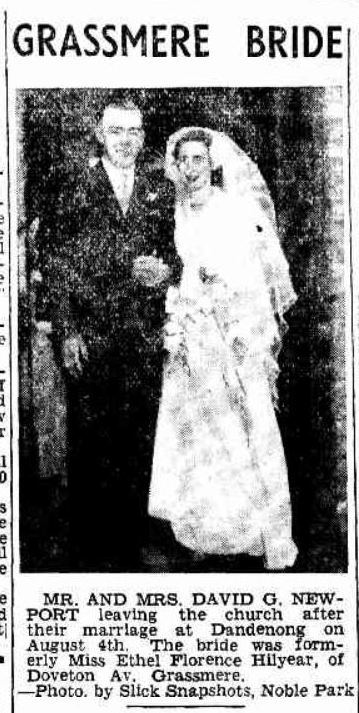
The area was originally known as Dandenong or Eumemmerring or more especially Grassmere after Thomas Herbert Power's estate. It was called Grassmere well into the 1950s, and renamed Doveton after John and Margaret Doveton in 1953 or 1954 who had given their name to Doveton Avenue (where their house was located). The use of the name in Doveton Avenue preceded the use of the name as a suburb as we can see from this wedding report, below, from the Dandenong Journal of  April 22, 1951. The photo  shows Miss Ethel Florence Hilyear of Doveton Avenue, Grassemere and her groom, Mr David Newport.


Dandenong Journal April 22, 1951

Another article in the Dandenong Journal of October 24, 1951 (see below) talks about General Motors Holden feeling that Eumemmerring as an address is 'unwieldly', although apparenttly International Harvester thought it was a 'thundering nice name'. The Journal asked if anyone knew the origin of the name and a further article in the Journal said the name was Irish. Not sure about that - most sources seem to say that it is of Aboriginal origin and means 'we are pleased to agree with you' or on a related theme, a word expressing pleasure or agreement.


Dandenong Journal, October 24, 1951.


Dandenong Journal November 21, 1951


Dandenong Journal April 29, 1953

According to an article in paper (see above) the name of Doveton was agreed to by the Shire of Berwick in April 1953 after  a request from the Hallam Progress Association. This decision preceded the establishment of the Housing Commission project at what was then called Dandenong East.

The Age September 27, 1954.

The Doveton Housing Commission Estate was announced in September 1954.

Dandenong Journal October 13, 1954

It seems that the formal adoption of the name Doveton for the Housing Commission Estate was in October 1954, according to the report in the Dandenong Journal, above. The area had been known as Dandenong East. It does appear that the year 1954 was the year the name Grassmere was finally abandoned for the area east of Doveton.  The modern day suburb of Eumemmerring was gazetted on May 20, 1981. As a matter of interest Doveton is a variation of the name Dufton which means ‘Farmstead where doves are kept’ in dovecotes.

Monday, 3 March 2014

Doveton North Technical School / Endeavour Hills Technical School

Doveton North Technical School opened in 1969, in Power Road, with five teachers and 45 students.   From 1974 it was  called Endeavour Hills Technical School, then from 1990 Endeavour Hills Secondary College. It changed its name again in 1993 to Eumemmerring College Endeavour Hills campus, then in 2008 the name changed back to Endeavour Hills Secondary College.   The School closed in December 2012.


The school site in 1968, above and below.


Construction of the School in 1968, above and the two photos below. 


The first staff - but there are no names attached to the photograph, but I believe they are - 
Standing: N. Chapple,  Harry Dengrove (English and Social Studies);  Don Banks (Maths and Science);  R.Rhodes (Sheet Metal)
Seated: Kevin McDonald (Headmaster); Marilyn Wallace (Secretary); Ron  Gamble (Principal)
A list of staff in a newspaper article (reproduced below) also has a Hugh Foster listed as an Arts Teacher. 
Mr Gamble was only 38 at the time of his appointment and was one of the youngest principals in the Education Department.


The School in 1969, the year it opened.


This article about the opening of the school appeared in the Dandenong Journal on January 14, 1969.


The Mothers Club was formed in March 1969, according to this article from the Dandenong Journal. I wonder what memories Dorothy Hall, Sylvia Rowe, Anne Nalty, Carol Kenyon and Gloria Robinson have about the first meeting?


This is page one from the Register of Corporal Punishment. I have obscured the names for privacy reasons. The register starts in July 1969 and finishes in July 1981.

Monday, 16 December 2013

William A. Smith lace factory in Doveton

Lace Street in Eumemmerring is the only  reminder of the William A. Smith lace factory which operated there from 1949 to the 1980s.  When the factory was built it was in Power Road, however Power Road was later diverted around the Eumemmerring Creek and the small section of it, south of the Creek, was renamed Lace Street (see aerial photograph below). The factory was in an area which has gone through many changes of name - initially Eumemmerring, then Dandenong, from 1954 called Doveton and from 1981 called Eumemmerring (again)

This article was  in, of all papers, the Kalgoorlie Times of March 30 1948 and is about the establishment of the lace factory. It also appeared word for word in the Burnie Advocate.  

Maria Harding, in her book, Doveton: a brief history says that the factory was built in 1949 and started operations that year. Two managers houses were also built at this time.  Mrs Harding writes that this factory made handkerchiefs, napery and veils, no doubt using the products imported from the English factory. In 1953, another factory was built alongside the original one and this factory manufactured lace. A third managers residence was also built and eighty four people were employed. The factory operated until the 1980s when it closed as it could no longer compete with cheaper imports. The factory, which was on the west side of Lace Street was sold and has been demolished as have the three houses.

The employees of the lace factory in 1951.

There was an article in the Women's Weekly of April 22, 1959 entitled Dandenong: a symbol of industrial strength. This article looked at various factories in the Dandenong,  including the lace factory. They interviewed William Smith and he claims that his factory was the first in Dandenong. It goes on to say that at his 300 year old walnut desk, brought from England, Mr Smith sighed ' for the old days at Dandenong (1947) when not a light could be seen for miles at night'.  "Look at the bustle now', he said. A heavy stream of traffic packed the four-lane highway in from of the factory.


This picture accompanied the Women's Weekly article about Dandenong and shows some of the lace factory employees.
Women's Weekly of April 22, 1959    http://nla.gov.au/nla.news-article48077502


This is a 1963 aerial of Doveton / Eumemmerring. Click on photo to enlarge it. That's the tree-lined  Eumemmerring Creek, snaking through from top right to bottom left and just to the right of the Creek, at the bottom, you can see Lace Street and the two factories on the western side, along with the three Manager's houses. Further north, the two ovals are Robinson Reserve and L.S. Reid oval. The intersection middle top is that of Frawley Road/Paperbark Street with Power Road. Follow Power Road to the bottom of the photo and it intersects with the Highway.  Power Road was diverted at this end as it would have been too expensive to build a bridge to take heavy trucks*. 

 *William Smith in an interview with Maria Harding

Monday, 29 October 2012

Eumemmerring Run

Doveton, Hallam, Endeavour Hills and the modern day suburb of Eumemmerring  were originally part of the  Eumemmerring Run. This run was 14 square miles (10,240 acres or 4,100 hectares) and was taken up by Dr Farquhar McCrae (1807-1850) in 1839.  It was described as good sheep country. Dr McCrae was the brother-in-law of Georgiana McCrae (1804-1890) who was married to his brother Andrew. Georgiana kept a journal, later published as Georgiana's Journal.  Later the same year it was taken over by Leslie Foster (1818-1900) or to give him his full name -  John Vesey Fitzgerald Leslie Foster, apparently known as 'alphabetical Foster’. Foster is pictured left.  Foster was, amongst other things, a first cousin of Sir William Foster Stawell (1815-1889) who was appointed Victorian Attorney General in 1851 and became Chief Justice of Victoria in 1857. Stawell Street in Cranbourne was named after him, as well as the town of Stawell. Foster also, in 1843, challenged Dr McCrae to a pistol duel over a land sale, when McCrae refused Foster whipped him and his horse with a horse whip. He was later fined £10 and had to pay £250 in damages. He went on to help draft Victoria’s constitution, acted as the administrator of the Colony between the departure of Governor La Trobe and the arrival of Governor Hotham.

Foster held the run until 1842 when it was taken up by Edward Wilson and James Stewart Johnson until 1846 when Thomas Herbert Power (1801 to 1873)  took it on.  The property then went from around the Dandenong Creek/Power Road all the way to Berwick. Power was a member of the Legislative Council from 1856 until 1864 and had land in other areas including Hawthorn, and is the source of the name Power Road. When he died in 1873 the value of his Estate was over £40,000. He still owned, according to his Probate papers 1,848 acres (747 hectares) in the Parish of Eumemmerring  when he died. Part of his Probate papers are reproduced below. You can see some of alloments  in the Eumemmerring Parish Plan, further below.

Part of  Thomas Herber Power's Probate papers. listing his Eumemmerring land, valued at £6006.  Wills and Probates up to 1925 are digitised and available on the Public Records Office of Victoria website. www.prov.vic.gov.au

 
Eumemmerring Parish Plan (partial) showing some of the land owned by Thomas Herbert Power.
 
It was apparently Power (pictured right) who called his property Grassmere and the Doveton  area was known as Grassmere or Eumemmerring until it was named Doveton in September 1954. On October 30 1888 Munro & Baillieu Estate Agents offered for sale  the Grassmere property of 3,000 acres (1214 hectares) subdivided into lots of between 1 acre and 20 acres (up to 8 hectares), some of which  was land from the Power Estate. It was described as having  extensive views of both mountains and sea and only a few minutes walk from this happily situated and pretty township, so fast becoming a favourite residential estate. The pretty township was Dandenong, pretty it may have been but even Usain Bolt wouldn't have made it from Dandenong to Grassmere in a few minutes. 

This is the plan of Grassmere which appeared in The Argus of October 30, 1888.  Marked on the map is the proposed railway line to Fern Tree Gully, which never eventuated.

It is highly unlikely McCrae, Foster or Power ever lived in the area, however in  the 1850s there were other land sales, especially around the Eumemmerring Creek, of smaller sub-divided blocks and farmers arrived and created a community - the  Eumemmerring, Denominational School started in 1858 and two Inns and  a race course were established and of course, a bit further east was the Hallam Hotel which began as a general store run by William and Mary Hallam, in the 1860s. These settlers didn't (generally) have roads named after them nor are remembered in any other way but Jean Uhl has listed them, on page 97,  in her book, Call back Yesterday: Eumemmering Parish (published by Lowden Press, 1972)  and they deserve to be recognised here.


Sources: Call back yesterday: Eumemmering Parish by Jean Uhl (Lowden Press, 1972). The photographs of Foster and Power are from the Parliament of Victoria website www.parliament .vic.gov.au. The Probate record of Thomas Power is from the Wills and Probate Papers digitised by the  Public Records Office of Victoria www.prov.vic.gov.au. The Grassmere plan comes from The Argus, available on Trove http://trove.nla.gov.au/newspaper.
The information on Leslie Foster comes from the Australian Dictionary of Biography on-line at http://adb.anu.edu.au/ The original article was written by Betty Malone.

Tuesday, 2 October 2012

Aerial photos of Doveton, Eumemmerring, Hampton Park and Dandenong

These aerial photographs were taken on March 3, 1970. The label says they were taken at  a 'height of 1,500 feet generally, down to 1,000 feet'. That is 450 metres down to 300 metres.  All the photographs have 'Eummemmerring Bypass from end of Mulgrave Bypass to South Gippsland Highway" on the back.  I presume that they were taken along the route of the proposed road between Stud Road and the Princes Highway East, which would act as a by-pass to the City of Dandenong. This work started in 1969 and was finished in 1972. The photographs are from the Shire of Berwick and have been annotated on the front  at some stage by a Council employee. 


This is the Princes Highway at Hallam/Eumemmerring, showing Kays Avenue at the bottom right and the General Motors Plant in the centre of the photograph. The South Gippsland freeway now runs to the left of  Kays Avenue and the right of General Motors. It's page 91 of the Melway Street Directory.


Kays Avenue is in the centre, the Princes Highway bi-sects the photograph, Doveton Avenue is to the right and  you can see the General Motors factory, centre left. 


Looking west (or towards Dandenong) up the Prince Highway. Kays Avenue is just below centre right.


This is looking south, over Eumemmerring and  General Motors to Hallam/Hampton Park. Kidds Road is at the bottom, right. General Motors Holden is at the centre, towards the top of the photograph. Florence Street is in the centre. It doesn't exist in the Melway anymore.


Another view across towards General Motors Holden.  Power Road is bottom right.


This is the South Gippsland Highway and Pound Road intersection at Hampton Park, looking north to General Motors Holden factory. It's page 96 of the Melway Street Directory.


The same intersection as above, the corner of the South Gippsland Highway and Pound Road. If you have been along here recently you would know that there have been some massive changes since this photograph was taken. To see another aerial photograph of this area, click here.

 This is Gladstone Road in Dandenong, looking towards where it intersects with Brady Road and further on Halton Road.  It's Map 81 of the Melway Street Directory.

Monday, 11 January 2010

John Doveton and Margaret Doveton - Part 2

In our last post we looked at the life of Captain John Doveton and in this post we will see what we can find out about his wife, Margaret. She was born a Doveton and married a Doveton and I feel that this means that the suburb of Doveton was really named for her as well as her husband. As we found out in the last post, I knew Margaret's parents names from her marriage certificate, i.e Francis Crossman Doveton and Margaret Bostock. I also knew she was born in Tasmania. The Tasmanian Indexes to Births, Deaths and Marriage (BDM), on CD-Rom, are available to use at Narre Warre, Cranbourne and Pakenham Libraries. A quick search revealed her parents married in 1842, that Margaret was born in Hobart in 1844 and that her sister, Rachel Emily, was born Campbell Town in 1846. That was all I could find, so I ‘googled’ Francis Crossman Doveton and according to some information on the Ballarat & District Genealogical Society website http://www.ballaratgenealogy.org.au/ Francis Crossman Doveton was the first Gold Commissioner at Ballarat, but I will tell you more about that later.

Now I knew that the family had moved to Victoria I looked up the Victorian Indexes to the BDMs and found that the next two children, Annie (born 1848) and Francis (1850) were born at Port Fairy and the last child John (1852) was born near Warrnambool. Margaret Bostock, had been born in 1824 in Tasmania and died in Victoria in 1853. After her death, Francis Crossman Doveton married Mary Ann Snell in 1855 and had eight other children. So already we have found out some personal information about our Margaret, including the sad fact that her own mother died when she was nine.

Francis Crossman Doveton had come to Australia with the 51st Regiment of Foot (2nd Yorkshire, West Riding Regiment). The Regiment arrived in 1838 and served in Tasmania and Western Australia and then left for Bengal in 1846, but Doveton remained in Australia. This same information is mentioned in the report of his death in The Argus of July 15, 1905. As Francis Doveton Crossman had a Government position in Victoria, I checked the Victorian Government Gazette, where all official appointments are announced, and found his first appointment as Commissioner of Crown Lands (reproduced below).

Victorian Government Gazette, Wednesday, August 27, 1851, page 312.

The Victorian Government Gazettes have been digitised from 1836 to 1997 and can be searched on the State Library of Victoria website, www.slv.vic.gov
According to the Victorian Government Gazette other appointments followed, amongst which were - in 1852 he was appointed a Magistrate of the Colony of Victoria, in 1855 Chairman of the Local Court of the District of Hepburn and in 1858 he was appointed a Warden of the Gold Fields, then a Chinese Protector and in 1860 he was appointed as a Coroner, acting at Daylesford. From The Argus I found out that in 1866 he was declared Insolvent in the Supreme Court, due to ‘want of employment and having accepted accommodation bills for others’. His liabilities were £2,233 pounds and his assets £206.


The Argus, Monday, November 17, 1941, page 6. http://nla.gov.au/nla.news-article8217085

As we found out in the first post, we know when Margaret was married (1873) and we know that she purchased the property at Doveton in her own name in December 1894. We also know that by 1900 the property was leased and they were living in Oakleigh. According to the Australian Electoral Rolls on Ancestry database, in 1909 Margaret was still at Atherton Road in Oakleigh, but in 1914 she had moved to Malvern East. In 1924, she was at Everdon, Rose Street in Surrey Hills and was still there in 1937. In 1941 she was living in Mordialloc. I looked up The Argus newspaper on the National Library of Australia's Australian Newspapers website and came across the interesting article, reproduced above, from the November 17, 1941 edition. Some of the same information was recorded in her Obituary in The Argus of December 16, 1941. The Obituary is reproduced below. The Obituary mentions she was buried at the St Kilda Cemetery, not Oakleigh, where her husband was buried.

The Argus, Tuesday, December 16 1941, page 3. http://nla.gov.au/nla.news-article822687

We know that John and Margaret were cousins, but I wanted to know how they were related. There are numerous Doveton Family histories on the Internet and one site lists the children of John Frederick Doveton and Elizabeth Crossman. The children include a John Bazett Doveton (born 1807) and a Frederick Crossman Doveton (born 1817). But, ever suspicious of ‘unofficial information’ on the Internet I wanted to confirm this with other sources. Now, in the last post we know the Captain John Doveton’s father was John Bazette Doveton. We know that John Bazette Doveton was born around 1807 and from the Oxford University Alumni 1500-1886 database on Ancestry, we know that his father was John Frederick Doveton, so that fits. We also know, from the Victorian Indexes to the Births, Deaths and Marriages that Francis Crossman Doveton was 87 when he died in 1905, which makes him born around 1817 and that his parents are listed as Frederick Doveton and Elizabeth Crossman. Francis is also listed as a past pupil of the King’s School at Bruton (a facimile copy of the School Register 1826 to 1890 has been digitized by Google Books) and his father is listed as the Reverend John Frederick Doveton. This gives us a few other sources which confirm that John Bazett Doveton and Francis Crossman Doveton are brothers, being sons of John Francis Doveton, and therefore John and Margaret are first cousins.

Two more interesting facts about the Doveton family. They have a connection to Everdon Hall in Little Everdon. It is a Grade 2 Listed building built around 1820 for General Doveton and interestingly, Everdon was also the name Margaret Doveton gave to her house in Rose Street in Surrey Hills. Secondly, the article on the Ballarat & District Genealogical Society website on Francis Crossman Doveton (full details at the bottom) states that Elizabeth Crossman, John and Margaret’s grandmother, is said to be a direct descendant of King Edward 1 (1239-1307) and his wife Eleanor of Castille (1241-1290). They married in 1254 and had sixteen children, with only six living to adulthood. The Royal couple were on a trip to Lincoln when Eleanor fell ill and died. A memorial cross was erected at every place where the entourage stopped, when her body was being transported back to London. These crosses are known as the Eleanor Crosses. Eleanor was buried in Westminister Abbey. If your family has been in the United Kingdom for many generations it is apparently more common than you would expect to be related to a member of the Royal Family, albeit very distantly, as is the case with John and Margaret Doveton, so the Royal connection is quite plausible. Anyway, it is a very romantic story and I really like the Royal connection to Doveton.

The effigy of Eleanor of Castille (1241-1290) at Westminister Abbey. Eleanor is said to be an ancestor of both John Doveton and Margaret Doveton.

All the sources I have used to find out this information on John and Margaret Doveton are freely available, with the exception of the Death and Marriage Certificates which I purchased. You can access the United Kingdom Census collection, the Australian Electoral Rolls and the Oxford University Alumni on Ancestry database, available at all our Libraries. The Victorian Government Gazette is accessed through the State Library of Victoria website. The old newspapers, the Australian Newspapers Project, can be accessed on the National Library of Australia website. You can use the Internet at all our Libraries and it is free with fast down-load times. The Indexes to the Births, Deaths and Marriages, from all the States of Australia, are available at Narre Warren, Cranbourne and Pakenham Libraries, as are the old Shire of Berwick and Shire of Cranbourne Rate Records. This means, you could well find out some of the same sort of information on one of your Ancestors as I have discovered on the Dovetons. In finishing, I can safely conclude that Captain John Doveton and Margaret Elizabeth Doveton were first cousins, as their fathers were brothers, in which case Margaret should have as much status as the ‘namesake’ of the suburb of Doveton as her husband.

*Francis Doveton, First Gold Commissioner at Ballarat by Thelma Birrell. http://www.ballaratgenealogy.org.au/art/doveton.htm

John Doveton and Margaret Doveton - Part 1

The suburb of Doveton was established in the mid 1950s by the Housing Commission to provide housing for the employees of the 'Big Three' Industrial companies, International Harvestor Company, H.J Heinz and General Motors Holden. The area was originally known as Grassmere or Eumemmerring, however in September 1954 the new suburb was named Doveton after Captain John Doveton. This is an interesting choice given that Captain and Mrs Doveton were only in the area for ten years and there are other families with a much longer or much earlier connection to the area. However it is a pleasant sounding name and is a variation of the name Dufton which means ‘Farmstead where doves are kept’.

Very little is known about the Dovetons, so I thought I would see what I could find out about them, using freely available resources and the best thing is, you can do the same sort of searches to find information on any of your own ancestors. You don't even need to have the Internet on at home, you can use the Internet, free, at any of our Libraries. The only money I spent was on obtaining a copy of John Doveton’s death certificate and a copy of their marriage certificate, but they gave me so much new information it was well worth the money, plus it gave me confirmed or official information.

There is a lot of Family History information on the Internet and some of the information I have come across on the Doveton Family I know is untrue, even from my own basic research on the family. I started my search by checking out the Indexes to the Victorian Birth, Death and Marriage (BDM) records. To obtain certificates you need the Registration numbers and the BDM Indexes give you these. You can access, for free, the Indexes to the BDM records at our Narre Warren, Pakenham and Cranbourne Libraries. For information about purchasing certificates follow this link to the Victorian Department of Justice http://online.justice.vic.gov.au


These are the signatures of John Doveton and Margaret Doveton from their Marriage Certificate. We don't have any photographs of them, so it is the only physical connection we have to them.

The marriage certificate told me that John Doveton married Margaret Elizabeth Doveton on October 8, 1873 at All Saints Church in St Kilda. The certificate also told me that his parents were John Bazett Doveton and Harriet Fenton and that her parents were Francis Crossman Doveton and Margaret Bostock. He was born in Saltford and his occupation was listed as Master Mariner. His father’s occupation was listed as “Clerk in Holy Orders”. Margaret was born in Tasmania and her father is listed as an “Officer in the Army”. On his death certificate I found out that John died, at the age of 61, on April 7, 1904 and that at the time he was living at Atherton Road in Oakleigh. He died of throat and liver cancer and was buried at the Oakleigh Cemetery. Once again it lists his parents and the name of his wife, and also the fact that they had no children. We also find out that he has been in Victoria for ‘25 years’. His age at death also gives us an approximate date of birth of 1843.

The Doveton marriage was announced in The Argus newspaper of Saturday, October 11, 1873, page 4. http://nla.gov.au/nla.news-article5873415

Now we can have some basic information, we can start working back and I looked at the Ancestry database, available free at all the Casey Cardinia Libraries, and searched for his father, John Bazett Doveton, in the United Kingdom Census Collection. It is a fairly unusual name and I found out that in 1851 the family was living at Burnett and his occupation was Rector of Burnett and that he was 44 and his wife Harriet was 32. There were five children, Catherine (aged 9), our John (aged 8), Bazett (aged 6) Caroline (aged 3) and Ella (aged 1). The household also had a Governess and four servants so it was a fairly comfortable household. John’s birthplace on the Census records is listed as Saltford, so that all ties in with the information on his Death and Marriage certificates. His age in 1851 is listed as 8 years old, which makes his year of birth 1843, which ties in with the date we worked out from his Death Certificate. In the 1861 Census, John Bazette Doveton was still the Rector of Burnett, but we find that there are two more children in the family, Mary Harriet aged 9 and Henry aged only 10 months.

This is from the Oxford University Alumni, 1500-1886, available on the Ancestry database

Ancestry also has an interesting database the Oxford University Alumini 1500-1886. We can find John’s father and grandfather listed as Alumni. John Bazett Doveton is the second son of John Frederick Doveton, of Blagden in Somerset, who obtained a Bachelor of Civil Law in 1804. John Bazett Doveton matriculated in 1825, aged 18, received his Bachelor of Arts in 1831 and his Masters of Arts in 1834. He is also listed as being the Rector of Burnett, Somerset – this ties in with the Census information, plus both the Census and the Alumni information both indicate that John Bazett Doveton was born around 1807. So you can see how we are building up a picture of John’s early life and solid upper middle class family back ground.

I thought I would see what I could find out about his life in Australia by searching the newspapers available through the National Library of Australia's Australian Newspapers Collection. The National Library of Australia (www.nla.gov.au) has digitised major Australian newspapers and they are a wealth of information. I found a notice of John's marriage to Margaret in The Argus of October 11, 1873 (reproduced above). There was a report in The Argus of September 22, 1876 about the new steamship Durham which had just arrived from London after 50 days of sailing. Mr John Doveton is listed as the Second Officer, but he did not sail again with the Durham when she left port, as he had ‘elected to remain in the Colony’. In 1879, John Doveton, as the Chief Officer of the Julia Percy, gave evidence at an Inquiry into a collision between the Julia Percy and the St Joseph. The Argus has various reports, in the Shipping Intelligence column, of Captain Doveton arriving and departing Melbourne as the Captain of the Julia Percy, then the Tamar and then the Southern Cross.


The Hobart Mercury, Monday, 8 May 1882, page 2. http://nla.gov.au/nla.news-article9009163

A report in the Hobart Mercury of May 8, 1882 (reproduced above) said Southern Cross, under Doveton, run ashore on the Vansittart Shoals between Babel Island and Cape Barren in Bass Strait. Captain Doveton was suspended from the Command, pending an enquiry. Another report in the May 23, 1882 said that Captain Doveton had resigned. After this, the only reports I could find about Captain Doveton involved him supervising work at the Wright, Orr & Co. floating Dry Dock and later at Dukes Graving Dock.

We now know something about John Doveton’s family life and his working life – and the next step is to find out about his connection to the area which eventually bore his name. The Library has the Shire of Cranbourne Rate Books from 1863 and the Shire of Berwick Rate Books from 1875 on CD-Rom. You can use these at Narre Warren, Cranbourne and Pakenham branches. The first listing for Captain Doveton was in the 1893-94 Shire of Berwick Rate books. He owned a house and 2½ acres at Lot 53 in Grassmere. The following year he had another 2½ acres at Lot 56, so five acres in all. From 1900 it was leased out and was sold on August 21 1903 to Robert Skinner. Even though Captain Doveton was listed as the ratepayer, according to a copy of the Title we have in the Archive, the property was actually purchased in Margaret's name. The house, which is now demolished was located around Gumbuya Close, off Doveton Avenue. In our Archive we also have a copy of an article from the South Bourke and Mornington Journal of April 10, 1896 which says that Captain Doveton had erected a 70 foot high flag pole in front of his ‘cosy residence’ where, on Sunday and high holidays, a 10 foot flag was flown.

This is from the Australian Electoral Rolls, 1903-1954, available on Ancestry database.

One other source of information we can use are the Australian Electoral Rolls on Ancestry database. The 1903 roll, for the Division of Kooyong, lists John and Margaret Doveton living at Ferntree Gully Road in Oakleigh and his occupation is listed as Poultry Farmer (see above). The death notice in The Argus on April 9, 1904 says that he died at “Burnett’, Atherton Road in Oakleigh, his property obviously being named after his childhood home. (see below)

The Argus, Saturday, April 9, 1904, page 9.
http://nla.gov.au/nla.news-article10313673

By using all these freely available sources we have built up a picture of Doveton’s life. In the next post we will look at Margaret Doveton's life and discover a connection to Royalty!

Monday, 12 October 2009

Doveton Library - the early years

Doveton Library began in the mid 1960s as a book exchange operating between members of the Doveton Presbyterian Church. The collection was held in the house where the Deaconess lived. The Friends of Doveton Library still have a copy of the catalogue of this Library. As you might imagine, there were many books of a religious nature for both adults and children, but there was also a collection of general books and a collection of books for Christian education. The list below is from the Religious books collection.

In 1967 a Community meeting was held to establish the Doveton Library, which would be run by a volunteer Committee, the Doveton Library Committee. The books were obtained from donations, from the Shire of Berwick, local businesses such as Heinz and General Motors Holden and community groups such as Rotary and the Presbyterian Church. The new Library was opened in part of the Methodist Church Hall by Cr Rynehart, with Mrs Patricia Adams as the Committee's first President. There was a stock of 1,427 Children’s books and 1,273 Adult books and 650 subscribers, who could borrow books a cost of five cents for adults and two cents for children. The Library was staffed by volunteers who run the service in a committed and professional manner.

Two long serving Doveton Library staff members. Joan Finlay on the left and Betty Fairbrother on the right. Mrs Fairbrother had been involved in the Doveton Library since the Book exchange days. This photograph was taken in the 1970s at the Kidd Road premises.

In 1969, the Shire of Berwick rented the Presbyterian Church Hall, in Ti Tree Drive, to accommodate the Library. In 1971 The Dandenong Valley Regional Library Service was established to provide Library Services for the Shire of Berwick, Shire of Cranbourne, City of Dandenong and City of Springvale. The Doveton Library became the second branch of the DVRLS on March 1 1973, after the Doveton Library Committee donated their book stock and other assets to them.

148 Kidd Road, Doveton

By this time the Library had moved into a house at 148 Kidd Road. The plans we have for this building (see below) are labelled “proposed layout, temporary premises” and dated January 25 1972. The Kidd Road location proved to be slightly more than temporary, as the Library was there for ten years.

The proposed layout of the temporary premises of the Library at Kidd Road, dated January 25, 1972.

The Council purchased an old service station at Autumn Place and this was converted into a Library and officially opened August 12 1983, by Cr Syd Pargeter, Mayor of Berwick. The continuous provision of Library Services to the residents of Doveton for the past forty five years is a testament to the hard work, community agitation and community support of Doveton residents. The volunteer spirit is still alive and well in Doveton as the Library has a supportive and resourceful Friends of Doveton Library group, who have been providing resources for the Doveton Library since April 1984.


The plan, above, comes from a brochure produced by the City of Berwick to commemorate the opening of the Doveton Library in Autumn Place. The cost of the land was $82,000, the building was $108,000, Furniture and Fittings $15,300 and Landscaping etc was $11,5000. The two photographs, below, were taken at the Opening on August 12, 1983.