Monday, 19 December 2016

An Acrostic Seasonal history of the Casey Cardinia region - Merry Christmas

This is an eclectic look at some themes from our history and the first letter of each theme spells a seasonal greeting! In our next post we will present an historical take on Happy New Year.

M is for Mechanics Institutes. Our earliest Library in the area is the Berwick Mechanics' Institute and Free Library which started in 1862 and is still going strong. There were once over 1,000 Mechanics' Institutes in  Victoria, many still exist as public halls, but there are now only six that still lend books, including the Berwick one. It is a remarkable achievement and there would be very  few other institutions that have played a continuous role in the history and social life our our community for over 150 years.


Berwick Mechanics' Institute 1970s

E is for Education. The earliest schools in the area opened in 1854 - there was a  school on Captain Robert Gardiner's property at Berwick - this was the fore-runner of the existing Berwick Primary School. In 1869 it was re-located to a new building on the corner of Lyall Road and Peel Street  and later moved to Lyall Road. Also in 1854 a Church of England School opened in Lyndhurst, the first teacher being Robert Davies. There were 12 boys and 10 girls at the school and they paid 2 pence per day to attend.  Free education in Victoria did not come in until 1872 when the Education Act made the Government responsible for 'free, secular and compulsory' education. Students who wished to continue their studies past Grade 8, the level at which State schools originally finished,  would have had to have gone onto a private school until State High Schools were established. Depending on where you lived in the region you could have gone to Warragul High (opened 1911) or Dandenong High (opened  1919) or Upwey High (opened 1937 as a Higher Elementary  and became a High School in 1944). Koo-Wee-Rup (opened in 1953 as a Higher Elementary and in 1957 as a High School) and the 1960s saw Doveton High open in 1960, Monbulk High  in 1963, Pakenham High in 1967 all providing local familes with closer options for continued education.

R is for Religion.  When towns were first surveyed the Government set aside sites for Churches. The earliest purpose built  Church in the area was, I believe, Scots Presbyterian Church in Cranbourne built in 1860, although before this services would have been held in private homes. This building no longer exists so the oldest church building in the area is St Johns Anglican Church in Cranbourne erected in 1865 and still in use today.   Other nineteenth century Churches in the area that are still in use for their original purpose include St Andrews Presbyterian (now Uniting) Church at Berwick built from 1879, the Avonsleigh Church of Christ built 1887 and the Koo-Wee-Rup Presbyterian Church built in 1888 as a Wesleyan Church in Cranbourne and then shifted to Koo-Wee-Rup in 1896.


Scots Presbyterian Church, Cranbourne, built in 1860 and replaced in 1953 by the existing Church.

R is for Recreation  The earliest record I can find of  any organized sport in the area is this advertisement (below) from 1860 of the Cranbourne Cricket Club's Annual dinner at the Schnapper Point Hotel. Schnapper Point is now known as Mornington. The Berwick Recreation Reserve was gazetted on July 14, 1863, five years before land was set aside in Cranbourne for 'public recreation and racecourse purposes' on August 3, 1868.


The Argus April 7, 1860 

Y is for Yuletide. 1839 is the earliest account I can find of Christmas being celebrated by European settlers with a connection to this area.  Robert Jamieson and Samuel Rawson had taken up land on the Yallock Creek and began to move cattle to the Station from November 13 1839. On their way back from Yallock they went to  Edward William Hobson’s Kangerong run at Arthurs Seat where they arrived on Christmas Eve  where  they were wassailed or toasted with a bowl of hot toddy ( a drink made from spirits, usually whiskey, hot water, sugar and lemon juice).
Christmas was celebrated in Old English style with champagne and Rawson wrote we were a merry party that evening sitting in a hut, which a beggar in England would hardly live in, the walls full of holes, the roof covered with bark through the crevices of which a person might have crept with the greatest ease, the floor the natural earth and situated in the middle of the eternal forest whence 18 months before a white man had never trod.
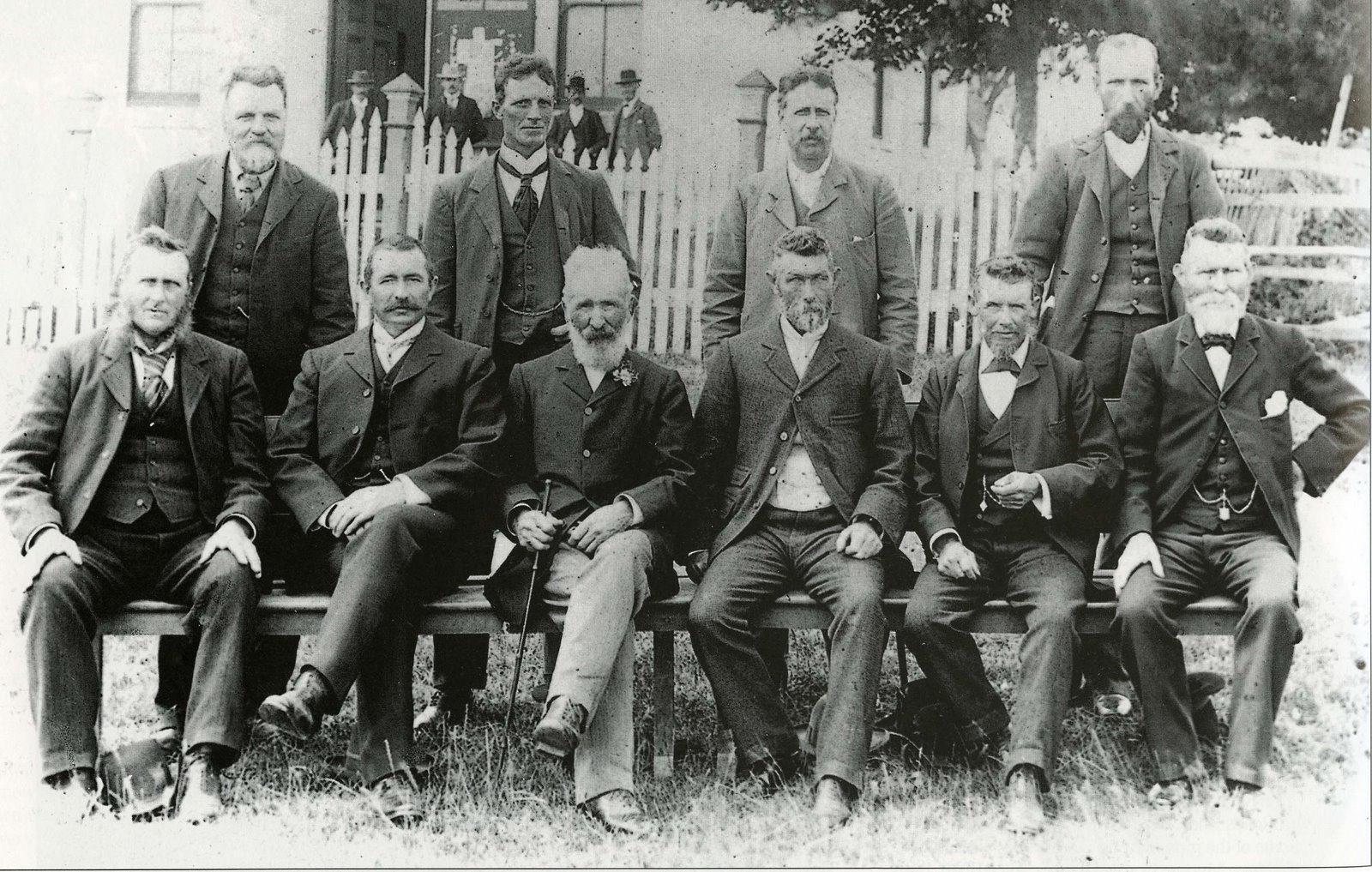
C is for Councils. The first form of local government in the area were the Road Boards - the Cranbourne Road Board was proclaimed June 19, 1860 and the Berwick Road Board on September 29, 1862. These Road Boards became Shire Councils in 1868 - Cranbourne on February 24 and Berwick on May 5.


Shire of Berwick Councillors, c. 1890s. 
They are photographed in front of the (now demolished)  Council Chambers, built in High Street Berwick in 1865.


H is for Holes in the ground - quarries and other extractive industries. The most  well known quarry in the area would be Wilsons Quarry at Berwick which began in 1859 and was owned by the Wilson family until 1978. It is now Wilson Botanic Park. There are other quarries in the area - the granite quarry at Tynong where the stone for the  Shrine of Remembrance was sourced is a well known example and of course there have been (and still are) sand mines at Cranbourne and Lang Lang.


 Quarry the granite for the Shrine of Remembrance at Tynong.

The caption reads (in part) Beautiful silver-grey granite of an eminently suitable kind is available at Tynong, in Gippsland, and workmen are shown in the photograph hewing the blocks of granite from the hillside. Inset:-A fine heap of granite blocks ready for dressing. They measure from six cubic foot upwards

 The Argus of November 14, 1928 http://nla.gov.au/nla.news-article3968930

R is for railways. Railways have been pivotal in the development of the Casey Cardinia Region. The Railways have always been used for personal travel - to go to work, to go into Dandenong or Melbourne for reasons such as shopping or to access medical services - but they have also influenced the location and growth of towns, transported produce to markets and tourists to holiday destinations. We have had four railway lines traversing the region and three are still operating. The earliest line is the Gippsland line to Sale which was opened from Oakleigh to Bunyip in October 1877 and fully opened in 1879. The Great Southern line commenced construction in 1887 and was fully operational from Dandenong to Korumburra by June 1891. It was later extended to Port Albert. It now only goes as far as Cranbourne. The famous Puffing Billy line, officially called the Fern Tree Gully to Gembrook line, opened in December 1900. Finally the Strzelecki line from Koo-Wee-Rup to Strzelecki opened on June 29, 1922 and closed in stages until it was completely closed in February 1959.

I is for Industry.  The 'Big Three' were established at Dandenong in the 1950s  - International Harverster in February 1952, Heinz in 1955 and General Motors Holden in 1956. Between the three of them they employed thousands of people  and they had an immediate impact on the area.  The factories required workers and even though a Railway Station was built for GMH and opened in the October or November of 1956, it was good if there was a pool of workers living close by, thus Doveton was established  as a suburb in 1954 by the Victorian Housing Commission to house these workers. The factories also accelerated the housing development in Hallam, Hampton Park and Cranbourne  from where people could drive to work and park - GMH alone  had a 1000 space car park.


International Harvester Factory, 1980s.

S is for Space. This area is notable for the Cranbourne Meteorites. So far thirteen meteorites have been discovered in the area in virtually a straight line from Officer to Clyde to Devon Meadows to Pearcedale from 1853 to 2008. You can visit the Cranbourne No. 13 meteorite at the Casey RACE Swimming pool in Cranbourne.


Cranbourne meteorite  with the chain which was employed to pull it from its position for transport to the Melbourne Museum, 21 February 1862. Photographer: Richard Daintree.

T is for Timber Industry. The Gippsland Railway line encouraged the growth of the timber industry by providing a source of transport to cart the timber to Melbourne where it was used to build houses, fences etc and as  a fuel supply. Officer and Garfield both owe their existence to the timber industry and the towns developed around the railway sidings used by the timber industry.


Carting timber at Gembrook
State Library of Victoria Image H32492/2163

M is for Market Town - that is Dandenong. The history of our area is historically linked to Dandenong as it was a service town to the surrounding area.  For instance, Dandenong had a large public hospital with specialists. It was also where the local children went to High School until local schools were built from the 1950s onwards.  Dandenong was also the major shopping area for people from the surrounding area  and a trip to the Dandenong market to buy clothes and other goods was a ritual for many. The Dandenong Market was also the major livestock market for the area. In the late 1940s and the 1950s my father used to drive his parents from Cora Lynn to the Dandenong market where they sold their eggs, chooks and calves (all carried on the back of the ute) and they were just one of the many thousands of small farmers who did the same. The Dandenong Market originally located on the corner of Lonsdale and McCrae Streets and opened in 1866, 150 years ago.  It moved to its present location on Clow Street around 1926 and in 1958 the stockyards moved to Cheltenham Road.  The Dandenong Stock Market was the last municipal owned and operated facility in Victoria, and closed on December 22, 1998. It is now a housing estate.

A is for Agriculture and farming.  Small family farms, were the main stay of the rural economy of this area from around the 1880s to the 1970s. These farms were dairy farms, poultry farms, pig farms, potato farms and market gardens.  The first settlers in the area were the squatters and large (often absentee)  landowners but from the 1850s the big squatting runs were broken up, Government land sales took place and other farmers moved in. Later on these farms were subdivided again (basically 1880s onwards)  and this gave small farmers the opportunity to purchase land - this was historically the pattern of settlement for most of our region. It was also encouraged by government schemes such as the drainage of the Koo-Wee-Rup Swamp and the Soldier Settlement Scheme after the Great War. We still have family farms in the area, but the nature of agriculture has changed and farmers need to get bigger to survive, plus there are land use competition pressures from  the ever expanding Urban Growth boundaries.
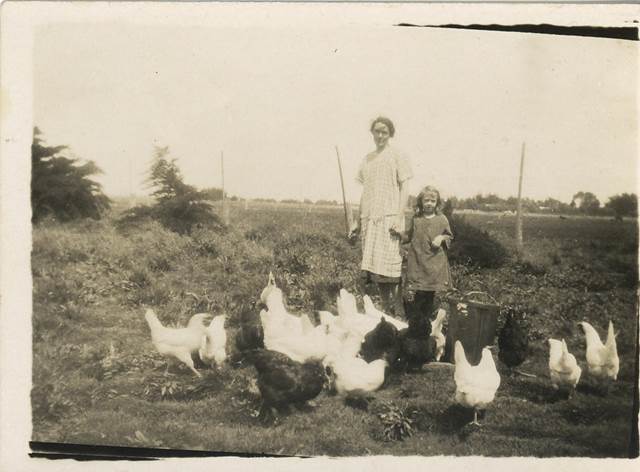

My grandma, Eva Rouse (nee Weatherhead) and my aunty, Nancy Rouse, on their small family farm at Cora Lynn, c. 1927.

S is for Swamp.  The Koo-Wee-Rup Swamp originally covered about 40,000 hectares or 96,000 acres and is part of the Western Port sunkland. The Swamp area is basically contained in  the Cardinia Shire which is about 128,000 hectares, so if you imagine that if it was left undrained, then one third of the Shire would be a Swamp.  The Chief Engineer of the Public Works Department, William Thwaites (1853 - 1907) surveyed the Swamp in 1887 and his report recommended the construction of the Bunyip Main Drain from where it entered the Swamp, in the north, to Western Port Bay and a number of smaller side drains. A tender was advertised in 1889. In spite of strikes, floods and bad weather by March 1893, the private contractors had constructed the 16 miles of the drain from the Bay to the south of Bunyip and the Public Works Department considered the Swamp was now dry enough for settlement. At one time over 500 men were employed and all the work was done by hand, using axes, shovels, mattocks and wheel barrows. By 1904, over 2,000 people including 1,400 children lived on the Swamp. Many more drains have been added over the years.


MERRY CHRISTMAS

Friday, 9 December 2016

Harkaway Lutheran Chuch

I wanted to find out about Lutheran Church at Harkaway so I started with one of my key resources for the history of the area  Early Days of Berwick and its surrounding districts and this (inter alia) is what the book said about the Church -
In 1869 it was decided to erect a school building. Under the guidance of builders Weise and Mayer, the settlers built a substantial weatherboard building more generally known as the German Church. On weekdays this served as a Church and on Sundays, a Church..... Because the school was  to be also used as a church, a bell was erected bear the building in 1869.....The earliest known Lutheran Pastor was Mattias Goethe, whose signature appears on the early marriage certificates. Then came Pastor Herlitz, who was suceeded by Pastor Schramm. Rev Hermann Herlitz was Pastor of the Lutheran Church at Melbourne and head of the Lutheran General Synod of Victoria.....At Harkaway during the Pastor's  absences the service swere conducted by  Dr G. Wanke. His son, the late Immanuel, acted as organist. (Early Days of Berwick, 3rd revised edition, 1979)


This photo of the Lutheran Church and bell tower is from Early Days of Berwick, 3rd revised edition, 1979.

This didn't tell me when the Church was demolished, neither did one of my other key resources In the Wake of the Pack Tracks, so I emailed Lyn Bradley, President of the Narre Warren & District Family History Group to see if the Group had any information on the Church and she sent me back a great document from 1935,  that they have in their Research Room. We don't know who wrote the article or where it was first published but it did tell us about the closure of  the Church  -   In later years due to many changes, the church in which the early settlers took such an active interest was closed. The organ was sold in 1912 and the building disposed of for removal -  so I assume the closure date was 1912 or a bit earlier and the building removed about the same time  - however there is more about the closing date below. The following is what the document had to say about the Church -

On December 11 1869 the local members of the Lutheran Church, desirous of erecting a church building secured a site having a frontage of 100 feet to Hessell's Road. The land was purchased  from the late Dr E.Wanke for the sum of 1 pound. Five trustees were elected, namely Messrs Louis Linsing, Ernest Hillbrick, John Fritzlaff, Heinrich Edebohis and Peter Erdman. As a result of a combined effort the church members erected a building which fulfilled the dual purpose of church and State school. By voluntary subscripion a bell was obtained, its weight being 210 lbs and its pleasing tone was the pride of the pioneers.  For many years Pastor Herliz (whose son, Dr Herliz, lives at Cheltenham) made the journey from Melbourne to conduct the services. He was very popular and the services were always well attended. In those days the late Mr I.G Wanke was one of those who presided at the organ.

The late Jacob Hessell conducted school for some time until transferred to the present school building.

On July 6 1882 five new trustees were appointed, Messrs Jacob Hessell, John Fritzlaff, Rudolph Halleur, August Dubburke and Rudolph Anderson. In later years due to many changes, the church in which the early settlers took such an active interest was closed. The organ was sold in 1912 and the building disposed of for removal. Two cypress trees that were planted many years ago by the late  Gottlob Aurisich,  are still growing on the site. At the  special request of the then two remaining pioneers, the  late  I.G Wanke and R Anderson, the bell was retained, and being close to the cemetery. it is tolled on the occasion of funerals, and is always rung on New Years Eve.  Those interested having passed away the site was developed into a 'no mans land'. Consequently, on  on February 25, 1935 a public meeting was held in the local hall. Cr D Boyd presiding, and those members of the Lutheran Church who attended appointed three trustees for the site Messrs H.I Wanke, J.W Nicol and H. C Weist. Mr Wanke is chairman and Mr Weist secretary and treasurer. On Saturday last, June 8. the new trustees entered into possession to carry out out their duties

Emulating John Batman, who had 100 years ago turned the turf with  a twig on the bank of the Merri Creek, the chairman turned the turf on the site, but with a spade, and each trustee planted a tree to commemorate the occasion. The bell was removed, and the dangerous tower pulled down  after a service of more than 60 years. Thanks to the generous spirit of Mr Nicol and several other enthusiasts, material and labour is to be provided for a new tower for the bell which, it is hoped, will ring out the old and welcome in the New Year for many years to come.  

The Bell Tower was officially opened on December 28 1935.


This is a report on the election of the Church Trustees as reported in the document, above.
Dandenong Journal March 7 1935

We have found this snippet of information in the Berwick Shire Council report in the Pakenham Gazette in 1917 (see below) which refers to the 'old Lutheran Church'  so this presents two possibilities - the Church building was still there in 1917 and hadn't been removed or else the site was locally known as the 'old Lutheran Church' even though the building did not exist.  


Pakenham Gazette June 8 1917

To throw another possibility into the mix the Narre Warren & District Family History Group also have a copy of  the Harkaway Cemetery: a brief history* in which an historic overview of Harkaway was written by Val Exell on September 29, 2000.  Mrs Exell writes this about the Church - On this site the belfry and the Lutheran Church were built in 1869, the bell coming from Germany. Until destroyed by fire the building was used for school on weekdays and Church on Sundays and closed in 1912. So the 1912 closure date is confirmed but Mrs Exell says the building was burnt down and not 'disposed of for removal'  

In the end whether the Church building was burnt down or removed (or possibly both) it doesn't really matter but I was a bit surprised that the Church closed as early as 1912 given the prevalence of the German ancestry amongst the Harkaway settlers, but the building was 43 years old by then and the Harkaway Hall was only three years old (it opened on June 9, 1909) so this would have been an alternate gathering place. 


This photo of the Church is from Oak Trees and Hedges:  a pictorial history of Narre Warren, Narre Warren North and Harkaway (published by the Berwick Pakenham Historical Society in 2002)

*Harkaway Cemetery: a brief history was created through a Work for the Dole program and published in 2001 by the Peninsula Training and Employment Program Inc.

Friday, 2 December 2016

Start of the Fountain Gate Shopping Centre

These fourteen photos are labelled 'the start of the Fountain Gate  Shopping Centre' They were taken by a now unknown City of Berwick staff member and show, as the name suggests, the start of the construction of the Shopping Centre.  The Fountain Gate Shopping Centre was opened on March 11, 1980 by the Governor of Victoria, Sir Henry Winneke, so these photos were most likely taken early 1979.


This is the view looking back towards the Civic Centre, which was officially opened on December 8, 1978, also by Sir Henry Winneke. Sir Henry was the Governor of Victoria from June 1974 until March 1982.


Another view looking towards the Civic Centre


Another view to the Civic Centre - there is the double storey section and what looks a bit like a colonnade on the right is section that faces the carpark on the Library side, you can see it better in the photo, below.


Similar views as above.


This is taken from the verandah on the east side of the Civic Centre, looking north.


I believe this is a view to the houses in the Fountain Gate Housing Estate on the west side of the Centre, possibly Raven Court or Fountain Drive and Summerlea Road, looking over what would be the Max Pawsey Reserve.


I believe this is looking north towards the transmission line that runs parallel to Brundrett Road in Narre Warren North


A nice row of pine (or are they cypress?)  trees - is it the same one as in the shot above? In the aerial below from January 9 1978 there are a few hedges of pines or cypress, not sure which one this is.


This is aerial of the Civic Centre (centre of photo)  and the Fountain Gate Housing Estate (top left of photo)  was taken January 9, 1978. I've included it here to see if it will help me get some orientation on the photos, hasn't really helped but it might help you. It does however show the landscape before the shopping centre was constructed. The building on the right of the Civic Centre is the Brechin Homestead, built in 1937 and demolished around 1990. You can read about it here.


I feel that this is looking north towards Narre Warren North


I think this is looking west to the Fountain Gate Housing Estate and Tinks Road


This is what became Magid Drive looking towards the Princes Highway


Looking west and the one below is looking south west. The trucks are an International Loadstar and an International Acco - both would have been made at the International Harvester Factory at Dandenong.


Friday, 18 November 2016

Flood - July 29 1987

These photographs were taken by the City of Berwick on July 29 1987


Beaconsfield Park showing the flooded Cardinia Creek. The Beaconsfield Park sign was erected in 1939 and refurbished and reinstalled in 2011 (it was then stolen and a new sign was made. I believe the old sign has just been found and that specific people living locally are 'helping police with their enquiries' )


Beaconsfield Upper Road


Beaconsfield - end of Adamson Street, looking west over Cardinia Creek and the Edrington property


Beaconsfield - Soldiers Road, north up the Cardinia Creek.


Hallam - Eumemmerring Creek looking east from end of George Avenue. 


Hallam - Eumemmerring Creek looking west from end of George Avenue.


Hallam - Gunns Road looking north to James Cook Drive and Hallam North Road. The photos were labelled in red texta, which was good as we know what they are, but the downside is that the texta has marked other photos. 


Hallam Road North looking west.


Hallam Road North looking south west.


Hallam Road North looking south to Belgrave-Hallam Road


Hallam Road North, Eumemmerring Creek looking east.


Hallam Road South, east side, looking south to the Railway line. Hallam Station is on the far right


Hallam Road South, east side, looking south to the railway line. This adjoins the photo above,


Ovals near Fountain Gate Shopping Centre and the retarding basin.

Monday, 7 November 2016

Gold Mining in Beaconsfield and Berwick region

The Berwick Beaconsfield area was once the location of gold fields.  What do we know about this gold discovery? The Early Days of Berwick (first published in 1948) had this to say about the subject  There were numerous gold mining companies about this time in 1870. To mention two, there were the Berwick Amalgamated Quartz Mining Co. and Happy-Go-Lucky Gold and Quartz Mining Company. As they brought numerous cases before the Court for non-payment of calls they could not have been too payable. In later years I heard my father speaking of another gold mining show in the district called the Go Bung which did not had a  very promising name to say the least of it. (This is from page 22)

This is also from The Early Days of Berwick   In even earlier days it is interesting to note that that the population of Beaconsfield exceeded that of  Berwick no doubt due to the gold mining activities carried out in Beaconsfield.... The gold mining was carried out in gullies named Mayfields, Walkers, Sailors and Haunted Gullies. An explanation of the latter being so named was said to be due to a miner wandering about the bush in the nude and appearing ghost like to his mates who were more or less in a similar condition of inebriation. (This is from page 115) Haunted Gully is now part of the Beaconsfield Reservoir.

This is what it says in the In the Wake of the Pack Tracks book
In 1872 H.J Valentine found gold south of Beaconsfield Upper in the Haunted Gully, now covered by Beaconsfield Reservoir. Prospecting was also carried out in Mayfield Gully to the east and Sailors and Welcome Gullies to the west. At one time over 200 miners were reported to be working in the locality. However yields were small and not payable  and no mother lode located (This is from page 57)

Also from In the Wake of the Pack Tracks (page 54)
For a time gangs of Chinese diggers, many wearing pigtails arrived at the Beaconsfield Railway station by the first train on Mondays and walked in single file up the Chinaman’s track (Bowman’s track) to the Haunted Gully diggings in Upper Beaconsfield.

The Berwick Amalgamated  Quartz Mining Company was registered on July 23, 1866 and as you can see from the notice in the Government Gazette, below, there were many familiar  local 'names' as shareholders - John Brisbane, Robert Bain, James Gibb, William and Ralph Brunt to name  a few.

Victoria Government Gazette July 27, 1866


The Happy-Go-Lucky Gold and Quartz Mining Company was registered on April 26, 1869. The General Meeting of the Company was held in January at Souter's Gippsland Hotel at Beaconsfield where William Brisbane, James Gibb, S.W Brooke, David O'Shea and Charles Souter were elected Directors. You can read an article in the Gippsland Times about this meeting here.

Victoria  Government Gazette April 30, 1869

There seems to have been a few different stages of gold discovery in the area - the establishment of the Mining Companies ( Berwick Amalgamated  Quartz Mining Company and Happy-Go-Lucky Gold and Quartz Mining Company) in the late 1860s, possibly as speculative ventures, then the actual discovery of gold in the region, which according to various reports on Trove was in 1873 and then there was another small gold rush in the early 1890s.

The Argus of June 16 1873 had this to say about the gold discovery in Berwick in 1873 -

The new gold field lately discovered in the ranges near Berwick about 30 miles from Melbourne, has excited some little interest, and new life has been infused by the discovery into the hitherto somewhat dull township. The scene of the operations can be reached without much difficulty. The road as far as Berwick is the main road to GippsLand, and in dry weather presents few difficulties, but in the rainy season some parts of the road are rendered almost impassable. The worst portions of the road are between Oakleigh and Mulgrave, where an attempt has been made to mend the road with clayey mud, the effect being anything but pleasant to travellers. The diggings lie about five miles north-east of the township of Berwick, amongst the spurs of the Dividing Range. The nearest way of reaching the gold-field is from the Gipps Land Hotel, near Kardinia Creek. A track leads from there to the diggings and is easily passable on horseback or on foot, but the steep ranges render the road scarcely suitable for vehicles. The mining operations are confined almost entirely to Haunted Gully and the immediately adjacent gullies. It is about two years since the prospecting for gold was commenced in that locality by some men employed by Mr. C. Wiseheart, of Melbourne, and other persons who were convinced that the country in that direction was auriferous. Some of the gullies were tested, and the result showed that the belief was not ill-founded. A shaft was sunk in Haunted Gully last year by a man named Valentine, and a quantity of washdirt was obtained averaging 6dwt per load. A prospectors' lease of 30 acres in the gully was applied for by Mr. Wiseheart and those who were acting with him, and the ground was pegged out. The news of the discovery however soon spread and in a short time the place was rushed. The ground which had been already secured by Mr Wiseheart was taken up, and in consequence of the difficulties which arose the matter was bought under the notice of the Minister of Mines. A compromise which, according to the nature of compromises, was not considered satisfactory by either side, was effected, and it was decided that Mr. Wiseheart should be allowed to choose 10 acres. He has selected 10 acres in the upper part of the gully, and the remainder of the ground which he applied for has been taken up by the other miners. The foregoing facts show the circumstances which have already transpired in connexion with this new discovery of auriferous country, but a description of the present appearance of the gold-field will doubtless prove of more general interest. You can read the rest of the article here.

There are other articles in the newspapers about the dispute between Mr Wiseheart and the other miners. I have created a list of many of the articles on Trove relating to these goldfields, you can access the list here.

There was also another minor gold discovery in the region in 1893. Clearly as Beaconsfield did not turn into another Ballarat, then the discovery must have also been economically unviable.


The Age May 7 1891

As mentioned before, I  have created a list of many of the articles on Trove relating to these goldfields, you can access the list here.

Monday, 31 October 2016

Bunyip Byways Tourism map

I came across this Bunyip  Byways tourism map the other day. The Bunyip Byways was a joint tourism promotion from the City of Casey and the Cardinia Shire.


Click on the images to enlarge them.

Bunyip Byways was obviously established after December 15 1994 which is when the two Councils officially came into being, but I was unsure of the exact date. However, through the wonders of a Google search,   I came across a reference to it in the Village Bell, Issue 117 from August 1997. The Village Bell is a community newsletter, run by volunteers from the Upper Beaconsfield Association. This newsletter has been produced continuously since July 1978, a remarkable achievement. Not only that, but you can access them all on-line through the Upper Beaconsfield Association website  https://upperbeaconsfield.org.au/

The article by Jo Carter from the August 1997 Village Bell had this to say about the Bunyip Byways project:  You will have noticed the signs Bunyip Byways which have appeared throughout the Shire, signposting the Bunyip Byways Trail. In an endeavour to attract tourists to the area, the Casey Cardinia Tourism Association has drawn up a trail which promotes the many interesting features and places of natural beauty within our communities. The name 'Bunyip' (Buneep) is derived from a local WOONGI (aboriginal) legend of a mystical water-based creature TOO ROO DUN who lived in the great Koo-Wee-Rup swamp. The cost of the Trail has been met by grants from the Federal Department of Tourism, and Casey and Cardinia Councils. The Trail forms a circular route through Berwick, Harkaway, Cardinia Resevoir, Emerald, Cockatoo, Gembrook, Tynong, Bunyip, Garfield, Cora Lynn, Bayles, KooWee-Rup, Tooradin and Cranbourne. There is a Bunyip Byways tourism map available which will assist travellers to find both well known and lesser known places of interest to explore. The Beaconhills Golf Club and the local restaurant Japonica Jelly are noted on the map. And of course we have many walks in Upper Beaconsfield which are not mentioned in the Bunyip Byways Trails. "This area does have significant attractions and natural features," says Ian Hall of the Tourism Centre. "We want visitors to view the wildlife on the edge of the City, walk in the nature reserves and bushland, as well as try the wine, buy the antiques, visit the nurseries, eat the natural produce and relax in the many restaurants and pubs." The article finishes off with some contact details, which I wont list here, as the holders of  the phone numbers may well have changed in the past 20 years.

This edition also had an interesting article about Tasmanian Tigers in Upper Beaconsfield, hence the masthead of the newsletter.   


There is still a Bunyip Byways sign near the Cardinia Reservoir, on Wellington Road, but that's the only one I know, I should take  a photo of it one day to record it for posterity. And congratulations to the Village Bell team at the Upper Beaconsfield Association who have taken the time to not only produce a newsletter for nearly 40 years but to make the interesting local information available to everyone by digitising the editions and putting them on their website.

Friday, 21 October 2016

"Settlers and Sawmills" and Bellbrakes, bullocks and bushmen" - the local timber industry

In this post we will look at two great local histories, both written by Mike McCarthy and published by the Light Railway Research Society of Australia  Settlers and Sawmills: a history of West Gippsland Tramways and the industries they served and Bellbrakes, bullocks and bushmen: a sawmilling and tramway history of Gembrook, 1885 - 1985.

I can't believe that I haven't spoken about these two books before because they are both fantastic local histories - meticulously  researched, great information, great photos, great maps and and they cover one of the very early primary industries in this region - the timber industry. Settlers and Sawmills looks at mills and tramlines at Beaconsfield, Officer, Pakenham, Nar Nar Goon, Tynong, Garfield and Bunyip and then continues down the road to Longwarry, Drouin, Warragul to Trafalgar. Bellbrakes, Bullocks and Bushmen covers Gembrook, Gembrook South and Beenak.

As I said before, apart from farming the timber industry was one of  first industries in this area and it was spurred on by the establishment of the Gippsland Railway line that was opened from Oakleigh to Bunyip in October 1877 and fully opened from Melbourne to Sale by 1879. This provided easy transport access to the Melbourne market which needed timber for houses, fences, fuel etc  Early mills that opened in the Gembrook area originally used this line until the Puffing Billy line or Gembrook line was officially opened on December 18, 1900.

Both Officer and Garfield began as railway sidings for the transport of locally harvested timber and then a settlement grew up around the sidings and the towns developed.

I do have a personal interest in this area of our history because my great grandfather, Horatio Weatherhead, and some of my great uncles, Fred, George, Arthur, Frank and Alf Weatherhead are mentioned in this book. Horatio was granted a 2000 acre (just over 800 hectares) sawmilling area at North Tynong in 1908 and the family moved their timber operations from the Wombat forest at Lyonville in 1909. His sons also operated their own mills and Arthur's sons Roy, Max and Cyril also operated a mill, which was worked solely by Roy until 1979.

The books extensively cover the tramways and the mills but also looks at some family history, railway history and the history of some of the local towns.
You can still buy these books from the  Light Railway Research Society of Australia  or you can borrow them from the library - click on the titles for availability  Settlers and Sawmills: a history of West Gippsland Tramways and the industries they served and Bellbrakes, bullocks and bushmen: a sawmilling and tramway history of Gembrook, 1885 - 1985.