Wednesday, 10 April 2019

Algernon Darge - photographer

'
Main Street, Lang Lang, c. 1930s, Photographer: Algernon Darge.

This great photo of Main Street in Lang Lang was taken by Algernon  Darge.  Mr Darge operated as a photographer from 1903 and his office was in the same building as The Herald and The Argus newspapers at 175 Collins Street.  His company  had the concession to take photographs at the Broadmeadows and Seymour army camps during the First World War. In the 1930s, the Australian War Memorial purchased the original glass negatives from Algernon Darge, along with the photographers' notebooks. The notebooks contain brief details, usually a surname or unit name, for each negative (Australian War Memorial website)

There is an interesting article by Joanne Smedley - 19,000 glass plate negatives: Algernon Darge’s First World War legacy*, which you can access here, about his World War One collection and the acquisition of it by the War Memorial. It was not a straight forward process and the War Memorial rejected early offers from Darge and it wasn't until 1938 that the collection arrived at the War Memorial.  It's  a great collection, it's a shame that it is very difficult finding photos on the War Memorial's less than user-friendly website.  Some of Mr Darge's photos were published in The Argus when they were reporting on the deaths of soldiers, such as the one below of Private A'Beckett.


Private Frank Leigh A'Beckett, a farmer from Upper Beaconsfiled, enlisted on February 10, 1915 and was Killed in Action at Gallipoli on August 7, 1915. His portrait by Darge appeared in The Argus on September 17, 1915. 


Algernon Darge was born Algernon Charles Gordon Sharp in 1878 and Joanna Smedley writes it was under the name of Algy Sharp that he initially operated “Darge.” Photographers. In 1913 he changed his name by Deed Poll to Algernon Darge, perhaps to overcome the confusion of a different surname to his studio’s name or possibly because he had become synonymous with his studio. 

Mr Darge died on January 24, 1941 and his ashes were scattered at Mount Matlock, near Woods Point. His obituary in The Argus of February 3, 1941 (read it here) described him as a pioneer of commercial photography in Melbourne and reported that his  collection includes many scenes of early Melbourne life, photographs of notable events in the city's history, of the first motor-cars to chug and rattle along its streets- Mr Darge himself was one of the first to use a car for commercial purposes. The obituary also reported on the contents of his will - he left his unique pictorial record of half a century of Melbourne's history, the carefully preserved collection of photographic plates to The Argus.....The residue of his estate is to be held in trust for 21 years, during which the income is to be used for the electrical engineering and mechanical engineering departments of the Melbourne Technical College, where Mr. Darge was formerly an assistant Instructor. The residue will become the property of the college after 21 years. Sadly, for us, according to Joanna Smedley, it seems his formal offer of negatives to The Argus was not taken up. 

The State Library of Victoria holds about 350 of his photographs, though not the one of Lang Lang and I can't find any other local photos in the collection.  

*Joanne Smedley - 19,000 glass plate negatives: Algernon Darge’s First World War legacy  Joanne Smedley. In: A Cultural Cacophony: Museum Perspectives and Projects Online Version (2016), pp. 165-175 https://www.museumsaustralia.org.au/ma2015-sydney  Published by the NSW branch of Museums Galleries Australia

Thursday, 4 April 2019

The Opening of the Devon Meadows State School March 30, 1916

The South Bourke and Mornington Journal of April 13, 1916 reported on the opening of the Devon Meadows State School on March 30, 1916. It's an interesting account and also tells us a little something of the history of the area, some farming advice and the names of some early settlers. You can read the article, here, on Trove and it is transcribed, below. Sadly, I do not have a historic photo of the school.

Devon Meadows State School.
The Opening Ceremony.

Some two years ago when an area of land, comprising about 1200 acres, and now known as Devon Meadows, was subdivided by Mr Cox and placed in the hands of Messrs Birtchnell Bros. and Porter in order that the land could be disposed of in small holdings (which has already been accomplished to a very great extent), it could hardly have been expected that at the present day the locality would have an up-to-date State school building, although of small dimensions but such is the case, and all credit to the people who assisted in the movement and thus secured educational advantages for the children in the locality. The school is situate half way between the Hastings road and Fisheries road, on Worthing road, and occupies a most commanding position. The site is comprised in a six acre block, reserved for public purposes. 

The building is of neat and attractive design, and the interior is fitted up in modern fashion, with dual desks, lunch cupboard, blackboards, book cupboard, and is well ventilated, the outlay being £400. A substantial fence has been erected, enclosing the school and about an acre of the reserve. There is convincing evidence to show that the school and consequent expenditure was justified, for there are already 34 names on the roll, although seating accommodation has been provided for 32 only. Miss Bury is in charge of the school, and members of the committee are Messrs Huckson, Peterson, L. McDonald, Young, Ryland and Alphey.

The official opening was fixed for the 30th ult., and arrangements were made accordingly by the committee, who were ably assisted by the parents, the mothers having a busy time preparing tempting
eatables, of which there was an abundance on the afternoon of the date mentioned, when there was a representative gathering present. The refreshments were enjoyed by adults and the children, and a
pleasant half hour was spent in.a social manner.

Mr T. A. Twyford, who recently retired from the Education department, and was for many years head teacher at the Clyde school, was appropriately selected as chairman for the occasion. Having briefly
explained the purpose of the gathering, Mr Twyford called upon Mr L. A. Birtchnell to perform the opening ceremony.Mr Birtchnell said that it was hardly necessary to state how pleased he was to be present, but he regretted the absence of Mr Tate, who was in every way the proper man to declare the school open on behalf of the Education department. In the first place he had to make brief reference to the sad death of Mrs Newbury, who had been an energetic and respected resident, and to the bereaved family he desired to extend his heartfelt sympathy in their sad loss.

In regard to the school, some two years ago the parents were informed that the proposal to erect a school could not be entertained until there were 20 scholars, and there was even some opposition. However, leading residents had successfully worn down the various obetacles, and although it might be invidious to mention names, he felt that he should refer to the good work accomplished by Mr Ryland and Mr Twyford. The advantages of free education were apt to be overlooked, and he desired to point out that such should be fully availed of in the present day. He well knew the difficulties attached to pioneer settlement, and the help children were called upon to render their parents on the farm, but he hoped the fathers and mothers would do all in their power to enable their children to obtain the benefits resulting from education, for there was every reason to feel proud of the school as it stood to-day.

Even on the opening day the building was hardly sufficient, but as time went on extensions could be made. He could assure them that Mr Cox and Mr Horsful would have been delighted to be present if it were possible, both of whom had the welfare of the community at heart, and he wished to impress upon those present that if there was anything further required they had only to present themselves at the firm's office and the matter would receive careful consideration. Mr Birtchnell enjoined upon the children the necessity for attending school regularly, paying attention to their studies, respecting their parents and teacher, and thus grow up in such a way as to prove a credit to Devon Meadows and he hoped they would always look back with pleasant recollections to the day upon which the school was opened. 

He also wished to tell them that during the past few months he had (with his motor car) met 25 hospital ships with soldiers aboard, who had been fighting for them, and related a pathetic story concerning a returned soldier, who had been a ward of the State, whose first expressed wish upon landing was to go and visit the Sister who had cared for him in his childhood days. In conclusion, he desired to state that he intended offering two prizes for competition, to be awarded on points, to be won by the boy and girl gaining the highest number of marks, (Applause) Previous to formally declaring the school open, Mr Birtchnell also spoke in recognition of the good work accomplished by members of the progress association.

Mr Ryland, on behalf of the school committee, expressed his pleasure at being present at the opening of the school, and intimated that the sum of £7 5/ had been collected towards defraying expenses in
connection therewith. 

Mr Porter referred to the successful and well-organised work carried out by the ladies, and then spoke of the hard tasks successfully accomplished by the early pioneers, afterwards speaking in prophetic terms of the possibilities of Devon Meadows. After the war, said Mr Porter, thousands of people in Europe would undoubtedly decide to come to Australia, for it would never be forgotten how Australia had fought for the Empire. The people from overseas would be seeking land where there was a good rainfall, and possibly would pass 82 Swanston street and see the produce exhibited there, and later on visit Devon Meadows, where it had been grown. Eventually, Devon Meadows would have cool stores, and up-to-date shops, larger even than those at Cranbourne. 

The estate was adapted for growing strawberries, poultry raising, and pigs; would grow mangolds [a member of the beet family]  to perfection one block had produced 88 tons to the acre. He recommended lime and bonedust as the best manure to be used, which would last for seven years. In regard to potatoes, they were at a great advantage compared with Warnambool, where the freight was £1 per ton as against 3/. He advised them to consider the advisability of planting fruit trees in June for, although the prices were low now, they would improve later on. It would be well to form a society for the purpose of controlling prices and the supply, for organisation was required amongst farmers just as much as in other interests. To the boys and girls he said -help your fathers and mothers on the farm, working early and late, for every acre cleared meant prosperity. He hoped, in conclusion, to see them all again in December, when the prizes donated would be presented. (Applause.)


Advertisement in The Age of October 4, 1913 for the sale of the Devon Meadows Estate.

Mr Twyford said that, after listening to the glowing prophesy by Mr Porter, he felt that there was indeed very little left for him to say. He wished to thank them for the invitation he had received, and had to congratulate them upon the splendid school that had been opened that day, which was a credit to the Education department. All joined heartily in singing the National Anthem, after which sweets and fruits were handed to the children including a gift from Mr Birtchnell of "something special" in the lolly line for each scholar. The afternoon function was followed by evening tea, and later, an enjoyable dance was held, interspersed with solos, including an item rendered by the four juvenile Peterson's. A tempting supper was partaken of, and the efforts of Mr Twiss, of Dandenong, were highly appreciated in the catering department.

It is pleasing to state that a credit balance remains after expenses have been met, and it is intended to augment this fund, which will be devoted towards the erection of a shelter shed in the school grounds. The function was thoroughly enjoyed, and proved quite an event at Devon Meadows.

Friday, 22 March 2019

Royal Commission into Overseas Settlers from Britain (Migrant Land Settlement) 1931

The Age, of January 24, 1931 reported on the Royal Commission on Migrant Land Settlement (read full article, here)


ROYAL COMMISSION'S INQUIRY,
To Commence on 4th February.
More Than 300 Complaints Listed.
The royal commission appointed some time, ago by the Federal and State Governments to inquire into certain allegations affecting the settlement on the land in Victoria of migrants from Great Britain will open the inquiry at 10.30 a.m. on Wednesday 4th February, at the Arbitration Court, Melbourne. The members of the commission are Chief Judge [George James] Dethridge, of the Arbitration Court (chairman), Mr. C. McPherson, and Mr. W.E. B. Macleod. The secretary of the commission is Mr. C. Nance, an officer of the Prime Minister's department.

The State Government will be represented by Mr. C. F. Knight, assistant Crown Solicitor for Victoria, and a large percentage of the settlers will be represented by Mr. G.U. Nathan, of John W. McComas and Co.

The terms of reference to the commission briefly are as follow:—
1. Whether the complaints, or any of them, are justified, having regard to the facts of each particular case and to the provisions of certain agreements between the Commonwealth, Victorian and British
Governments.
2. Whether the Victorian Government has failed to fulfil any, and if, so what, obligations arising out of or under the agreements, and by it agreed to be performed.
3. In what respects, if at all, has the Victorian Government failed to fulfil the said obligations.
4. Are there any, and if so what, circumstances directly or indirectly comtributing to the subject matter of the complaints, or any of them, over which the Victorian Government has no control.

As a matter of interest and quite unrelated to this story, apart from a rural connection, Chief Judge George James Dethridge was the younger brother of  John Stewart Dethridge who worked for the Public Works Department and later the State Rivers and Water Supply Commission and the inventor of the Dethridge Water-meter, used in flood irrigation.


The three Royal Commissioners - Chief Judge George James Dethridge, of the Arbitration Court (chairman), Mr. C. McPherson, and Mr. W.E. B. Macleod. 
The Herald December 9, 1930


The Royal Commission took evidence from some local farmers and some of this was reported in the papers. The settlers' evidence is typical of  all the evidence presented - the land was too dear, unsuitable for the purpose, there was inadequate training and supervision etc. Some reports mention Elcho, which was the Government training farm for migrants near Geelong.

Evidence from Cr Donald Macgregor
Councillor Donald M. Macgregor, farmer of Dalmore, and a member of the Berwick Shire Council. He said:- About the year 1924 and 1925 a good deal of this land was acquired for the State Government by a sole agent (Mr Rowan) without any knowledge on the part of the local authorities. When we discovered that the Hallam Valley Estate had been acquired for closer settlement purposes my colleagues in the council and myself protested to various members of Parliament because we knew that the Hallam Valley was not suited for closer settlement. The land on the flats was unsuitable. The cost of drainage was excessive Protests against the purchase were made in the Legislative Council. I saw the method used in clearing the land. We worked out the cost, and we estimated that it was costing from £24 to £26 an acre to break down the scrub on the ground.
The scrub was burnt and men were then put on the land with mattocks to grub out the stumps before the ploughs could be put into the ground. The timber on the higher ground was burnt, and firewood has to be purchased to-day at a high price.
The council has refused to accept responsibility for the roads in the settlement. There are 10¾ miles of roads in the Hallam Valley settlement, and a number of bridges and culverts. We could not see our way to commit the ratepayers to the expense of maintaining these roads when we could not see any prospect of deriving revenue from the settlement. The land has been over-capitalised. There is, moreover, over-production of this class of market garden produce. (The Argus, May 7 1931)

Evidence from William Herbert Jarvis, market gardener, Narre Warren North.
Before I left England for Australia I was engaged as a market gardener and fruitgrower. I was receiving £3 a week and had free rent. I was attracted to Australia, thinking that it would offer a good future for myself, wife and family. I was assured that I would be able to earn a good living in Australia. The area of my block at Narre Warren is 14 acres and the price of the land was about £45 an acre. At the time I took possession there was a partly constructed house on the land. The land was fenced. I do not know how we have managed to carry on. My total private debts are now about £80. I do not think that I have paid any rent. The most that I have received in one year was £300 and I suppose that I spent £150 for labour out of that amount. I have very rarely received profitable prices at the Queen Victoria market for the class of produce that I can grow at Narre Warren. We formed an association and one of the questions which we took up with the State Rivers and Water Supply Commission was the drainage of the land. (The Argus, May 7 1931)

Evidence from George Owen, Yannathan.
The Argus reported on May 8, 1931 on the evidence that George Owen of Yannathan gave. George's evidence is included in a blog post I have written on the Owen Family, here.

Evidence from Charles James Dixon, Caldermeade.
Before coming to Australia I was employed in a steelworks, receiving £3/ 10/ a week. I saw various posters and advertisments, advertising Australia and I went to Australia House. I had a pension as an Imperial Soldier. At Wembley I heard a lecturer dealing with land settlement in Victoria. He touched on the patriotic side. He said - We helped you during the war. "Now you come and fill our empty spaces" (laughter) The second picture that was shown was of the glorious Sydney Harbour (laughter) I learned to milk at Elcho. My block has an area of 68 acres and the price was £42 an acre. I took possession on December 9 1925. I had never touched a plough before I went on to the block. I have lost crops through bad drainage. My arrears to the board are about £2,000. I suggest that I should have more land and more stock and that the price of the land should be reduced. My father visited me in 1928. He intended going into partnership with me but when he saw the land he booked his passage back to England. (The Argus, May 8 1931)

Evidence from George Arthur Green, Caldermeade.
Before I came to Australia I was engaged in farming operations. I was earnnig £ 2/10/ a week had house rent free and commission on buying and selling cattle I questioned Mr Wyatt, who was migration officer at Australia House, and decided to come to Australia. My block is 40 acres in area and the price was £50 an acre. After I got on to the block I discovered that it had been abandoned by the previous occupier. I could see that the land had been ploughed and then left. My block has not been revalued. (The Argus,  May 8 1931)

Evidence from A.G Ludlow, Narre Warren North
Mr A.G Ludlow, of Narre Warren North, continued the evidence which he began on Friday. The area of his block is 22½ acres. He said that he did not think that, under existing conditions, his successful settlement could be accomplished.
Chief Judge Dethridge (chairman)  - Anywhere?
Mr Ludlow:- I have no faith or confidence in the country. I have had a pretty bad spin. I have lost £1400.
Chief Judge Dethridge - You will not take Victoria as a gift? (Laughter)
Mr G.U. Nathan (who is appearing for the settlers) - Is it your desire to stay on the land if you can be satisfactorily settled?
Mr. Ludlow. - Yes, but I want to see that it is absolutely certain that I can be satisfactorily settled. It was stated on the prospectus that the land is suitable for intense culture. The former owner of the
land had grown oats on the land until it would not grow oats any more, and then sold it to the Water Commission (Laughter)
Replying to Mr C.F. Knight, assistant Crown solicitor who is appearing for the Government of Victoria, Mr Ludlow said that the reason he had not carried on with poultry farming was that it was unprofitable. There was no export trade at that time, and there were gluts in the market. The land was over-capitalised. (The Argus, May 12 1931)

Evidence from  Clifford Smith De Grey, Narre Warren
Clifford Smith De Grey, baker, said that before leaving England he was engaged in the bakery trade and that he was attracted to Australia for health reasons. He wanted to lead an outdoor life. He came to Australia to take up dairying. He had had no previous experience of that kind. He had raised £1,000 from the sale of his business in England, and he brought £815 with him to Australia. he was married and had two children. He arrived in Australia in 1925, and took up a block at Narre Warren.
The area of the block was between 13 and 16 acres and the price was £40 an acre. He left the block in June 1928. He was advised to give up the block when he was offered employment in the district. His motor-lorry was sold for £40. He desired to be satisfactorily settled on the land if it could be assured there was a living in it. His block was productive in certain seasons of the year. the land, however, would not grow cauliflowers.
Mr. Knight. - was as not the reason that you gave up the land that you became despondent with marketing and could not get the prices you wanted?
Mr . De Grey. - No. I was advised to leave the block. (The Argus, May 12 1931)

Evidence from Henry Stephen Bywater, Hallam Valley Estate
Henry Stephen Bywater produced photographs of the Hallam Valley settlement after the heavy rains in March last. He said the he was employed in England by Messrs. Thomas Cook and Son, tourist agents. He saw all the booklets issued in England about land settlement in Australia. He saw Mr Wyatt (who was migration officer at Australia House) in Manchester. Mr Wyatt, in his lecture pointed out the seaside resorts where farmers from the north spent the summer (Laughter). Witness and his brother arrived in Melbourne in December, 1926. He did not go to the Elcho training farm, which he understood was not for single men. He began to look for land in 1927, and was advised to take up market gardening in the Hallam Valley. He decided to apply for block nine, and was the only applicant before the land board. He did not get block nine. The father of the man who got that block was appointed a supervisor shortly afterwards. Witness was given block two, consisting of 13 acres at £49 an acre, unimproved. His brother went on to the block with him. Witness's receipts up to the end of 1928 were £27/2/11. In 1929 his receipts were £84/19/ for the first half of the year and £42/7/ for second half. In 1930 his receipts were £13/3/9 for the first half of the year and £121/11/9 for the second half. He and his brother had spent their money on the block. At least £700 had been expended. During the heavy rain in March last 9½ acres out of the 13 of his block were under water The effect of the mole drainage of his land was perfect for the time being but the ground had cracked, and the subsoil had fallen into the chains. (The Argus, May 12 1931)

Evidence from J.G. Viccars, Hallam Valley Estate
Before coming to Australia Mr J.G Viccars, of Hallam Valley, was employed in an engineering works. Giving evidence yesterday he said that he was at present engaged in dairying and market gardening. From his conversations with Mr Wyatt he came to Australia with the impression that at the end of five years he would be a farmer and have a farm of his own. He brought £230 to £240 to Australia with him. He arrived here in January, 1926. He spent 12 weeks at Elcho, and then he and his wife took a married couple's job for four months. He had a fortnight at the farmers' classes at Dookie. As land was not available he took up another position for 12 months He selected a block of 20 acres in the Hallam Valley, the price of which was £36 an acre. He went into occupation in October, 1927. No supervisor visited him during the first few months, and he made a good many mistakes during that time. He was making about 30/ a week from his block at the present time from dairying to market gardening. He was now just paying his way, but not his commitments to the Water Commission. When he went to the block he was told that the land was too valuable for keeping cows. (The Argus, May 12 1931)

Evidence from William Samuel Farman, Hallam Valley Estate
Before coming to Victoria in January, 1928. William Samuel Farman was a soldier in the Imperial army for 26 years. He said that because of the promises and bright future predicted for him by migration officals in England he came to Victoria and selected a block of 22 acres at £38 an acre in the Hallam Valley Estate. He had £450 in capital and a pension of £63 a year He intended to use the block for market gardening, and tried this for l8 months. The returns in the first year were £57/10/, and practically nothing thereafter. The soil was defective. The farm was merely a wornout cultivation plot. He had spent all his capital and annual pension. He then changed to dairying, and was now making 30/- a week. Land that cost £38 an acre was too expensive for dairying, but that was all the block was good for. (The Argus, May 13, 1931)

Evidence from Albert Thomas Groves, Hallam Valley Estate.
Albert Thomas Groves said that when he came to Victoria in 1925 he was not given adequate training as had been promised. He had £670 in capital. He took up a block in the Hallam Valley Estate to engage in market gardening and poultry farming. The land cost £38 an acre. He thought he was buying 19 acres, but later found that it actually was a block of 24 acres. The land was defective, and generally the block was a hopeless proposition. He lost all his capital in 12 months. It had cost him £75 to lay pipes to bring water to the house. (The Argus, May 13, 1931)

Evidence from Frederick George Triggs, Narre Warren
Frederick George Triggs , Lower Hall, Hammersmith England was put in by Mr. Nathan. In his affidavit Triggs said that he was accepted as an approved settler in 1928. When he arrived in Victoria in March 1928, his selection of land was limited to blocks at Narre Warren. He took one over, and within a month it was waterlogged. Eventually he brought the whole of it under cultivation, but then found the promises regarding marketing were not fulfilled, and much of his produce was wasted. After 18 months his capital of £623 was exhausted and his accumulated debt to the Water Commission was £800. With his wife and two children he worked from 4 o'clock in the morning until night . A number of experts pronounced the block a hopeless proposition, and the commission , realising that his complaints were fully justified, offered him a transfer to another block, but that block was disposed off before he replied. The price of the land, £61 an acre, was out of all proportion to its economic value There was no depth of soil; the top soil of 3 in. had a layer of stiff blue clay beneath it. After an inspection of the Water Commission, officials realised that it was impossible to cultivate the block, and allowed him £3 a week for four months before he abandoned the land. He later returned to England. He claimed that there had been grave misrepresentation by the Lands department, that the price of the land was excessive, and that he had not received promised training and supervision. He asked that he should be resettled on another suitable block or be granted compensation by the return of the capital he had lost amounting to £650.  (The Argus,  May 13, 1931)

Evidence from Henry James F. Jones, Koo Wee Rup (later at Fish Creek)
Henry James F. Jones, farmer, of Fish Creek, stated in 19136 he left England, where he was earning £5 12/6 as a painter. Mr Wyatt told him land suitable for dairying could be obtained at from £5 to £10 an acre. He and his wife had £850 between them upon landing in Australia. After being at Elcho farm he was shown land at Kooweerup valued at £1966, portion of which was swamp abandoned by a former settler. The board's solicitor stated the board admitted the land was unsuitable for settlement, and the whole question was a matter of compensation. Witness, continuing, said the block was completely saturated with water at one time. Officials of the board said improvements were futile on such land. Draining cost him £90. In 1927 his receipts from potatoes and dairying were £566. In 1928 and 1929 he received £929, and his expenses were £692. Owing to flooding of the land he gave up and went to Fish Creek. On 100 acres at £23 an acre he had 12 cows, from which he received £120 for the year. He grew potatoes and the highest price he received was £3 a ton. He had only £50, four cows, three horses and farm implements when he left Kooweerup. His interest and principal to the board was accumulating, as the area was not large enough to make a living. (The Age, May 20, 1931)

Evidence from George Lewis Williams, district officer for the Water Commission of the Mornington peninsula area.
As might be expected some of the officials who gave evidence had a different viewpoint. Mr Williams was quite blunt in his evidence.

"From time to time", continued Williams, "I engaged gardening experts to supervise and instruct the settlers, but these man gave up in disgust because they could not get the men on the blocks to take their advice. Many of them tried to cultivate an area that was too large. They were advised to concentrate on small areas, but would not follow that advice. They held Bolshevik meetings to ventilate their grievances. The Water Commission has supplied a motor-truck, and employs two men to transport vegetables. The settlers even refused to cart the produce from their blocks to the packing shed for sale. There are too many misfits among the overseas settlers. They have been offered the use of scoops and other implements to do work on their blocks, but would not take advantage of the offer. They were too lazy. They also would not take advice on methods of cultivation and growing vegetables. They are the most contrary men I have ever met"

Findings of the Royal Commission
The findings of the Royal Commission can be accessed on the Victorian Parliament website, here. However, the Weekly Times had a comprehensive report of the findings of the Royal Commission on April 8, 1933
The Royal Commission in Migrant Land Settlement has found in its report to the Lieutenant-Governor (Sir William Irvine) that the settlers were justified in their complaints of misrepresentation by Commonwealth and State representatives in London........
The Commission examined 504 witnesses at 146 public sittings. The inspection of holdings and the examination of witnesses in country centres necessitated the travelling of 10,000 miles.....
In a summary of the conditions of 318 individual settlers, the commission finds that in practically every instance conditions were not such as to provide "a living and all commitments" and that in such cases the opportunity given to the settler of earning a living and ultimately acquiring his farm more or less fall short of the State's obligations to him. The Commissioners, however contended that they had no right to make any recommendation concerning the remedy or redress of any of the complaints.

The findings of the Royal Commission also has a  summary of the evidence of  318 individuals - which gives a good indication of the areas covered by the Commission which include The Mallee, Murrabit, Maffra, Katandra, Stanhope, Alberton West, Shepparton, Leongatha, Tongala, Coleraine, Red Cliffs and this region. It is no wonder they travelled over 10,000 miles to inspect the properties. The evidence summary includes notes on training, block condition and whether  it could provide the farmer with  a living and the ability to fulfill commitments. The local farmers who are listed in the findings (that we haven't already referred to) are - G.T. Bedford, Pakenham; R.V. Ford, Dandenong; A.Long, Pakenham East; J.M. Mason, Narre Warren; J.A. Millar, Koo Wee Rup and E. Moralee, Narre Warren.

The farms were clearly thought to be small family farms. John Roy, farm supervisor, Water Commission, gave this evidence -  Dairying was not necessary if a man was making a success of market gardening, but if a man had a growing family it was a good thing to have cows, pigs and poultry, and keep family occupied on the farm. (The Age, May 15 1931) If a farmer did not have  a wife, he was advised to get one - Charles Rowatt McTaggett, dairy farmer, Alberton West. He came to Victoria with £300 capital but was given no training. His present block which he took over from the board was of 48 acres and cost £2,253 with £600 for improvements, making the price £61 an acre. It would carry only 18 cows, and was far too small to return a living. When he complained, Mr. Weir, who was in charge of the Closer Settlement scheme, advised him to get married, because he would then be able to milk 12 more cows. He did not follow that advice.

I have created  a list of newspapers articles on Trove relating to this Royal Commission, you can access the list here. All the papers referenced in this post are on the list.

Thursday, 21 March 2019

Cranbourne Senior Citizens Opportunity shop

I came across this article in the Koo Wee Rup Sun of November 7, 1973 and was intrigued by the head line 'New shop for elderlies' and turns out it wasn't a shop where you can buy yourself a new Grandma or Grandpa - it was the Cranbourne 'Elderlie' Citizens new Opportunity Shop, in the heart of Cranbourne's shopping centre.  It had just been officially opened by Cr Ern Marriott. Before the opening a band of volunteer workers had spent two weeks restoring the premises. Led by Mr. Tony Nyhuis, they did a fine job to make the premises much more attractive for business.

I don't know  the exact location of the building in High Street in Cranbourne, if you know then we would love to hear from you.

Koo Wee Rup Sun November 7, 1973.


We also have this photograph in our collection, I didn't have a date for it, so this article was helpful in dating it.

Thursday, 21 February 2019

Timeline of Lord Casey's life

This is a timeline of the life of Lord Casey, the namesake of the City of Casey. I rather like timelines and created this one a few years ago and, as I was looking for it amongst all my documents the other day, I thought it would be just easier to post it here. Much of this information comes from the book Casey by W.J Hudson (Oxford University Press 1986)  Mr Hudson also wrote the entry for Lord Casey in the Australian Dictionary of Biography 

1890 Richard Gavin Gardiner Casey born on August 29 in Brisbane. Eldest child of Richard Gardiner Casey and Jane Eveline Casey (known as Evelyn, nee Harris). Richard’s father was 44 years old when he was born and his mother was  24.

1891 The future wife of Casey, Ethel Marion Sumner Ryan, known as Maie, born on March 13, in Melbourne.  She was the daughter of Sir Charles Snodgrass Ryan and Alice Elfrida Sumner.  Her brother, Rupert Sumner Ryan had been born in 1884.

1893 Casey Family moves to Melbourne, where his father worked as a Company Director.

1893 Sister, Eileen Ruth Evelyn Casey is born on August 21. She died December 13, 1894.

1897  Brother, Dermot Armstrong Casey is born on August 27. He died in 1977. He was married to Gwynnedd Mary Browne. Her mother, Mary Chirnside, was the sister of Andrew Chirnside who was married to Winifred Sumner. Winifred was the aunt of Lady Casey and left Edrington to Maie and her brother Rupert Ryan.

1895-1908 Schooling at Cumloden until 1905, then his final years at Melbourne Grammar.

1909 Started Engineering Degree at Melbourne University, then moved onto Cambridge University.

1913 Graduated with a Bachelor of Arts from Cambridge and a Master of Arts in 1918.

1914 Appointed Lieutenant in the A.I.F on September 14 and left Melbourne on October 21 for Egypt. Later served at Gallipoli and the Western Front and worked in intelligence gathering.

1917 Awarded Military Cross in January and Distinguished Service order in 1918.  Promoted to rank of Major.

1919  Demobilized on June 10.  Casey’s father died in April, leaving an Estate of £100,000.

1919-1924 Worked in various Companies.

1924  Joined the Commonwealth Public Service and went to London as Australia’s Liaison Officer, effectively a political agent for Prime Minister, Stanley Bruce.

1926 Married Maie on June 24, in London.

1928 Daughter Jane Alice Camilla born in England on October 7. She died  August 26, 2015.


There was a gushy report in the Australian Women's Weekly of April 3, 1937, with the headline - Have you seen our Mr Casey? In London they think he's simply divine!  He was described as tall, well built and graceful. 
Australian Women's Weekly April 3, 1937


1931  Returned to Australia and was elected to the seat of Corio, for the United Australia Party.

1931 November. Son Richard Charles Donn (known as Donn) born. The Casey’s are described (by W.J. Hudson)  as taking ‘no pleasure in small children’ and ‘they were largely left to the mercies of a nanny’. Donn never married and died in January 2009.

1934 Maie Casey and her brother, Colonel Rupert Ryan, inherit Edrington at Berwick from their aunt, Winifred Chirnside (nee Sumner)

1935 Became Treasurer, under Prime Minister Joseph Lyons.

1938 Casey Airfield established at Berwick by Colonel Ryan. Casey had purchased a Perceval Gull monoplane and commuted to Canberra in the plane.

1939 Became Minister for Supply and Development. Lyons died in 1939 and Casey stood for the United Australia Party leadership (later the Liberal Party), but was defeated by Robert Menzies.

1939 Appointed Privy Counsellor.


A report in the Australian Women's Weekly about Lord Casey's Washington appointment.
Australian Women's Weekly March 9, 1940


1940 Resigned from Parliament and appointed as the first Australian Diplomat to the United States by Prime Minister Robert Menzies. ‘As in London, he proved to have an extraordinary flair for diplomacy’  and ‘he was a keen convert to the American craft of diplomacy’ Quotes from W.J. Hudson.

1942 Accepted the post of United Kingdom Minister of the State in the Middle East (offered to him by Sir Winston Churchill)


 Lord Casey relaxes at Edrington, on the skin of a tiger he shot whilst Governor of Bengal*
Australian Women's Weekly, February 10 1960.


1944 Became Governor of Bengal, India.

1944 Appointed C.H (Companion of Honour). The order consists of the Sovereign and 65 ordinary members. The Order's badge is a gold oval-shaped medallion with a representation of an oak tree. Hanging from a branch is a shield of the Royal Arms, and on the right of it is a representation of a knight in armour mounted on a horse.  The badge, surmounted by an imperial crown, has a blue-enamelled border bearing the motto of the Order, 'In action faithful and in honour clear'.

1946 Back to Australia.

1947 Federal president of the Liberal party.

1949 December - elected to the Federal seat of La Trobe and became Minister for Supply and Development  for Works and Housing.

1951 Minister for External Affairs (also responsible for the Australian Secret Intelligence Service). Casey preached the importance of Asia and was a frequent visitor to Asia.

1952 Maie’s brother, Rupert, died. He had married in 1924, divorced in 1935 and had one son Patrick (died 1989). When he returned from England after his divorce he and his son lived at Edrington, as did the Caseys when they were in Melbourne.

1955 Daughter Jane married Murray Wynne Macgowan on March 12 at Christ Church in Berwick. The reception was held at Edrington.


Jane Casey's wedding to Murray Macgowan at Christ Church, Berwick, was featured in the Australian Women's Weekly of March 23, 1955. The gown was described being fashioned from an  Indian sari of fine cream silk, narrowly bordered in gold. (AWW February 23, 1955)

1955  Grand-daughter Anna Macgowan born in December.

1957 Grand-daughter Marian Macgowan born.

1959 Played a lead role in negotiating the Antarctica Treaty covering co-operation in exploration and scientific research.

1959 Grand-daughter Tempe Macgowan born.

1960 Made a Life Peer in January and resigned from Parliament to sit in the House of Lords.

1960-1965 On the C.S.I.R.O executive.

1965 September- Appointed Governor General of Australia. Retired in April 1969.


The Australian Women's Weekly reported on the swearing-in of Lord Casey as Governor General in their October 6, 1965 issue. -  Attended by members of the Household Staff, Lord Casey took  the General Salute on the steps of Parliament House immediately his arrival for the swearing-in ceremony in the Senate Chamber. Directly behind him are Lady Casey,  the Prime Minister, Sir Robert Menzies,and Dame Pattie Menzies. Crowds waited outside the House from early morning to watch the arrival of guests, who came from all over Australia
Australian Women's Weekly  October 6, 1965

1965 Appointed G.C.M.G  - Knight of  Grand Cross of the Order of St Michael and St George.
The Star and Badge of the Order feature the cross of St George, the Order's motto, and a representation of the archangel St Michael holding in his right hand a flaming sword and trampling upon Satan.

1965/66  Grand-son Richard Macgowan born. He was christened on Easter Sunday 1966 according to the Australian Women's Weekly of April 13, 1966.

1968 Named Father of the Year.

1969 Awarded K.G - Knight of the Garter. The Order consists of the King and 24 Knights and is a personal gift of the Monarch. The investiture was held June 16.

1969 Lived at Edrington with Lady Casey. They also had a house in East Melbourne.

1970 Named Australian of the Year for 1969.

1976 June 16 - died. He left an Estate of $621, 560 in Victoria and £64, 899 in England. Buried at Macedon.

1983 Lady Casey died January 20 at Edrington. Buried at Macedon.

1994  Newly created City of Casey named for Lord Casey

* Casey Cardinia Links to our Past does not condone tiger shooting, in fact I can't believe anyone ever thought it was a good idea.

Friday, 15 February 2019

Lord and Lady Casey, at home at Edrington, 1947.

These photographs of  Lord and Lady Casey, at Edrington, their property at Berwick were taken by Ivan Ives in October 1947. They illustrate the interests of the couple - Lady Casey and her easel, she was an accomplished artist and Lord Casey is shown in his workshop, he trained as an engineer and is also shown with a model aeroplane. Both Lord and Lady Casey were pilots and had a plane at Casey Airfield at Berwick.  They are from the  Mitchell Library, State Library of New South Wales and Courtesy ACP Magazines Ltd. You can see the original record here


Lady Casey in the Tack room. Photographer: Ivan Ives
State Library of New South Wales Image FL9435908


Lady Casey at her easel - the painting is that of the Berwick Inn / Border Hotel in High Street, Berwick. 
Photographer: Ivan Ives
State Library of New South Wales Image FL9435951


Lord and Lady Casey relaxing inside. Photographer: Ivan Ives
State Library of New South Wales Image FL9435937


Lord  and Lady Casey relaxing outside Edrington. Photographer: Ivan Ives
State Library of New South Wales Image FL9435946


Lord and Lady Casey relaxing outside Edrington. Photographer: Ivan Ives
State Library of New South Wales Image FL9435945


Off for a drive.Photographer: Ivan Ives
State Library of New South Wales Image FL9435944


Lord and Lady Casey and I presume their daughter Jane, who was born in 1928.  
Photographer: Ivan Ives
State Library of New South Wales Image FL9435922


Lord and Lady Casey and daughter, Jane and sheep. 
Photographer: Ivan Ives
State Library of New South Wales Image FL9435935


Out in the paddock. Photographer: Ivan Ives
State Library of New South Wales Image FL9435938


Out in the paddock. Photographer: Ivan Ives
State Library of New South Wales Image FL9435936


Going for a walk with the dog. Photographer: Ivan Ives
State Library of New South Wales Image FL9435939


Climbing over the stile. Photographer: Ivan Ives
State Library of New South Wales Image FL9435940


Lord Casey at his desk, he is holding  model plane. 
Photographer: Ivan Ives
State Library of New South Wales Image FL9435941


Lord Casey at the saw bench. Photographer: Ivan Ives
State Library of New South Wales Image FL9435942


Lord Casey selecting the right tool. Photographer: Ivan Ives
State Library of New South Wales Image FL9435943


Lord Casey at the bench drill. Photographer: Ivan Ives
State Library of New South Wales Image FL9435966

Monday, 4 February 2019

Back to Cranbourne, April 1927

Over 400 people attended a Back-to Cranbourne in April 1927. There was a full report of the weekend's activities in the South Bourke and Mornington Journal of April 21, 1927. You can read the report on Trove, here, and it is also transcribed, below. It is an interesting account of the events that took place over three days at Easter, April 16th to 18th 1927 and interesting to see the names of the old residents.


BACK TO CRANBOURNE
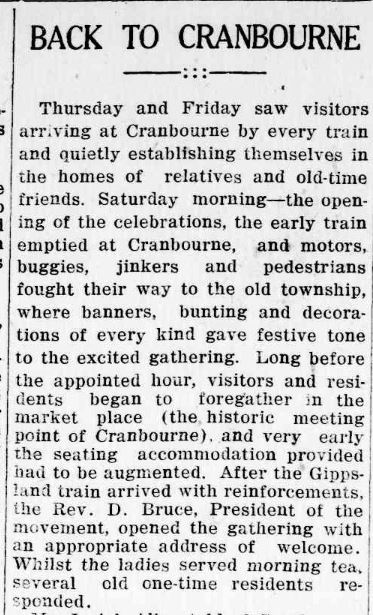
Thursday and Friday saw visitors arriving at Cranbourne by every train and quietly establishing themselves in the homes of relatives and old-time friends. Saturday morning—the opening of the celebrations, the early train emptied at Cranbourne, and motors, buggies, jinkers and pedestrians fought their way to the old township, where banners, bunting and decorations of every kind gave festive tone to the excited gathering. Long before the appointed hour, visitors and residents began to foregather in the market place (the historic meeting point of Cranbourne), and very early the seating accommodation provided had to be augmented. After the Gippsland train arrived with reinforcements, the Rev. D. Bruce, President of the movement, opened the gathering with an appropriate address of welcome. Whilst the ladies served morning tea, several old one-time residents responded.

Mr. Josiah Allen told of Cranbourne as he found it in 1862 after a journey of 14 hours from Melbourne. Angus Cameron traced its development from his infancy. Mr. J. Nelson, told of its ancient glory, and Mr.Frank Facey referred to the great pleasure they all experienced in seeing again the faces of old friends. The Rev. Thomson, one-time Vicar of Cranbourne, also expressed the pleasure he and Mrs. Thomson felt at being present. Mr. R. C. Garlick, secretary, apologised for the absence of Messrs. William Brunt (who was not well enough to attend). H. White, A. L. N. Walter, M.L.A., and many others. In the absence of the Shire President and all the local Councillors, Cr. J. Crabbe, of Devon Meadows, the only Councillor present, spoke, and wished the celebration
every success.

After lunch, a large number proceeded to the old school at Clyde North, where further reunions were enjoyed and school, under the direction of Mr. T. A. Twyford, the respected master of olden days, was conducted. “Tardy scholars” were still in evidence, and punishment duly admnistered. Contrary to the olden school practice, afternoon tea was dispensed, and all returned to Cranbourne happily appreciative of their reception in the old school. In Cranbourne a football match between Well’s-road and Cranbourne provided an exciting entertainment for those who stayed home.

In the evening a concert and social evening was held in (and out of) the Shire Hall. Long before 8 o’clock the building was filled to overflowing, and hundreds had to be content with what they could see and hear through the windows. By way of keeping the anxious throng quiet Mrs. Norman McLeod played old but popular airs, which all joined in singing. The gathering was the largest recorded in the history of Cranbourne.

The Rev. Bruce presided, and the whole programme, with one or two exceptions, was provided by former leaders of song and speech. Two very old-timers, “Mr. and Mrs. Donovan” (afterwards discovered to be Messrs. Paddy and Ernie Einsiedel), were introduced to the audience in due form by the secretary, and their silent comedy “brought the house down.” Miss Faulkiner then steadied the fun with a very fine pianoforte selection of popular airs, and after Mrs. Evans had splendidly rendered the “Floral Dances,” Mr. Josiah Allen, a former well-known identity, gave a short speech reminiscent of 50 years ago. Master Angus Facey, a young scion of the Facey-Bethune clan, then favored the audience with a violin solo. Miss F. Hart gave a recitation, “Make My Coffee Strong.”


Back to Cranbourne, April 18, 1927. 
Left to right - George Binding, ? Cameron, Jim Binding, Harry Bird. 
Seated - Donald McKay. 
Cranbourne Shire Historical Society photo

Mr. Alex. McLellan an ex-Councillor of the Cranbourne Shire, was then in introduced by Mr. Garlick. His Celtic blood was up, and for a short period he kept the house in a whirl, and could the bagpipes have been introduced there would have been nothing lacking His name sounded Scotch, his speech commenced the same, but ended in the wild Irish song, “Tim Flaherty.”

Miss Jessie Cameron, a descendant of the Cameron clan, who invaded these parts in the early 50’s, then sang “Back to Dear Old Cranbourne.” Mrs. Avard (Ada Hunter) sweetly sang Angus McDonald,” and so prepared the way for another “old-timer,” Mr. Angus Cameron, who told of “the good boys” who inhabited Cranbourne 60 years ago, how they “borrowed” fruit from the gardens, chased kangaroos, swam in the lagoons, and altogether established a standard for all succeeding generations of “good boys. ’ He told, too, of the wonderful horsemen of those days—Jim Adams, Will Lyall, and Frank McCraw. Mrs.Sibley sang “Coming Home,” and Mrs. Avard and Miss Inez Hunter sang the duet, “Maying.”

Mr. R. Herkes, another old-time Councillor, said he would like to make a speech, but was afraid someone might “pinch his seat,” and so, imagining that Cranbourne was as bad as ever, was taking no risks. The Rev. and Mrs. Bruce astonished the house by the splendid way in which they rendered the duet, “Keys of Heaven.”

Cr. Wm. Greaves spoke on behalf of the pioneering Greaves family, and Mr. Norman Brunt on behalf of his father (Mr. Wm. Brunt) who for 20 years held a seat in the local Council, and who was to have opened the proceedings, but was too ill to do so. Mrs.Radford, another one-time resident, then favored the audience with a song, “My ’Ain Folk,” accompanied by Mr. Angus Facey on the violin. Mr. Ernie Einsiedel turned the house “upside down and inside out” with a couple of his inimitable comics. Had Mr.Einsiedel taken to the stage in his youth Harry Lauder would not be known. Mr. William Greening, a 66-year old “boy,” told more tales of early Cranbourne, and how he held the ‘gobbler” by the neck and went in swimming.

Finally, with Mrs. Norman McLeod at the piano, and Mr. Evans wielding the baton, the whole audience broke into song, and the “Swannee River,” “Home, Sweet Home,” and “Auld Lang Syne” ended an evening of unalloyed enjoyment, followed by supper.

Sunday morning saw all  the churches full, afternoon the Sunday schools, and in the evening the town assembled in the Shire Hall, where a people’s service was conducted by the Rev. Douglas Bruce, who took as the theme of his discourse the one word, “Home.” All that “Home” meant both on earth and in Heaven, was splendidly expounded.

A united choir filled the stage, and Miss Elsie Bethune at the organ led a large congregation in fervent praise and thanksgiving. The collection was equally divided between the three churches — Church of England, Roman Catholic, and Presbyterian.

The celebrations, which were most successful throughout, concluded on Monday. It was proposed to hold sports and a football match on the recreation reserve, but the crowd was so large that this could not be done. An “old-time” ball was held at night, and the Shire Hall, Parish Hall, State School, and Poole’s motor garage had to be used to accommodate the dancers.