Monday, 31 January 2022

One of a Kind - the Kirth Kiln

By Kate Davis - Casey Cardinia Libraries.

Kurth Kiln Regional Park, just north of Gembrook, is one of the most popular park areas in the region for its impressive array of walking trails, camp sites and picnic areas. The park encompasses 3,500 hectares of land and has close to 50 walking tracks that spread over 100 kilometres (1). The park sits on Wurundjeri Woi Wurrung country.

The history of the park is deeply embedded in Gembrook’ s strong timber history. For many years, the area was home to timber harvesting and milling alongside tin, lead, and gold mining. Saw milling was the lifeblood of Gembrook from the 1880’s to the 1930’s, with over 50 mills running in the area during that time (2). This industry boomed until the Black Friday bushfires of 1939. Read here to find out more about the local timber industry in Gembrook.

The park itself is named after the historic kiln situated at its heart. The name Kurth comes from the creator of the kiln, Dr. Ernest Edgar Kurth. Dr. Kurth had a Doctor of Chemistry from the University of Tasmania (awarded in 1934) and was studying alternative sources of motor fuel, such as shale oil and wood, to help make Australia less dependent on overseas fuel sources (3). This was particularly pertinent at the beginning of World War Two, with petrol rationing introduced in October 1940 and motorists using petrol only allowed to drive 1300 kilometres a year by 1942 (4)

Kurth Kiln site – the kiln itself is the tall brick structure on the left.


Simultaneously, Dr. Kurth had invented a revolutionary new design for a continuous charcoal kiln; wood added at the top, charcoal extracted at the bottom, 24 hours a day, 7 days a week. The charcoal would be cooled for safe extraction by a series of waterpipes. This design was approved by government and a full-scale kiln was commissioned by the Forests Commission of Victoria (5) in 1941 and was built on Tomahawk Creek (6).

This area was selected as the ideal site for the kiln because of its water and timber availability, and the sloping land. The kiln required 9,100 litres of water per day to ensure its cooling systems were effective and used 103 cubic metres of timber per week. The sloping land made it much easier to load the wood into the top of the kiln (7). On March 18, 1942, a trial of the kiln began. During this trial, the Kurth Kiln produced three tons of charcoal every 24 hours, from 21 tons of wood. This process was faster and less-labour intensive than any other methods used at the time and the charcoal created in the kiln was of a consistent quality, free from contamination (8).
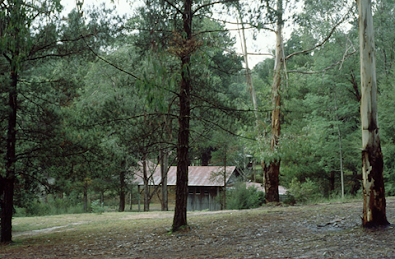
Kurth Kiln site. I believe this image was taken from the right of the structure pictured in the first image. It shows the natural slope of the land.


 1943 brought the easing of petrol rationing, and the Kurth Kiln was shut down (9). The site was unused for the remaining war years. Between the years of 1946 and 1963, the site was then used as a forestry camp for the Forests Commission of Victoria, housing some 80-100 men in ‘masonite’ huts that had been purchased from the army. These huts were approximately 15 feet (4.5 metres) by 12 feet (3.6 metres). Several huts were then lost in a bush fire in 1963, during which the site had become a firefighting base, and others were modified as forestry operations were scaled down (10).

In the 1980’s, the site was developed into a picnic area. At the time, 2 huts were dismantled and the materials used to rebuild one of the existing huts. Today there are only 4 huts left. One of these rebuilt huts was designated as a caretaker’s residence, which was occupied by a Mr. Ron Thornton in 1985. He had been an avid visitor of the site since the early 1980’s, and took up the unofficial caretaker position until his death in 2000. The huts are now only used by students and volunteers performing environmental project work in the park (11)


Kurth Kiln site. This image looks to have been taken from the back of the structure in the first image. Here we can see the wall of the kiln on the right, and what appears to be a well. Water in this well would have been pumped through the pipes in the kiln, to cool the charcoal.

Historical Significance

In 1993, the park was officially named Kurth Kiln Regional Park by the Land Conversation Council (12).

In 2002, Parks Victoria commissioned a heritage action plan for the site and in 2008 the Kurth Kiln and its historic buildings were added to the Victorian Heritage Register; number H2012 (13). The kiln is also included in the Heritage Inventory of archaeological sites maintained by Heritage Victoria; number H8022-0013 (14).

In 2008, a report was commissioned on the historical significance of the site. With its heritage collection of 1300 catalogued objects from the original site, including everything from nuts and bolts to machine tools and larger fittings, it was determined that the sites significance lies in its ‘ability to demonstrate the representative tools machinery and artefacts of the 1940s and 50s as related to both charcoal production and general forestry activities in Victoria’ (15). The author of this report, Gary Vines, remarked that the collection of items at the site ‘demonstrate a way of life that has since disappeared, and reflect on the slower pace and closer community ties of the time and place’ (16).

As the title might suggest, the Kurth Kiln is one of a kind; it was the only kiln of its type erected in Victoria (17). The Kurth Kiln site gives a glimpse into the experience of charcoal refining and forestry work during the mid-to-late 20th century. It also demonstrates a great invention that was a direct result of the experiences of World War Two in Australia. This kiln likely would not have existed had it not been for the fear of fuel shortages. Development of the site also meant it could then be used as a base for forestry works and even firefighting efforts around Gembrook. The survival of this site and its many uses over the years makes the Kurth Kiln heritage area incredibly significant for the history of Gembrook.

The Friends of the Kurth Kiln group was established in 1999 and are the group responsible for the maintenance and running of the park to this day, including the running of the Kurth Kiln Heritage Festival, since 2003 (18).

You can find out more about Kurth Kiln Regional Park from Parks Victoria and find out more about the Kurth Kiln site on the Friends of Kurth Kiln website.

Want to know more about the history of Gembrook? Look at our other blogs posts here!


Footnotes

1- A. Klink, & U. Klink, ‘Walking for Pleasure in Kurth Kiln National Park’, Friends of Kurth Kiln, p. 7; p. 11; p. 9, 2016.

2- Ibid, p. 7.

3- Ibid, p. 99.

4- Friends of Kurth Kiln, ‘Friends of Kurth Kiln – About [webpage]’, Parks Victoria, para. 1, n.d., https://www.friendsofkurthkiln.org.au/about.html

5- A, Klink & U, Klink, p. 99; p. 100.

6- Friends of Kurth Kiln, ‘Friends of Kurth Kiln – Timeline [webpage]’, Parks Victoria, para. 2, n.d., https://www.friendsofkurthkiln.org.au/timeline.html

 7- Friends of Kurth Kiln, ‘Friends of Kurth Kiln – About [webpage]’, para. 2-3.

8- A, Klink & U, Klink, p. 100

9- Friends of Kurth Kiln, ‘Friends of Kurth Kiln – Timeline [webpage]’, para 4.

10- G. Vines, ‘Kurth Kiln Collection – assessment of significance [report]’, Biosis Research Pty Ltd project no. 6473, p. 3, 2008, https://auklanddrive.org/Kurth%20Kiln/Storage/7083%20Kurth%20Kiln%20report.pdf

11- Friends of Kurth Kiln, ‘Friends of Kurth Kiln – Home [webpage]', Parks Victoria, para. 1-2, n.d., https://www.friendsofkurthkiln.org.au/

12- Friends of Kurth Kiln, ‘Friends of Kurth Kiln – Timeline [webpage]’, para 10.

13- A, Klink & U, Klink, p. 100

14- Friends of Kurth Kiln, ‘Friends of Kurth Kiln – About [webpage]’, para. 7.

15- G. Vines, p. 24-25.

16- Ibid, p. 25.

17- Ibid, p. 3.

18- A. Klink & U. Klink, p. 101.


Images (in order of appearance).

Shire of Pakenham, ‘Kurth Kiln Gembrook 3’, 1980s – pre-December 1994, Shire of Pakenham scanned slides, https://cclc.libsvic.ent.sirsidynix.net.au/client/en_AU/search/asset/267145/0

Shire of Pakenham, ‘Kurth Kiln Gembrook 1’, 1980s- pre-December 1994, Shire of Pakenham scanned slides, https://cclc.libsvic.ent.sirsidynix.net.au/client/en_AU/search/asset/267143/0

Shire of Pakenham, ‘Kurth Kiln Gembrook 2’, 1980s – pre-December 1994, Shire of Pakenham scanned slides, https://cclc.libsvic.ent.sirsidynix.net.au/client/en_AU/search/asset/267144/0

 

Monday, 10 January 2022

The Bell still ringing - Church Bell at Harkaway

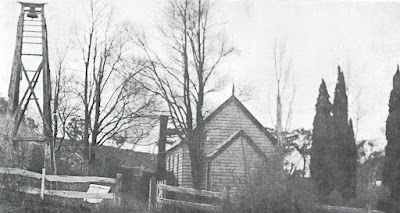
The Lutheran Church of Harkaway is long gone, with the remains of the building finally being dismantled in 1912, (find out more at: http://caseycardinialinkstoourpast.blogspot.com/2016/12/harkaway-lutheran-chuch.html), but the Church Bell still remains. It stands alone in its tower in Hessel Road Harkaway, opposite the Harkaway Cemetery, and it still plays an important part in the local community

“The bell was imported from Germany at a cost of 16 pounds and once erected was christened "Concordia" by Pastor Herlitz. The Lutheran community built the first school and church on the site as the government of the time would not provide either a church or a school…... The bell is still rung each New Year's Eve, and whenever there is a funeral it tolls when the approaching cemetery hearse is sighted, ceasing when the funeral cortege is inside the cemetery.” (Berwick Cemetery Trust - A short history of the Harkaway Cemetery.  https://bhct.net.au/harkaway-cemetery/)

The bell was initially erected near the church building in 1869, with the timbers for the original tower coming from the property of the late Wilhelm Aurisch, a prominent Harkaway land-owner.  The tower was later demolished (long after the church had gone), in 1935 and a new bell tower erected on the same site, with new wood also coming from the Aurisch property.  (Early Days of Berwick and its surrounding districts, compiled by Norman E. Beaumont etc, pages 84-86)


(Early Days of Berwick and its surrounding districts)

Sometime between 1935 and 1993 (date unknown), Hessel Road was realigned on Cemetery Corner, necessitating the move of the Bell tower.  It was moved only a short distance to its current location and additional works have included adding parking spaces adjacent to the reserve in which it now stands.

“The new tower, resembling the original, has a gable protecting the original bell and its brass bearings and timber cross bracing bolted between the main supports.” The plot on which the bell now stands, is surrounded by a hawthorne hedge, with additional Italian cypresses and elms.  It is 0.093 hectares and the land and bell are now managed by the City of Casey( formerly City of Berwick).   (Heritage of the City of Berwick 1993)  

(Heritage of the City of Berwick 1993) 

 The Bell stills ring on New Year’s Eve.  To satisfy our curiosity, developed over many years of hearing the bell ring at midnight, my family and I went to the bell on New Year’s Eve and were delighted to find a small group of 40 people, including local residents and curious visitors.  A small introduction was given, one of the key holders unlocked the bell and just before midnight, some test peals were done.  We counted down to the stroke of midnight and then the bell was rung in earnest.  We all then had the chance to ring the bell, before stopping to sing Auld Lang Syne together and share best wishes. 

 
Play to hear the bell ringing just after midnight 01.01.22
 
It was amazing to revisit that history in person, but also to be part of this ongoing tradition.


Thursday, 23 December 2021

Native Police Corps at Nerre Nerre Worran

 A special post from Casey Cardinia Libraries staff member and local history enthusiast - Kate Davis.

**Aboriginal and Torres Strait Islander people should be aware that this article contains the name of deceased persons. **

Dandenong Police Paddocks Reserve in Endeavour Hills is one of the most important post-contact Indigenous sites in Victoria. It was the original site of the first Native Police Corps in Victoria, which recruited Aboriginal Australians to police the local area, in an effort to integrate the Indigenous population into European settled society.

Drawing of the Native Police Corps, from Public Record Office Victoria.


The concept of a Native Police Corps was first proposed by Captain Alexander Maconochie in 1837, as a tool for assimilation of Indigenous peoples and compensation for use of their land (1). Billibellary Ngurungaeta, an elder of the Wurundjeri-willam peoples, was enlisted by the European settlers to help recruit Indigenous men (2). These men were taught English and military discipline, which the European settlers hoped would be passed on to their families.

The Native Police Corps site was established in October 1837 (3). The site sat along the Dandenong Creek and bordered the lands of the Ngaruk-willam people of the Boon wurrung language group. It is recorded that the site was suggested by ‘some of the 15 Woi wurrung and Boon wurrung men who enlisted initially,’ (4) who knew the area as Nerre Nerre Warren. The Corps was commanded by Christiaan de Villiers at this time. Within 10 weeks though, de Villiers had resigned.

William Thomas, Assistant Aboriginal Protector.
Image from State Library.
 3 years later, the site was given over to the newly-     created Aboriginal Protectorate, as their base for the  Westernport area. The role of the Aboriginal         Protectorate was ‘protection and civilisation’ of   Indigenous peoples; assimilation and destruction of   their culture. The Assistant Protector, William   Thomas, took up residence at the site in October   1840, with the intention of creating an agricultural   station for Indigenous peoples to live and work on.   Thomas was unsuccessful and gave up in 1842 (5).


At the same time, a decision had been made to reform the Corps, this time led by Sir Henry Dana, with

Sir Henry Dana. Image from State Library.

cooperation from Assistant Protector Thomas (6). By 1851, 9 years later, the Corps would consist of 60 men, 45 of whom were Aboriginal, the other 15 European (7).

Records from 1848 show that daily activities included patrolling, locating individuals, checking passes, carrying messages and escorting travellers. It can be assumed that these activities remained largely the same over the entire existence of the Corps. From 1849 onwards, the Corps was commanded to patrol gold reserves in Port Phillip, and during 1850 and 1851, served as guards at Pentridge prison in Coburg (8).

The Indigenous men who joined the Corps did not, as had been hoped by the Europeans, abandon their traditional lifestyles. The Europeans in the Corps proved to be particularly bad influences also, with alcohol abuse being prevalent (9).

Indigenous Significance

The significance of the site for Indigenous peoples extends beyond the Corps though. It was also the death and burial site of Bungelene, an Aboriginal elder from the Gunai/Kurnai areas in Gippsland. He was arrested in 1848 for the alleged kidnapping of a white woman and died in custody on November 21, 1848 (10).

**The story of the alleged kidnapping presented in this article is from records of printed material created by European settlers – it must be acknowledged that these records include no Indigenous recollections. **

According to an article published in The Australian, in 1847 2 white women and 5 white men had been shipwrecked on the coast in Gippsland. Upon reaching land, they had stayed with the ‘Paul Paul’ tribe. A few days in, the ‘Parberry Long’ tribe visited and took one of the women, spearing the white men, the other woman remaining behind. The women who remained behind was killed shortly afterwards. The kidnapped woman was taken by an Indigenous man named Patko, and then was allegedly stolen by Bungelene and taken into the mountains (11).

Excerpt from article written by C. J.  de Villiers (who we can assume is the same Christiaan de Villiers formerly of the Native Police Corps) published in The Australian, paragraph 8.

Some years later, another article re-told of the alleged kidnapping. According to this article, the woman had been perhaps identified as a Miss McPherson. After the initial expedition which lasted 3 months, the government despatched a second party who returned not with the woman, but with Bungelene, leader of the tribe they believed had taken the woman, along with his 2 sons. Bungelene died while in custody at the site of the Native Police Corps. Shortly after, one of his sons escaped to the bush, while the other was removed to an Aboriginal station and raised by European settlers. Bungelene was buried at the site (12).

Excerpt from article published in The Cornwall Chronicle, paragraph 7.

 From these records, we can suppose that the knowledge of these events was never fully understood and as such, the persecution of Bungelene and his sons perhaps lacked evidence. It can also be assumed that Bungelene’s death was due to poor treatment while in custody. Regardless of how these events unfolded, Bungelene was ripped away from his country and culture, as were his 2 sons.

End of the Native Police Corps

In 1853, the Native Police Corps was made redundant due to several factors, most notably the founding of Victoria Police and the death of Sir Henry Dana, their leader. Many of the Corps members went on to employment in the new gold exploration fields.

The site was then utilised by Victoria Police for breeding and training horses for their mounted branch, until July 1931 – hence the name Police Paddocks, and the naming of nearby Stud Road.

Digitised Diary

The Public Record Office has a fantastic resource for those wanting more of an insight into the day-to-day activities of troopers in the Corps; a fully digitised diary from the Native Police Corps lasting from 1845 to 1853. Access it here!


Footnotes

1.1  1. City of Yarra, ‘Native Police,’ The Aboriginal History of Yarra [webpage], 2021, para. 1-2 https://aboriginalhistoryofyarra.com.au/8-native-police/
2. Ibid.
3. Presland, G., ‘Dandenong Police Paddocks Reserve: the most historically significant post-contact Indigenous site in Victoria’, Royal Historical Society History News, Issue 354, June 2021, p. 7, https://www.historyvictoria.org.au/wp-content/uploads/2021/06/digital-RHSV_June_News_2021.pdf
4. Ibid
5. Ibid.
6. Ibid.
7. Public Record Office Victoria, ‘Native Police Corps,’ Public Record Office Victoria [webpage], 2021, para. 4 https://prov.vic.gov.au/archive/VA4759
8. Ibid, para. 2-3
9. City of Yarra, op. cit., para. 3.
10. Presland, G., loc. cit.
11. De Villiers, C. J., 'Country News', The Australian (Sydney, NSW: 1824 - 1848), 2 March 1847, p. 4, http://nla.gov.au/nla.news-article37128202
12. Gordon, A. 'Victoria', The Cornwall Chronicle (Launceston, Tas.: 1835 - 1880), 25 June 1859, p. 5, http://nla.gov.au/nla.news-article65732271

Images

Capt. Dana, De Balk, Eugen Wilhelm Ernst, photographer, 1866, State Library of Victoria, Accession no: H2013.315/1.

William Thomas, Davies & Co., photographer, 1860, State Library of Victoria, Accession no: H2002.87.


Monday, 1 November 2021

Mr Beuhne's Bee Farm at Garfield

The Leader newspaper of September 3, 1893 had an article on bee keeping in Garfield which also gave some interesting insights into the development of the town. The interview was with R. Beuhne. This was Frederick Richard Beuhne, known as Richard.

Richard applied to be naturalised in August 1914 and his application papers tell us that he was born in Germany in January 1859 and arrived in Victoria in September 1880. His occupation was an Apiarist, and he had lived at Garfield for 15 years and then at Tooborac for 19 years. Other sources tell us that he was married to Annie Maxwell and they had a son Claud Ralph born in 1887 and a daughter Hilda Bertha Rhoda, born 1891 (1).

The first mention of Richard that I can find in the Shire of Berwick Rate books was in 1884 where he is listed as owning 226 acres, Crown Allotment 71, Parish of Bunyip. He sold the land around 1896. CA 71 fronted what is now called the Princes Highway and was on the west side of North Garfield Road.


Parish Plan of Bunyip - the township of Garfield on the railway line is bottom, centre. Crown Allotment 71, owned by Frederick Richard Beuhne, is north of the town on the Gippsland Road or Princes Highway.
Click on image to enlarge. 
See the full Parish Plan at the State Library of Victoria http://handle.slv.vic.gov.au/10381/112025

Mr Beuhne died on June 24, 1933 - this is from his obituary - Mr. F. R. Beuhne, secretary of the Victorian Apiarists' Association, which has just finished its annual conference in Melbourne, was found dead in his room at the Victoria Palace, Little Collins street, on Saturday morning. Apparently he had had a heart seizure. Mr. Beuhne, who was aged 70 years, was one of Australia's leading authorities on bees. He had been a member of the Victorian Apiarists' Association for 41 years. His term as secretary began about six years ago, on his retirement from the office of apiculturist to the Department of Agriculture. Mr. Beuhne's first association with the department was as consultant on apiculture. In that capacity he did most valuable work, and when the industry grew to one of importance he was appointed a full-time officer. His two text books on beekeeping and honey flora are much valued by apiarists in Australia and overseas. Mr. Beuhne had been editor of the "Australian Bee Journal'' since its inception. He was the Victorian Apiarists' Association delegate to the Chamber of Agriculture, and was the judge of honey at the Royal Show. He was also a member of the field Naturalists' Club (2).

On June 24, 1949 a Memorial Cain was unveiled by the Victorian Apiarists' Association in honour of Richard Beuhne as a tribute to his work in the bee keeping industry (3).


Plaque on Frederick Richard Beuhne's cairn, near Kilmore.
Photographer: Kent Watson. Source Monument Australia

Richard's brother Karl Richard Beuhne also lived at Garfield. He was born in Germany in 1855 and had arrived in Australia in 1890 and was naturalised in 1926 at the age of 71. He and his wife Maria Theresa Josefa (nee Borroman or Borrmann) had four children, all born in North Garfield - Alfa Toni (1892-1899), Friedrich Hans (1896), Otto Kurt (1898) and Rosie Dora (1905). I can't find Karl listed in the Rate books, but he was still in the area when he died on October 30, 1938 at the West Gippsland Hospital in Warragul (4).


Report of Karl Beuhne's death, he was Richard's brother.


BEE FARMING AT GARFIELD
BY OUR AGRICULTURAL REPORTER
The Leader September 2, 1893 (see here)

The little wayside hamlet of Garfield is one of those places which has sprung into existence since the main trunk railway line to Gippsland was built. It is distant 40 miles from Melbourne and overlooks the Kooweerup Swamp, that extensive tract of reed beds and morass which is now being reclaimed by the State. The township of Garfield is still in the embryo stage, and as yet gives no promise of future greatness. Most of the land hereabouts was selected 10 or 12 years ago, and a farming population settled on it, who proceeded to turn it to profitable account in the usual way by ringing, clearing, cultivating and stock keeping.

The advancement of the district has certainly not been assisted by the operations of the land syndicates, who during the "boom" purchased from the original selectors several thousand acres of land with a frontage to the railway line and in the vicinity of the railway station. This land is now lying idle and absolutely unproductive, while the owners are still holding on in the hope of settlement being attracted some day, thus giving them a chance to dispose of it at something approaching the prices paid for it to the original settlers. As the land was bought at prices varying from £18 to £25 per acres, this hope is not likely to be realised for some time to come. 

The soil for the most part cannot be called rich, except narrow strips in some of the with a growth of heath and coarse sedgy grasses. The timber is not of good character, and its principal use hitherto has been for firewood, of which large quantities used to be sent to Melbourne; but since the unemployed have been engaged at the work of wood cutting most of the residents of the district have found out that it does not pay to enter into competition with them, consequently sending firewood to Melbourne from Garfield has been practically abandoned.
  

Richard Beuhne's farm. 
The Leader, December 9, 1893 - see Footnote 5

The main Gippsland road runs through the district and the principal stream is the Cannibal Creek, a tributary of the Bunyip River. Several of the farms some distance back from the station are fairly well improved, and in a couple of instances beekeeping engages a good deal of attention. Nowadays, when so many people are anxious to get on to the land and engage in some occupation that will prove profitable, beekeeping is an industry which should receive more attention than has hitherto been given it.

It must, however, be admitted that only comparatively few persons are fitted by nature for the occupation, but amongst those who have made it a success is Mr. R. Beuhne, whose farm is situated about 1½ mile from the Garfield station and on the Gippsland-road. Mr. Beuhne selected land here about 11 years ago, and is now the holder of 220 acres. About 30 acres have been thoroughly cleared, a comfortable house erected, an orchard established and other improvements, carried out, but attention is mainly devoted to beekeeping. This is generally considered one of the small things of a farm, but Mr. Beuhne has found it profitable enough to justify him in almost exclusively depending on it; indeed, he is of opinion that if carried on on anything like an extensive scale it does not go well with any industry except poultry keeping, as during the busy season all other work must be neglected in order to attend to the bees.


Richard Bruhne offers lessons in bee keeping.

From a small beginning Mr. Beuhne gradually increased the number of his colonies until now he has 136 to control, and the many duties connected with them keeps him fully employed. Indeed, the work in connection with so many hives, when pursued scientifically, is almost endless, but at the same time it is light and highly interesting to any one who really cares for the occupation. If the beekeeper is not really interested in the pursuit and does not follow it for love of the work he will never make it a success, and it is better to direct his attention to some other business. If, on the other hand, attention to all the details of the industry is a pleasure, beekeeping becomes a profitable undertaking in any district that is adapted for the pursuit. 

Some localities are much better adapted for beekeeping than others on account of the climate, the greater profusion of honey producing trees, shrubs and flowers. The Garfield district is not specially suitable, the varieties of eucalypts with which it is timbered being principally those known as stringy bark and peppermint, whereas the box and white gum blossoms secrete most honey, while the flavor of the article is also superior. In the gullies and swampy places also a good deal of ti-tree grows, from the blossoms of which honey of a peculiar character is obtained. It possesses a distinct flavor of its own, and, strange to say, cannot be extracted from the comb by the centrifugal extractor. The closeness with which it adheres to the sides of the cells seems to indicate that it partakes somewhat of the character of gum, though persons who are in the habit of using it declare that they prefer it to any other kind of honey. The taste for it, however, requires to be educated, and its general popularity is never likely to rival that of honey obtained from box or white gum blossom. On account of its non-extracting peculiarity small section frames have to be used in the hives during the period, when the ti-tree is in bloom, while at other times, the ordinary large frames are placed in the boxes.


Richard Beuhne working with his bees.
The Leader, December 9, 1893 - see Footnote 5

Mr. Beuhne uses hives of the Langstroth principle, but the boxes are two inches shorter than the regulation size. He has made them all himself, being an amateur carpenter of no mean skill, and most of the appliances used in their manufacture have also been supplied by his ingenuity. A small circular saw, made out of a piece of a broken hand saw, has been set in a neat frame and worked by a treadle. With this the laths used in the frames of the hives are quickly sawn, and an appliance for boring holes, also worked by foot power, has been provided. Each hive is made exactly the same size so that the parts are interchangeable and he is thus able to work amongst the bees with that confidence which is absolutely necessary if success id to achieved in dealing with these remarkable insects.

In dealing with his bees, Mr. Beuhne is general follows out the practice adopted by the majority of skilled apiarians in attending to the thousand and one particulars involved in beekeeping, and which could not be fully described in anything short of the limits of a book; but he is also experimenting, and there is a possibility of his experiments proving successful, and having an important bearing upon the future of the industry. For instance, he thinks there is a possibility of breeding out the swarming impulse, which causes so much trouble during the season. He points out that it is just as natural for hens to sit as for bees to swarm, yet the desire to hatch has been almost entirely overcome, by breeders in connection with certain breeds of fowls. 

Of course bees are more difficult to control, but by selection and management much may be done. He would select queens, from stock that experience had shown displayed comparatively, little disposition to swarm, and by mating her very late in the season a beginning leading to the desired end would be made. In order to secure the fertilisation, advantage would be taken of a favorable day when the drone bees were likely to fly, and by giving them a little stimulating feed liberating the queen shortly afterwards the desired end would be accomplished.

A careful attention to the laws of selection having the definite object in view of producing non-swarming bees, and following out the lines indicated, would he thinks, eventually result in the apiarian being able to control the impulse as the progeny of queens fertilised late in the season evince less disposition to swarm than those mated early. Mr. Beuhne has at various times grown patches of buck wheat as pasture for the bees, but, as a rule, the insects have to depend for stores on what nature provides. Wattles and acacias, as well as different kinds of heaths, blossom well in the district, but, unfortunately, the flowering season is too early to be of much benefit to the bees, and the blossoms in most instances have disappeared by the time they are most wanted. Just at present the prickly mimosa and pink and white heaths are in full bloom, but the bees are not to be tempted out during the present unsettled weather, and consequently the stores of honey which the flowers contain cannot be utilised.

Mr. Beuhne is now engaged in the endeavor to solve the problem of how to prevent the crystallisation of honey during the winter months. It is well known that the best and purest honey crystallises in cold weather, and this has a prejudicial effect upon its sale, more particularly if it has been put up in glass jars. It frequently happens that the crystallisation is only partial, and while one portion of the contents of a jar assumes the consistency of lard, the remainder is liquid. This causes many persons to think that the honey has been adulterated, and accordingly they decline to buy. The honey does not deteriorate in quality by becoming crystallised; indeed, not a few who know the difference consider that it is improved thereby; but its sale to the general public is undoubtedly affected, hence the necessity for preventing crystallisation if possible. Mr. Beuhne, by a process which he has invented, but which is yet a secret, believes that he can not only prevent any honey from crystallising, but can also treat that which has already become crystallised in such a way that it will ever afterwards remain liquid. If the process, after being thoroughly tested, is the success which he claims, it will have the effect of increasing the local sales of honey, and will be of immense importance if an export trade is established on anything like an extensive scale, as no doubt it will be some day. A press which he has constructed for obtaining wax is very simple and useful, and with it he can obtain just as good wax from old black combs as from now unstained comb.


Richard Beuhne working with his bees.
The Leader, December 9, 1893 - see Footnote 5

 With regard to the profits to be derived from beekeeping, it must be remembered that this district is not a good one for bees, consequently results obtained here are likely to be greatly exceeded in other and more suitable localities. Last year, which was a bad one, Mr. Beuhne obtained only an average of 30 lb. of honey from each hive; the previous season he obtained over 50 lb., and his best record was 80 lb per hive. There is certainly nothing startling in these returns, but, taking one year with another, say 60 lb. of honey, worth at least 4½d. per lb., can be got from each hive, and this is certainly not an excessive estimate, then the gross return per hive amounts to £1.

Mr. Beuhne would advise all who think of going in for bee culture to begin on a small scale and gradually work up. Although much information may be gleaned from books, practical experience must be gained, and this will be less costly when pursued in connection with a few hives than when the care of a large number is attempted by one who has had no previous knowledge of the business. If possibly an opportunity should be sought of getting employment with a practical aparian for at least 12 months, and thus gain the benefit of his experience. Even after such an opportunity to gain knowledge it is necessary to make haste slowly, as there is always something to learn or some unexpected difficulty to overcome. Perseverance, however, will eventually be crowned with success, and the industry offers a means of making a fair livelihood to those who have a taste for beekeeping; and if this industry is combined with poultry farming, the owner of a small block of land ought to make not only a good living, but to ultimately realise a handsome competence.

Trove list
I have created a short list of newspaper articles connected to Frederick Richard Beuhne, his time at Garfield and his other activities. Access it here

Footnotes
(1) Naturalisation papers at the National Archives of Australia www.naa.gov.au Family information from Indexes to the Victorian Births, Deaths and Marriages.
(2) The Argus, June 26 1933, see here.
(3) Read the full report of the unveiling in the Kilmore Free Press, June 30 1949, see here.
(4) Naturalisation papers at the National Archives of Australia www.naa.gov.au Family information from Indexes to the Victorian Births, Deaths and Marriages.
(5) The illustrations are from The Leader December 9, 1893, see here. The newspaper incorrectly stated that these illustrations were of Mr M'Farlane's farm at Lyndhurst. There was a correction in The Leader of December 16, 1893, see here In last week's Leader a full page illustration of "Bee Farming," the central picture in which is a representation of Mr. Beuhne's apiary, was inadvertently described as Mr. M'Farlane's. The mistake occurred through our reporter having visited both the apiaries named, and his description of Mr. M'Farlane'a place at Lyndhurst was attached in error to the drawings taken by our artist on the establishment of Mr. Beuhne, at Garfield, about 40 miles from Melbourne, on the Gippsland railway.
