Monday, 13 May 2019

'Around Beaconsfield' by The Vagabond

On November 28, 1885 The Argus published an article by the journalist, The Vagabond, on his trip 'Around Beaconsfield' You can read it here, on Trove, but it is also transcribed, below. I have also added some footnotes about people and buildings mentioned in the text.  It is an interesting look at Beaconsfield, Upper Beaconsfield and Berwick from 130 years ago. The Vagabond was John Stanley James (1843 - 1896) and after a mixed career in England and America he arrived in Melbourne in 1876 and commenced writing in The Argus, under the name of The Vagabond. His first article was A night in the model Lodging House, published April 15, 1876. You can read it here. In 1877,  a collection of his works was published in a book The Vagabond Papers: Sketches of Melbourne Life, in Light & Shade. You can read James' entry in the Australian Dictionary of Biography, here.

There has been more recent research into his life by Michael Cannon and Monash University Press republished his works with additional chapters (click here for link to our Library catalogue) Additional research has revealed that The Vagabond was more than likely, the father of J.B. Cooper, the author of the The history of Prahran and the History of St Kilda, amongst other works. This family research was undertaken by Julianne Spring, the great grand-daughter of J.B. Cooper. You can read more on this, here. There is a local connection between J.B. Cooper and this area - you can read about it, here.

PICTURESQUE VICTORIA.
BY "THE VAGABOND."
AROUND BEACONSFIELD.

Bound to Gipps Land, my first halt in search of the picturesque is at Beaconsfield, 28 miles out from Melbourne. One of the pleasantest of " saunterings by rail " will be found in the journey thither. The much needed Victorian Railways Tourists' Guide more particularly describes this. Past Caulfield it is as far as the line is concerned quite new ground to me. But I have some souvenirs of travels hither by road. We pass the cottage where nine years ago I spent some pleasant days and nights. I think of the mud baths my learned and athletic host delighted in, and the hard work he did in the garden before, having " worked off the steam," he sat down, quietest of men, at the breakfast table. I was solicited to join in the morning's amusement, but with my witty friend and fellow guest stood out. We left the trial to one of Victoria's gilded youth who, in his after career exploring in Queensland and Western Australia never had such a rough time as in the quick run across country from the mud hole. This form of exercise would be impossible now. Cottages and farms and market gardens are dotted over what was then wild heath and primitive paddock.

At Dandenong again come memories of a halcyon day spent in a ride from thence in goodly company to Sassafras Gully, the most charming experience I have had in Australia. As my first trip into the bush it remains fixed m my memory. But the drive back to Melbourne was spoilt by the dust. As a means of getting into the country I find that the rail is for preferable. This Gipps Land line has thus been taken advantage of by many townspeople and at all the stations within easy distance well known Melbourne citizens are seen to alight. They have left the strife and cares of business to seek their nightly or weekly rest in pleasant rural homes.

Dandenong and the neighborhood deserve special notice in the annals of "Picturesque Victoria." But that will be given in the account of the " beauty spots " immediately surrounding Melbourne, which I hope some day to write. In the meantime I acknowledge the kind invitations I have received from residents of this district. Near Berwick, the neighbourhood of the railway line, is especially lovely. Green fertile slopes and hedges blossoming with the white hawthorn of English May give a "home" touch to the landscape. At Beaconsfield station quite a goodly company leaves the cars. We find a collection of wheeled vehicles to drive us to our destination, for this is not Beaconsfield itself, although there is a pleasant cottage by the side of the line, and a charming little country hotel where
travellers can sojourn and be well treated by Mrs Gissing (1) The Beaconsfield Hotel (2) waggonette is filled with visitors, and the Professor takes charge of me, and drawn by the good horse "Punch," and with the black retriever "Soudan" barking ahead giving notice to all whom it may concern that they had better clear the track, we drive due northwards from the main Gipps Land road. The track is a good one, winding after a time up the steep hillsides, not too steep, however, for comfortable driving.


This is the charming little country hotel at Beaconsfield, referred to by The Vagabond. Photo from the early 1900s. 

At every turn in the road one gets glimpses of the landscape below. The picturesque wooded gullies remind me of the ranges between Nar-be-thong and Marysville. As we ascend the air gets lighter and purer. One feels a sense of mental expansion, and also of physical hunger. Five miles from the railway line we come on a small settlement, then turning eastward I shortly receive my first welcome to Beaconsfield, an English welcome to be remembered, at the house of Professor Halford (3) A little further on is the Beaconsfield House (4)  or as it is commonly called here " the Big House " Here, two hours and a half after leaving Melbourne we sit down 1,200ft above sea level, and five miles from a railway station, to as good and acquire a meal as the most exigeant, of holiday makers need desire. And whilst Mrs. Somner (5) tells tales of her travels and experiences at Port Darwin, two Englishmen, old schoolfellows, who meet here swap yarns of their youth, and two others, mates in Adelaide in 1849, exchange records, and I am more than ever convinced that this is a very small world indeed.

The physical man satisfied, we seek the open air. Monsieur and Madame, who, I hope, thoroughly enjoy their visit here, sit in the rose-embroidered verandah; others lounge on the garden seats or the sloping lawn. The daughter of the house is playing dreamy music in the parlour. A sense of blissful content steals over one. We are here, away from all the noise and struggle of man, on the highest point of the spur, above all other habitations, above everything which could interfere with our content. We have left our cares in the city. The Professor forgets his pupils, the architect his specifications, the accountant his balances, the veteran his double on the Derby and Cup, the business man his profits. I for a moment forget my editor and his demand for "copy." Our young couple forget everything except each other. Far below us there are twinkling lights of residences, to the south-west a bright flash shows Queenscliff, a will-o'-the wisp, as it seems, denotes the presence of some vessel in Western Port. Then the moon rises, and costs great shadows from the ranges and down the gullies. The distant plain is bathed in soft rays.
' The earth, and every common sight
To me did seem
Apparelled In celestial light
The glory and the freshness of a dream."

The scent of roses perfumes the air. I feel that I could lie here and dream for ever, that I could easily lose all sense of my own poor personality, that I could fancy myself Endymion resting on the classic Mount, waited on by the invisible nymphs of Diana. Is that the rustle of their wings ? Jove ! it is a mosquito which reminds me that I am still of the earth earthy, and that it is not good for old men to lie long at nights on the cold ground. Also I wish to see the sun rise, so with a night cup I retire to bed to rest in the best room I have occupied in any holiday place in Victoria, 'twixt sheets which smell of lavender and rosemary and cause me to dream of boyish days in merry country homes in England.

This is the view The Vagabond would have seen during his time at Upper Beaconsfield.
Outlook over Westernport, Upper Beaconsfield.
 Photographer: Rose Stereograph Co. 
State Library of Victoria Image H32492/2113


Mr Alfred Smith (6) and Mr Somner (5) get me out of bed, according to contract shortly after 4 a.m. The first grey dawn of the morning is stealing over the ranges. There is a subtle scent of fresh earth and of flowers from the garden. Soon in the east, flashing to the north and the south, are rosy rays, then the hills are tipped by a golden light,whilst the valley below is yet steeped in shadow and mist. Then with a bound old Sol rises once more and sets at work another day of Nature. The shadows disappear, the mists roll from the gullies and the plain, and we have a full view of nearly 360 degrees all around the horizon. The last time I saw the sun rise was from a coach driving across barren downs in Western Queensland. Very different here. I place this with my experiences of early morn in midwinter on the Alps as the most charming of the sort I have known in Australia. I do not know where one can get a more extended view than from the Big House. To the south are the level plains of Mornington county, dotted with many fertile fields and large and small homesteads. Townships too, as at Cranbourne and Frankston and Hastings. Woodland patches here and there and a dark fringe of scrub around the great Koo-wee-rup Swamp, 78 miles in extent. Farther ahead the inner waters of Western Port Bay, flecked by the white sails of a yacht. French Island and Phillip Island border the horizon in that direction. More to the west Port Phillip Bay gleams in the sunlike ocean itself. Faint smoke from seagoing steamers floats over its bosom. The You Yangs are a dim line beyond whilst Mounts Eliza and Martha and Arthur's Seat are plainly visible. In another direction is the Bass Range, and the level country towards Gipps Land, watered by many streams. To the north the Dandenong Ranges and the Harkaway Ranges are fringed with the State Forest. Standing sentinel at the end of this chain is Mount Baw Baw, and due northwards from us is Mount Juliet, which I last saw from Healesville.

One has a view here which takes in every adjunct in a landscape-mountain, plain, valley, woodland, stream, and sea. It is the most perfectly beautiful summer resort I know of in Australia. The most extraordinary thing is that till the other day I, like thousands of Melbourne people, was totally unaware that there was such a place as Beaconsfield where one can enjoy a charming villiegatura within easy distance of town, getting The Argus and one's letters at half past 9 a.m. , and with a telegraph office at the hotel by which you can wire to your wife or your chief that you have missed the morning train. These ranges are, in fact, almost a terra incognita to the rest of Victoria. They were first explored by the wandering prospector, who the historian of our goldfields points out, is one of the most useful members of Australian society:-
"His position is humble, he is despised for his nomadic restless habits, and jeered at for his devotion to the search for a will-o'-the wisp. But when it is considered how much the colonies owe to the gold discoveries the prospector may be said to have done to Australia is important services as any other class of men. With his pick and shovel over his shoulder, his blanket slung behind his back, and his billy and quart pot hanging by his side, he tramps over the most rangy and inaccessible regions of the colonies, sometimes digging in the lonely gullies, sometimes working on the sheep stations at shearing time, and nearly always as poor as a wandering Arab"

Leaving the Gipps Land road at Berwick the wandering prospector toiled through the scrub  northwards to the ranges, and struck gold at Emerald on the slopes of the Dandenongs. There was a small rush thither. Afterwards tin was discovered on Sir William Wallace Creek, and so the country became opened by packhorse roads. But gold and tin gave out. A few selectors came, and took up the good land near the Zoological Society's reserve at Gembrook but the discoverer of picturesque Beaconsfield was Mr Snell (7) draper, of Collingwood, who in 1875 took up the very pick of the district, 320 acres, on the height at the end of the spur, and built a four roomed cottage there, which has now blossomed into the "Big House. " Mr Snell however, shared the fate of most pioneers, in that he did not profit by his foresight. He sold out to Mr. W. Brisbane (4) in 1877, who claims to be the father of the district. The house was added to, and a " Sanitarium" on temperance principles started here, Mr Brisbane, like myself, being a believer in the virtues of cold water ; only I use most of mine in my bath. People came and were entranced with the view and the combined mountain and sea air.

Professor Halford was one of the first to recognise the salubrity of the situation and early erected a house here. Many Melbourne residents followed, and took up 320 acres or 20-acre blocks, and now Beaconsfield has a summer society of professors, lawyers, doctors and well-to-do business men, some of whom leave their families here all the year round. There are 100 good private houses within a circle of two miles, two stores, state school, an excellent public hall built by subscription and used for religious services, balls, and other social entertainments. A Ladies' College is being built and, I should imagine, would be a great success and local industries are represented by timber getters, carpenters, and a brickfield. The only thing which annoys me here is that I did not secure 20 acres of land to build me a retreat for my old age. But I am thankful for the Big House, the best kept and nicest holiday hostelry I know of. There may be a bar here, but if so it is located in some out of the way corner. In this respect everything is so different to the ordinary bush pub and many town resorts. In the garden there is a wealth of flowers, as well as of strawberries, and gooseberries, and asparagus and bushes of lavender and rosemary. Then there is a menagerie in the shape of a pet wallaby, a caged eagle and half a dozen magpies. There is a fernery, and Californian sequoias and pines surround the lawn tennis ground, and altogether there is everything to satisfy one here. I would be quite content to lie on the lawn and look at the sheen on the far away waters and the blue haze over the distant hills, and talk to the telegraph clerk.

It is a blazing sultry hot-wind day in the city, yet here, though warm, it is still pleasant, especially so on the lawn. But Beaconsfield having got me here will not let me rest. A committee of citizens takes me in hand, and in two days drives me around the country to the show places and picturesque points. Very lovely drives are these there are fresh points of beauty everywhere. The bush itself is far more luxuriant than the scrub on the flats. There are many graceful wild cherry trees here. Pines which have been planted on some selections flourish well. One finds here most beautiful specimens of the Australian heath, the epacris. There is the native currant in flower, side by side with the sensitive, "the fly eating " plant. This, which bears a pink flower, is a harmless looking weed : but its thin stem is tough and strong, and will hold a great weight. Flies and spiders resting on its leaves are enclosed in a deadly grasp , their life is sucked from them to nourish the plant. In California, before I ever thought of coming to the colonies, I had a long talk with Mr Harry Edwards, well known, I believe in Melbourne, on the flesh eating plant of California. He, although a good botanist, as well as an old Victorian, never claimed that we possessed this curiosity. But the wild flowers on these Beaconsfield hills are found in the greatest profusion. There are violets, flowers "which stand first with most but always with a lover." New chums, perhaps are not aware that we have many kinds of violets in Australia, some scentless, some with a perfume.In Southern Queensland one can lay ones handkerchief over a bed containing hundreds of these. Here I find as many different kinds of wild flowers as there are in England. We twine them round our hats like lads going a Maying. There is a variety of colour in all. Many a specimen of pink and crimson orchids. Very profuse is a brown golden flower like a broom - the Planta genista, worn by my Norman ancestors. I do not think it is a real broom, but I am just as happy with these flowers as it I knew the name of every one like the Baron (8) or Mr. Guilfoyle (9)

Nature worship is firmly planted in all of English blood, wrote The Vagabond. I am sure he was impressed by the wonderful fern gullies around Upper Beaconsfield.
Fern Gully at Upper Beaconsfield
Photographer: Rose Stereograph Co. 
State Library of Victoria Image H32492/2107

Nature worship is firmly planted in all of English blood. Our early poets are full of it.We may not be aesthetic, but in English country life there is a good healthy love for woodland and meadow, and stream and copse,  for wild flowers and birds and beasts. I was brought up in this cult, and to day in these surroundings my youth comes back. All nature sings a song of gladness. The aroma from the gum trees is as healthy as from the pines in Californian or Columbian forests. The Professor explains to me that the sea breeze at this altitude acts on the gum forests and turns oxygen, a very good thing in itself, into the finest quality of ozone, of which you cannot imbibe too much. You are, in consequence always ready for the next meal or drink, here. How the locusts chirp as we drive between sloping hills, past fern tree gullies by the depths of the stream, to Hughenden. where Mr J A Kitchen (10)  has built himself a fine brick house and cleared a quantity of land at the expense of about £30 an acre.

Rhododendron and ivy give beauty in the garden; there is a lovely shade of green on the sloping hillsides between which a peep of the flat plain and Western Port Bay is framed. It is for all the world like a bit of North Wales, like that home in the Eryri Mountams where two young Australian ladies of my acquaintance once lived, and to the British and American tourists passed as daughters of the land, artlessly replying, "Dim Sassenach!" to all questions. Two such refined pretty girls," said my informant," but could not speak a word of English. A nice house, too, Plas Coch. I cannot understand how they can bring children up here in such ignorance. I suppose you and Henry Stanley could not speak English till you went to America." "I'm not Welsh my friend, " I replied, " and you have been sold. The young ladies of Plas Coch were born in Melbourne.

Mr Kitchen has solved the capabilities of the soil here. He has 80 acres planted with apple trees, 20 with stone fruit, 10 with gooseberries. Nothing but a large expendíture of capital could have so changed the face of nature, for the country for some miles northwards from the railway towards the Ranges is really only adapted for residences. And very pleasant residences are dotted up and down the slopes. Now, in fault of not possessing the Big House, I would prefer Professor Halford's bungalow, and after that "The Hut," belonging to Messrs Smith and Johnson (5), where the green sward in front, and the honeysuckle embowered verandah, tempt me to linger. The next best view is, perhaps, from Mr Elms' (11) but from every site there is a grand panorama. Mr Walford (12) is known as possessing a capital spring of freshwater I shall always remember with the greatest of pleasure the kind reception given me by the ladies of Beaconsfield, and especially at Miss Moon's (13) poultry farm, the Steyne, name which recalls memories of Brighton. Up and down hill you drive past Mr Bullens (14)  towards Mr A Beckett's. (15)  The new cottage is on the left of the road. There is an older residence with a few acres of ground opposite it for sale. I wish I could purchase this. At the Steyne white Hamburgs, Polands, game, and other pure bred domestic fowls have a good time of it. Corralled in small yards they have shelter sheds from the sun, cool water, dust baths, and everything a fowl could desire. The only want they cannot satisfy is to sit. The incubator does that for most of them. It is a luxury reserved only for a few favourite fowls. This establishment is evidently conducted on first class business principles. The motto Mens sana in corpore sono is illustrated by the fact that here a lady who for some years has devoted herself to successfully cultivating the muscle of female young Victoria has a home in which there are the most charming traces of artistic culture. I should like to buy Miss Moon out, and devote my energies to chicken raising.


Holm Park owned by Mrs Armytage, described by The Vagabond as a 'champion showplace'
Holm Park, Beaconsfield, c. 1957.
Photographer: Colin Caldwell
State Library of Victoria Image  H84.276/7/23A

The champion show place around Beaconsfield is Holm Park, (16) the property of Mrs Armitage (16) This is about two miles from the railway line, and a mile from the road, the approach being by a private drive bordered with pines and English trees. On a high knoll with a broad view below Holm Park is certainly a place to be coveted, a charming adjunct to Toorak and Mount Sturgeon station. Another show place, which interests me even more, is the state school. This is far inland from the junction or cross roads near the Assembly hall, and where the new store and Mr Goff's (17) house are situated.

Past the Pinegrove Hotel (18) we descend into a hollow very like that of Nar-be-thong. Here we find Miss Russell presiding over 18 children, only six of whom are girls. When I was in Kara Kara the other day I found the proportion of the sexes quite the other way. A large number of children here are of German parentage, selectors who have taken up land towards Gembrook. At this Beaconsfield state school I am particularly pleased with the rules of the playground code of honour which are hung on the wall. These, signed by a committee of the scholars, set forth that at all games, " truth, gentleness and good temper must prevail; defaulters will be expelled from all games for the day." The like punishment will fall on " anyone calling names." This, I expect, is rough on the girls unless liberally interpreted. In selecting sides at cricket " choice of ' first pick' will be decided by throwing at a mark." I have visited many state schools in the colonies, and have seen nothing so sensible as this code of honour instituted by Miss Russell (19) It ought to be generally adopted by the department. Also, I think, this school should be a little nearer to the centre of population at the junction.

On our return we halt at the pleasant Pinegrove Hotel, a great stopping place, kept by a worthy German settler (18).  Here some new chums, sawyers and splitters, have made the occasion of my visit an excuse to knock off work and imbibe colonial beer. These are men from the midland counties, who came out as immigrants to Rockhampton, but soon took the chance of migrating south. They are pleased that I know "the old smoke" of the Black Country. I am pleased to meet a hardy pioneer, one of the first selectors in the Gembrook district. He is ploughing a paddock close by with a team of oxen and to gratify him I take the handles for a few minutes and strike a fairly straight furrow. The farmer gives me his views of the necessity of a light railway or tramway from the main Gipps Land line to Gembrook. It appears that this was included in Mr Bent's bill (20) and partly on the strength of that land was purchased and residences erected. A light line could be easily made, the gradient not exceeding 1 in 40, and only that at one or two places. I have just come from railway journeying in Queensland over grades 1 in 33 and 1 in 25 ! Not only are there the number of private residences on Beaconsfield heights causing traffic which would make a tramway pay, not only would it open out a new locality to pleasure and health seekers bringing Beaconsfield within an hour and a half of the city, but, above all, and this seems to me a special reason, there is a rich and valuable country at and around Gembrook, on which at the present moment small farmers are struggling for a living, owing to their distance from market.

The land at Gembook is far richer than at Beaconsfield. Much clearing has been done, and a vast amount of labour expended in converting dense bush into good grazing or agricultural land. Mr Crichton (21) has the largest place and the best improved. Dr Bromby (22),  and Messrs Alexander (23), Sharples (24), Godfrey (25), Le Souef (26), Whitfield (27), Tyler (28), Ford (29), and Nash (30) Captain Page (31)  and Mr McMahon (ex mayor of Fitzroy) (32) have properties here. Mr Curtois (33), Government engineer, who surveyed the route of the proposed line, reporting on its practicability, also adds - "The land is really good at and beyond Gembrook, where the general appearance of the country is very similar to Mirboo and neighbourhood, but owing to the cost of transit very little cultivation is carried on and that only tor local use. Mirboo, I believe, is one of the richest districts in Gipps Land , and so I hope Gembrook will soon get its railway. Our engineering authorites will here have a chance of inaugurating a series of light and inexpensive lines as feeders to the main railways.

Good bye to Beaconsfield. I leave with regret, and hope to come here again. It is not my own will which carries me back to Melbourne, but duties connected with the Cup Carnival. I would much prefer to linger on the lawn at the Big House to mixing with the throng on the lawn at Flemington. I carry away with me the pleasantest of souvenirs of a real good health giving time and kindly attention from the residents Even the splitters offer me 7s a day if I like to stop here with the proviso however that I find my own axe.

We return by the night train from Berwick, Mr Elms escorting me thither. We have lost our bugler, and the drive is a quiet one. Berwick is on the main Gipps Land road, on the banks of the Kardinia Creek. It lies in a hollow, green hills sloping down to the township, the fertile paddock of Mr. Buchanan (34) and Mr. Gibbs (35) being prominent features. A very pretty township this, the elms and poplars in the streets giving it an English look. Quite a live place too, centre of a dairy farming. district which helps to supply the metropolis. Berwick owns two churches, the Presbyterian a new and fine building, two banks, a state school and mechanics institute. Bain's Hotel (36)  however is the principal institution which concerns the passing traveller. This is the "Border House," sign of the time when all beyond was the unknown district of Gipps Land. Here we take our evening meal, and I feast on the best of strawberries and the thickest of cream, and stroll, talking theology with the Presbyterian pastor, in a walled-in garden rich in flowers and fruit. Everything here is thoroughly home-like. Peace and prosperity reign together.

The last train from town brings its contingent of citizens, and amongst them a worthy Collingwood blacksmith who has a nice country residence here. Then a "crack" with the landlord on geology, a drive to the station and a meeting with an esteemed correspondent. I find in the cars a fellow passenger in Mr Fairbairn, whom I last met on the Peak Downs. We agree that this is considerably better than Northern Queensland, although he certainly has the pick of his district there. Also, I agree with Mr Fairbairn that our railways have been made on far too expensive a system. Queensland could give us a lesson in that," says he: "we want a man like Mr Ballard (37) to teach Victorians how to make light and cheap railways, and so open up places like Beaconsfield. " So mote it be !

Foot Notes:
(1) Mrs Gissing was born Maria Brooks, married to George Gissing. You can read more about the Gissings on  Marianne Rocke's excellent and extensive website, Residents of Upper Beaconsfield https://www.upperbeaconsfieldhistory.au/index.htm. George's entry is here and Maria's entry is here.
(2) The Hotel at Beaconsfield was called the Gippsland Hotel, established by Janet Bowman in 1855. It is now known as the Central Hotel. Read more about  it, here.
(3) Professor Halford - George Britton Halford (1824 - 1910)  Residents of Upper Beaconsfield 
(4) Beaconsfield House was built by William Brisbane (1842 - 1910) in 1877, on the highest point in the town on what was to become St Georges Parade and Salisbury Road. Most of the building was destroyed by fire on the night of May 30, 1893. Sadly, we do not have  a photo of the building. This information is from Upper Beaconsfield: an early history by Charles W. Wilson.  More information on William Brisbane can be found Residents of Upper Beaconsfield  
(5) Mrs and Mrs Somner  - Arthur Hay and Grace (nee Foreman) Somner operated Beaconsfield House Residents of Upper Beaconsfield - Arthur's entry is here and Grace's is here.
(6) Alfred Smith - Upper Beaconsfield resident, Alfred Louis Smith (1831 - 1907)  Architect. He designed, with  his partner, Arthur Ebden Johnson (1821 - 1895)  the Esplanade Hotel in St Kilda, Como House and the Supreme Court buildings. Both men are written up in   Residents of Upper Beaconsfield  Alfred's entry is here and Arthur's is here.
(7) Mr Snell - Henry Snell (1839 - 1910) first person to build a house in Upper Beaconsfield Residents of Upper Beaconsfield 
(8) The Baron - Sir Ferdinand Jakob Heinrich von Mueller (1825-1896) Director of the Royal Botanic Gardens in Melbourne. Read his Australian Dictionary of Biography entry, here.
(9) Mr Guilfoyle - William Robert Guilfoyle (1840-1912) Director of the Royal Botanic Gardens, Read his Australian Dictionary of Biography entry, here.
(10) J. A. Kitchin -  John Ambrose Kitchen (1835 - 1922) Residents of Upper Beaconsfield 
(11) Mr Elms - William Elms (1825-1903) Residents of Upper Beaconsfield 
(12) Mr Walford - James Oliver Walford (1831 - 1896) Residents of Upper Beaconsfield 
(13) Miss Moon - Caroline Mercy Alice Moon (1855 - 1894) Residents of Upper Beaconsfield  The Steyne was built in 1878. When Alice Moon sold the property in 1888 it was bought by Amelia Noble and  later became the Guest House Kia Ora owned by Katie Hudson. (Upper Beaconsfield: an early history by Charles W. Wilson.) Caroline Moon shared the property with Harriet Elphinston Dick, Residents of Upper Beaconsfield  
(14) Mr Bullen  - George Bullen (1842 - 1925)  Residents of Upper Beaconsfield 
(15) Mr A'Beckett - Edward Fitzhaley A'Beckett (1836 - 1922)  Residents of Upper Beaconsfield 
(16) Holm Park and Mrs Armitage - Holm Park was built in 1879 by George Ramsden. In 1884 Caroline Morell (nee Tuckwell) Armytage became the owner, she was the widow of Charles Henry Armytage of Como House fame. Read the Victorian Heritage Database citation on Holm Park, here. Read about the Armytage family here - Residents of Upper Beaconsfield 
(17) Mr Goff -  William Henry Goff (1842 - 1906) Residents of Upper Beaconsfield 
(18) Pinegrove Hotel - Pine Grove Hotel in Upper Beaconsfield was built around 1880 and was destroyed in the Ash Wednesday fires in  1983. The 'German settler' referred to is Hubert Lenne (1843 - 1926) Residents of Upper Beaconsfield 
(19) Miss  Russell - Alice Russell (1861 - 1939). Head Teacher at the School from 1884 to 1889. Married John Robert Alp in 1886.  Residents of Upper Beaconsfield 
(20) Mr Bent  - Sir Thomas Bent - Commissioner for Railways, Premier of Victoria. Read his Australian Dictionary of Biography entry, here.
(21) Mr Crichton - William Alexander 'Sandy' Crichton (1835 - 1921) Residents of Upper Beaconsfield 
(22) Dr Bromby- Reverend John Edward Bromby (1809 - 1889) Read his Australian Dictionary of Biography entry, here.
(23) Mr Alexander - Charles Stiffing Alexander (1824 - 1889) Residents of Upper Beaconsfield
(24) Mr Sharples - John Sharples (1833 - 1896) Residents of Upper Beaconsfield
(25) Mr Godfrey - possibly F.R Godfrey, listed in In the Wake of the Pack Tracks, as selecting land in Pakenham Upper 'around the Raleigh property'
(26) Mr Le Souef - Albert Le Souef, early land owner at Gembrook. Le Souef was a member of a syndicate who applied for a lease to prospect for gemstones, in a creek he had called Gem brook. Many early settlers found small gems such as emeralds, garnets and sapphires in the area. Le Souef was also the first official settler in the area when he purchased 129 hectares (320 acres) of land in July 1873. He called this property Gembrook Park. (Forest to Farming: Gembrook an early history by Genseric Parker)
(27) Mr Whitfield - no other information at the moment
(28) Mr Tyler - possibly J.C. Tyler listed in In the Wake of the Pack Tracks, as selecting land in Pakenham Upper 'around the Raleigh property'
(29) Mr Ford - possibly Thomas Ford (1832 - 1921) Residents of Upper Beaconsfield 
(30) Mr Nash - William Douglas Nash (1852 - 1924)  Residents of Upper Beaconsfield
(31) Captain Page - Captain Page was the manager of Albert Le Souef's property. (Forest to Farming: Gembrook an early history by Genseric Parker)
(32) Mr McMahon - John McMahon, Mayor of Fitzroy 1880 - 1881. McMahon owned The Grange, Huxtable Road, Pakenham Upper.  He also founded the Fitzroy Football Club. You can read the Victorian Heritage Database citation on The Grange, here.
(33) Mr Curtois - Willoughby Curtois (1844-1934) Residents of Upper Beaconsfield 
(34) Mr Buchanan - James Buchanan (1827 - 1914) Member of the Legislative Council, Berwick resident. Read his Australian Dictionary of Biography entry, here.
(35) Mr Gibbs - James Gibb (1843 - 1919) Member of the Legislative Assembly, owned Melville Park (later known as Edrington) in Berwick at one time. His wife also owned the Tulliallan property in Cranbourne, read here.
(36) Bain's Hotel - Information on the Bain family and the Hotel can be found, here.
(37) Mr Ballard - Robert Ballard (1839 - 1912) Read his Australian Dictionary of Biography entry, here.

Monday, 6 May 2019

Hampton Park land sales

This is the earliest advertisement that I could find for land sales in Hampton Park, it was in the South Bourke and Mornington Journal of July 26, 1917. This Estate was named the “Hampton Park” estate by the developer Edward Victor Jones of the Equitable Building in Melbourne. You can read a short history of Hampton Park, here. This same advertisement was running in the paper until April 1918.


South Bourke and Mornington Journal  July 26, 1917.

The first advertisement in the Melbourne papers was in the first week of August.


The Age August 3, 1917

The land was still being advertised a year later - this time as poultry farms.


The Argus October 24, 1918
http://nla.gov.au/nla.news-article1422823


This is the advertising poster produced for the Hampton Park Estate -
 'Clean rich virgin soil - Magnificent red gum timber'
State Library of Victoria - click on this link to see the original on the SLV website of download a high-resolution copy - http://handle.slv.vic.gov.au/10381/169514


This is an enlargement of the sub-division plan from the advertising poster - Pound Road is at the top, Somerville Road, in the centre and what would be Fordholm Road at the bottom - the road on the left is South Gippsland Highway.   http://handle.slv.vic.gov.au/10381/169514


A lovely rural scene - one of the photos from the poster


One of the magnificent river red gums


Somerville Road perhaps? Is this Mr E.V. Jones? Perhaps.

Tuesday, 23 April 2019

Webb Street, Narre Warren - 1990s

These are photographs of Webb Street Narre Warren, taken in the 1990s, by the City of Berwick (when Councils focused on the traditional 3 Rs - Roads, Rates and Rubbish) Back in the days before large shopping centres such as Fountain Gate, which opened in March 1980, and Centro at Cranbourne, which opened in 1979, were built, people used to do all their shopping at strip shopping centres such as Webb Street or High Street in Cranbourne or Main Street in Pakenham. If you wanted something special you went to Dandenong to the shops or the market or even 'into town' i.e. Melbourne.


This is Webb Street in 1992. You can see the Signal box from the Narre Warren Railway Station in the back ground. The Signal box is now at Myuna Farm. The Railway Station moved from original location (west of Webb Street) to current location (east of Webb Street) in 1995. 


Almost the same view as above, but a better view of the Signal box, early 1990s.


Webb Street, early 1990s. If the sign is accurate then this must have been taken before November 1992 as this was when the Narre Warren Library moved from Malcolm Court to next to the Fountain Gate Shopping Centre. 


This is Bailey's supermarket, taken in 1992


This is a bit earlier than the other photos but shows, on the right, Bailey's supermarket, being constructed. The main building is the old cool store, which is being demolished. Some car fans have dated some of the cars in this photo -  a 1977 Torana Sunbird, a post 1978 Datsun 200B and possibly a 1977 Corolla and the green car in the centre is a HG Monaro - now apparently worth $100,000! Anyway, these identifications date this photo to at least the late 1970s. 

Tuesday, 16 April 2019

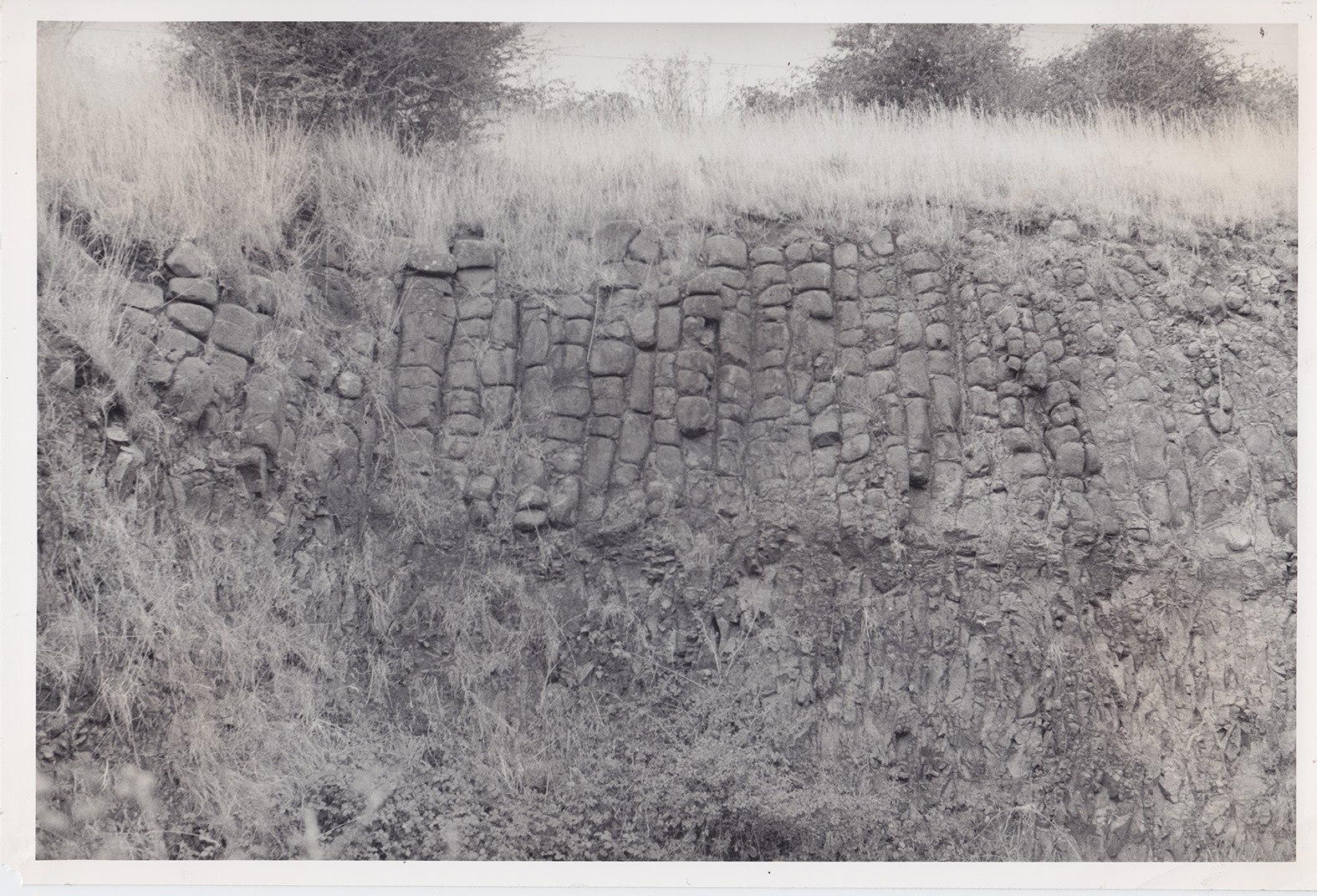
Columnar Basalt at Narre Warren North

Max Thomson, published this photograph of Columnar Basalt at Narre Warren North,  in his book Little Hills 1839-1977. Sadly, these impressive and interesting basalt columns have been destroyed, but I have found some information about them


Columnar Basalt, north of A'Beckett Road, 1960
Image: Little Hills 1839-1977 compiled by Max Thomson


Information from Little Hills 1839-1977 compiled by Max Thomson on behalf of the State School No.1901 Centenary Committee (Narre Warren North State School Centenary Committee, 1977) pages 45 & 46.

Mr Thomson wrote this about the basalt columns - 

On the north side of a'Beckett Road was once a fine example of columnar basalt. The late Mr Crsobie Morrison a well known field naturalist and also editor of "Wild Life and Outdoors' visited the area in 1943. An illustrated article appeared in the magazine later.

Mr Morrison wrote as follows: "On a peaceful dairy farm we found a hole in the hillside by  a clump of gum trees and wild cherry, and  a wall remaining in parts as true as any mason ever dressed a stone. At the end of the wall was a pillar - an absolutely regular six-sided pillar built in sections as any pillar might be: part of it still standing in its original position, but other sections which fitted accurately and were dressed to the same regular outline lay strewn about the floor of the depression"

"The remains of the wall were particulary striking. The rectangular stone which composed it were enormous; probably it would require half  a dozen men to lift one of them. And instead of being laid horizontally, their greatest dimension was vertical.  Between them was a mortar almost as hard as the rocks themselves. Whoever said that these were ancient ruins could scarcely be blamed for his conclusion.The similarity to  human handiwork is most convincing."

"In spite of their convincing resemblance to the handiwork of man these relics, it seem are examples of Natures' craftsmanship. The rock of which they are composed was once molten lava pouring from some ancient volcano long extinct."

"Their form is sufficient evidence in itself that this was once a thick lava flow, which extended over Narre Warren North and away beyond Berwick."

"Then there is the puzzling 'mortar'. This does not seem to be a general feature of columnar basalt formations. In the case of these ruins it is probably due to the weathering and cementation over very long ages."

"The Sydenham Organ Pipes are a comparatively recent formation - they belong to the Newer Basalt series in Victoria, or Pleistocene age.  The Narre Warren North example is Older Basalt, of the Lower Tertiary. Much more time has elapsed here to permit the washing of  minerals into cracks between the columns, and the deposition of the minerals out of  solution to form a secondary rock that serves as a 'mortar.' It is just what was needed to give the final touch of realism to the spectacular natural phenomenon."


Basalt columns at Bayview Quarry, 1954.
Image courtesy of Narre Warren & District Family History Group, Max Thomson collection.
Original caption: Columnar basalt at old Bayview quarry on the west slope of Bayview Hill 1954.

Information from Early Days of Berwick, 3rd edition, pages 101 & 102

The book Early Days of Berwick, first  published in 1948, has this to say about the columnar basalt -

To geologists, and also of general interest, is the spectacular natural phenomenon which occurs in Cr. George Rae's property, of columnar basalt. This was the subject of a very interesting illustrated article on "Wild Life' magazine of  June 1943 , by Mr Crosbie Morrison. "Dr A.V.G James, the recognised authority on the volcanic rock formations of Victoria, sets out that the rock of which this is composed was once molten lava pouring from some ancient volcano, long extinct. Volcanic lavas, on cooling, assume many different forms, and sometimes the flow of lava has remained intact and very thick. The evidence is that this was once a thick lava flow which extended over Narre Warren and away beyond Berwick. As it cooled it formed  a solid crust above, beneath, and at the sides and ends of the mass. Solid rock being  a poor conductor of heat, the interior cools slowly, once the initial crust has been formed. The outer crust, as it cools, tends to contract, but is not flexible. As it contracts, something has to give way, and the rock, being fine grained and homogeneous, the stresses are distributed evenly through it, so that when it finally gives way, the cracks occur at regular distances in every direction, the final result being, when all the rock is hardened and cooled, a series of hexagonal columns, not all vertical,  but extending from the periphery of the molten mass and meeting at the centre."

The Narre Warren North example belongs to the older basalt series of formation in Victoria of the Lower Tertiary Age. The same formation occurs at the Giant's Causeway, Northern Ireland, the Tesselated Pavement and Organ Pipes of Southern Tasmania, and the Organ Pipes of Sydenham, Victoria - thus Narre Warren North has a formation of uncommon interest.

Information from Volcanoes: An Introduction to Systematic Geomorphology Volume 6 by Cliff Ollier (Australian National University, 1969) Available on-line at https://openresearch-repository.anu.edu.au/bitstream/1885/115134/2/b1032284x.pdf

The only other reference I could find regarding Columnar Basalt in the Narre Warren area, was this photograph from the book, above. I don't believe these are the same columns as in the photo above - so there must have been more than one example of the phenomenon in the area. Do any still remain?


The top photo is captioned 'Lava Flow at Narre Warren, Victoria, showing lower colonnade with vertical columns, a central entablature, with curved columns and an upper scoriaccous  zone without columns (A.A. Baker)'  The photo at the bottom is The Giant's Causeway, Northern Ireland, as mentioned in the Early Days of Berwick article.
Image: Volcanoes: An Introduction to Systematic Geomorphology Volume 6 by Cliff Ollier 


When were they destroyed?
Mr Thomson's book, published in 1977,  says there was once a fine example of columnar basalt. The photo in his book is dated 1960, so the destruction date range would be sometime between 1960 and 1977.  What of the example published in Mr Ollier's book in 1969?  I don't know if they still exist, but I doubt it, or when they were destroyed.

Wednesday, 10 April 2019

Algernon Darge - photographer

'
Main Street, Lang Lang, c. 1930s, Photographer: Algernon Darge.

This great photo of Main Street in Lang Lang was taken by Algernon  Darge.  Mr Darge operated as a photographer from 1903 and his office was in the same building as The Herald and The Argus newspapers at 175 Collins Street.  His company  had the concession to take photographs at the Broadmeadows and Seymour army camps during the First World War. In the 1930s, the Australian War Memorial purchased the original glass negatives from Algernon Darge, along with the photographers' notebooks. The notebooks contain brief details, usually a surname or unit name, for each negative (Australian War Memorial website). 

There is an interesting article by Joanne Smedley - 19,000 glass plate negatives: Algernon Darge’s First World War legacy*, which you can access here, about his World War One collection and the acquisition of it by the War Memorial. It was not a straight forward process and the War Memorial rejected early offers from Darge and it wasn't until 1938 that the collection arrived at the War Memorial.  It's  a great collection, it's a shame that it is very difficult finding photos on the War Memorial's less than user-friendly website.  Some of Mr Darge's photos were published in The Argus when they were reporting on the deaths of soldiers, such as the one below of Private A'Beckett.


Private Frank Leigh A'Beckett, a farmer from Upper Beaconsfiled, enlisted on February 10, 1915 and was Killed in Action at Gallipoli on August 7, 1915. His portrait by Darge appeared in The Argus on September 17, 1915. 


Algernon Darge was born Algernon Charles Gordon Sharp in 1878 and Joanna Smedley writes it was under the name of Algy Sharp that he initially operated “Darge.” Photographers. In 1913 he changed his name by Deed Poll to Algernon Darge, perhaps to overcome the confusion of a different surname to his studio’s name or possibly because he had become synonymous with his studio. 

Mr Darge died on January 24, 1941 and his ashes were scattered at Mount Matlock, near Woods Point. His obituary in The Argus of February 3, 1941 (read it here) described him as a pioneer of commercial photography in Melbourne and reported that his  collection includes many scenes of early Melbourne life, photographs of notable events in the city's history, of the first motor-cars to chug and rattle along its streets- Mr Darge himself was one of the first to use a car for commercial purposes. The obituary also reported on the contents of his will - he left his unique pictorial record of half a century of Melbourne's history, the carefully preserved collection of photographic plates to The Argus.....The residue of his estate is to be held in trust for 21 years, during which the income is to be used for the electrical engineering and mechanical engineering departments of the Melbourne Technical College, where Mr. Darge was formerly an assistant Instructor. The residue will become the property of the college after 21 years. Sadly, for us, according to Joanna Smedley, it seems his formal offer of negatives to The Argus was not taken up. 

The State Library of Victoria holds about 350 of his photographs, though not the one of Lang Lang and I can't find any other local photos in the collection.  

*Joanne Smedley - 19,000 glass plate negatives: Algernon Darge’s First World War legacy  Joanne Smedley. In: A Cultural Cacophony: Museum Perspectives and Projects Online Version (2016), pp. 165-175 https://www.museumsaustralia.org.au/ma2015-sydney  Published by the NSW branch of Museums Galleries Australia

Thursday, 4 April 2019

The Opening of the Devon Meadows State School March 30, 1916

The South Bourke and Mornington Journal of April 13, 1916 reported on the opening of the Devon Meadows State School on March 30, 1916. It's an interesting account and also tells us a little something of the history of the area, some farming advice and the names of some early settlers. You can read the article, here, on Trove and it is transcribed, below. Sadly, I do not have a historic photo of the school.

Devon Meadows State School.
The Opening Ceremony.

Some two years ago when an area of land, comprising about 1200 acres, and now known as Devon Meadows, was subdivided by Mr Cox and placed in the hands of Messrs Birtchnell Bros. and Porter in order that the land could be disposed of in small holdings (which has already been accomplished to a very great extent), it could hardly have been expected that at the present day the locality would have an up-to-date State school building, although of small dimensions but such is the case, and all credit to the people who assisted in the movement and thus secured educational advantages for the children in the locality. The school is situate half way between the Hastings road and Fisheries road, on Worthing road, and occupies a most commanding position. The site is comprised in a six acre block, reserved for public purposes. 

The building is of neat and attractive design, and the interior is fitted up in modern fashion, with dual desks, lunch cupboard, blackboards, book cupboard, and is well ventilated, the outlay being £400. A substantial fence has been erected, enclosing the school and about an acre of the reserve. There is convincing evidence to show that the school and consequent expenditure was justified, for there are already 34 names on the roll, although seating accommodation has been provided for 32 only. Miss Bury is in charge of the school, and members of the committee are Messrs Huckson, Peterson, L. McDonald, Young, Ryland and Alphey.

The official opening was fixed for the 30th ult., and arrangements were made accordingly by the committee, who were ably assisted by the parents, the mothers having a busy time preparing tempting
eatables, of which there was an abundance on the afternoon of the date mentioned, when there was a representative gathering present. The refreshments were enjoyed by adults and the children, and a
pleasant half hour was spent in.a social manner.

Mr T. A. Twyford, who recently retired from the Education department, and was for many years head teacher at the Clyde school, was appropriately selected as chairman for the occasion. Having briefly
explained the purpose of the gathering, Mr Twyford called upon Mr L. A. Birtchnell to perform the opening ceremony.Mr Birtchnell said that it was hardly necessary to state how pleased he was to be present, but he regretted the absence of Mr Tate, who was in every way the proper man to declare the school open on behalf of the Education department. In the first place he had to make brief reference to the sad death of Mrs Newbury, who had been an energetic and respected resident, and to the bereaved family he desired to extend his heartfelt sympathy in their sad loss.

In regard to the school, some two years ago the parents were informed that the proposal to erect a school could not be entertained until there were 20 scholars, and there was even some opposition. However, leading residents had successfully worn down the various obetacles, and although it might be invidious to mention names, he felt that he should refer to the good work accomplished by Mr Ryland and Mr Twyford. The advantages of free education were apt to be overlooked, and he desired to point out that such should be fully availed of in the present day. He well knew the difficulties attached to pioneer settlement, and the help children were called upon to render their parents on the farm, but he hoped the fathers and mothers would do all in their power to enable their children to obtain the benefits resulting from education, for there was every reason to feel proud of the school as it stood to-day.

Even on the opening day the building was hardly sufficient, but as time went on extensions could be made. He could assure them that Mr Cox and Mr Horsful would have been delighted to be present if it were possible, both of whom had the welfare of the community at heart, and he wished to impress upon those present that if there was anything further required they had only to present themselves at the firm's office and the matter would receive careful consideration. Mr Birtchnell enjoined upon the children the necessity for attending school regularly, paying attention to their studies, respecting their parents and teacher, and thus grow up in such a way as to prove a credit to Devon Meadows and he hoped they would always look back with pleasant recollections to the day upon which the school was opened. 

He also wished to tell them that during the past few months he had (with his motor car) met 25 hospital ships with soldiers aboard, who had been fighting for them, and related a pathetic story concerning a returned soldier, who had been a ward of the State, whose first expressed wish upon landing was to go and visit the Sister who had cared for him in his childhood days. In conclusion, he desired to state that he intended offering two prizes for competition, to be awarded on points, to be won by the boy and girl gaining the highest number of marks, (Applause) Previous to formally declaring the school open, Mr Birtchnell also spoke in recognition of the good work accomplished by members of the progress association.

Mr Ryland, on behalf of the school committee, expressed his pleasure at being present at the opening of the school, and intimated that the sum of £7 5/ had been collected towards defraying expenses in
connection therewith. 

Mr Porter referred to the successful and well-organised work carried out by the ladies, and then spoke of the hard tasks successfully accomplished by the early pioneers, afterwards speaking in prophetic terms of the possibilities of Devon Meadows. After the war, said Mr Porter, thousands of people in Europe would undoubtedly decide to come to Australia, for it would never be forgotten how Australia had fought for the Empire. The people from overseas would be seeking land where there was a good rainfall, and possibly would pass 82 Swanston street and see the produce exhibited there, and later on visit Devon Meadows, where it had been grown. Eventually, Devon Meadows would have cool stores, and up-to-date shops, larger even than those at Cranbourne. 

The estate was adapted for growing strawberries, poultry raising, and pigs; would grow mangolds [a member of the beet family]  to perfection one block had produced 88 tons to the acre. He recommended lime and bonedust as the best manure to be used, which would last for seven years. In regard to potatoes, they were at a great advantage compared with Warnambool, where the freight was £1 per ton as against 3/. He advised them to consider the advisability of planting fruit trees in June for, although the prices were low now, they would improve later on. It would be well to form a society for the purpose of controlling prices and the supply, for organisation was required amongst farmers just as much as in other interests. To the boys and girls he said -help your fathers and mothers on the farm, working early and late, for every acre cleared meant prosperity. He hoped, in conclusion, to see them all again in December, when the prizes donated would be presented. (Applause.)


Advertisement in The Age of October 4, 1913 for the sale of the Devon Meadows Estate.

Mr Twyford said that, after listening to the glowing prophesy by Mr Porter, he felt that there was indeed very little left for him to say. He wished to thank them for the invitation he had received, and had to congratulate them upon the splendid school that had been opened that day, which was a credit to the Education department. All joined heartily in singing the National Anthem, after which sweets and fruits were handed to the children including a gift from Mr Birtchnell of "something special" in the lolly line for each scholar. The afternoon function was followed by evening tea, and later, an enjoyable dance was held, interspersed with solos, including an item rendered by the four juvenile Peterson's. A tempting supper was partaken of, and the efforts of Mr Twiss, of Dandenong, were highly appreciated in the catering department.

It is pleasing to state that a credit balance remains after expenses have been met, and it is intended to augment this fund, which will be devoted towards the erection of a shelter shed in the school grounds. The function was thoroughly enjoyed, and proved quite an event at Devon Meadows.

Friday, 22 March 2019

Royal Commission into Overseas Settlers from Britain (Migrant Land Settlement) 1931

The Age, of January 24, 1931 reported on the Royal Commission on Migrant Land Settlement (read full article, here)


ROYAL COMMISSION'S INQUIRY,
To Commence on 4th February.
More Than 300 Complaints Listed.
The royal commission appointed some time, ago by the Federal and State Governments to inquire into certain allegations affecting the settlement on the land in Victoria of migrants from Great Britain will open the inquiry at 10.30 a.m. on Wednesday 4th February, at the Arbitration Court, Melbourne. The members of the commission are Chief Judge [George James] Dethridge, of the Arbitration Court (chairman), Mr. C. McPherson, and Mr. W.E. B. Macleod. The secretary of the commission is Mr. C. Nance, an officer of the Prime Minister's department.

The State Government will be represented by Mr. C. F. Knight, assistant Crown Solicitor for Victoria, and a large percentage of the settlers will be represented by Mr. G.U. Nathan, of John W. McComas and Co.

The terms of reference to the commission briefly are as follow:—
1. Whether the complaints, or any of them, are justified, having regard to the facts of each particular case and to the provisions of certain agreements between the Commonwealth, Victorian and British
Governments.
2. Whether the Victorian Government has failed to fulfil any, and if, so what, obligations arising out of or under the agreements, and by it agreed to be performed.
3. In what respects, if at all, has the Victorian Government failed to fulfil the said obligations.
4. Are there any, and if so what, circumstances directly or indirectly comtributing to the subject matter of the complaints, or any of them, over which the Victorian Government has no control.

As a matter of interest and quite unrelated to this story, apart from a rural connection, Chief Judge George James Dethridge was the younger brother of  John Stewart Dethridge who worked for the Public Works Department and later the State Rivers and Water Supply Commission and the inventor of the Dethridge Water-meter, used in flood irrigation.


The three Royal Commissioners - Chief Judge George James Dethridge, of the Arbitration Court (chairman), Mr. C. McPherson, and Mr. W.E. B. Macleod. 
The Herald December 9, 1930


The Royal Commission took evidence from some local farmers and some of this was reported in the papers. The settlers' evidence is typical of  all the evidence presented - the land was too dear, unsuitable for the purpose, there was inadequate training and supervision etc. Some reports mention Elcho, which was the Government training farm for migrants near Geelong.

Evidence from Cr Donald Macgregor
Councillor Donald M. Macgregor, farmer of Dalmore, and a member of the Berwick Shire Council. He said:- About the year 1924 and 1925 a good deal of this land was acquired for the State Government by a sole agent (Mr Rowan) without any knowledge on the part of the local authorities. When we discovered that the Hallam Valley Estate had been acquired for closer settlement purposes my colleagues in the council and myself protested to various members of Parliament because we knew that the Hallam Valley was not suited for closer settlement. The land on the flats was unsuitable. The cost of drainage was excessive Protests against the purchase were made in the Legislative Council. I saw the method used in clearing the land. We worked out the cost, and we estimated that it was costing from £24 to £26 an acre to break down the scrub on the ground.
The scrub was burnt and men were then put on the land with mattocks to grub out the stumps before the ploughs could be put into the ground. The timber on the higher ground was burnt, and firewood has to be purchased to-day at a high price.
The council has refused to accept responsibility for the roads in the settlement. There are 10¾ miles of roads in the Hallam Valley settlement, and a number of bridges and culverts. We could not see our way to commit the ratepayers to the expense of maintaining these roads when we could not see any prospect of deriving revenue from the settlement. The land has been over-capitalised. There is, moreover, over-production of this class of market garden produce. (The Argus, May 7 1931)

Evidence from William Herbert Jarvis, market gardener, Narre Warren North.
Before I left England for Australia I was engaged as a market gardener and fruitgrower. I was receiving £3 a week and had free rent. I was attracted to Australia, thinking that it would offer a good future for myself, wife and family. I was assured that I would be able to earn a good living in Australia. The area of my block at Narre Warren is 14 acres and the price of the land was about £45 an acre. At the time I took possession there was a partly constructed house on the land. The land was fenced. I do not know how we have managed to carry on. My total private debts are now about £80. I do not think that I have paid any rent. The most that I have received in one year was £300 and I suppose that I spent £150 for labour out of that amount. I have very rarely received profitable prices at the Queen Victoria market for the class of produce that I can grow at Narre Warren. We formed an association and one of the questions which we took up with the State Rivers and Water Supply Commission was the drainage of the land. (The Argus, May 7 1931)

Evidence from George Owen, Yannathan.
The Argus reported on May 8, 1931 on the evidence that George Owen of Yannathan gave. George's evidence is included in a blog post I have written on the Owen Family, here.

Evidence from Charles James Dixon, Caldermeade.
Before coming to Australia I was employed in a steelworks, receiving £3/ 10/ a week. I saw various posters and advertisments, advertising Australia and I went to Australia House. I had a pension as an Imperial Soldier. At Wembley I heard a lecturer dealing with land settlement in Victoria. He touched on the patriotic side. He said - We helped you during the war. "Now you come and fill our empty spaces" (laughter) The second picture that was shown was of the glorious Sydney Harbour (laughter) I learned to milk at Elcho. My block has an area of 68 acres and the price was £42 an acre. I took possession on December 9 1925. I had never touched a plough before I went on to the block. I have lost crops through bad drainage. My arrears to the board are about £2,000. I suggest that I should have more land and more stock and that the price of the land should be reduced. My father visited me in 1928. He intended going into partnership with me but when he saw the land he booked his passage back to England. (The Argus, May 8 1931)

Evidence from George Arthur Green, Caldermeade.
Before I came to Australia I was engaged in farming operations. I was earnnig £ 2/10/ a week had house rent free and commission on buying and selling cattle I questioned Mr Wyatt, who was migration officer at Australia House, and decided to come to Australia. My block is 40 acres in area and the price was £50 an acre. After I got on to the block I discovered that it had been abandoned by the previous occupier. I could see that the land had been ploughed and then left. My block has not been revalued. (The Argus,  May 8 1931)

Evidence from A.G Ludlow, Narre Warren North
Mr A.G Ludlow, of Narre Warren North, continued the evidence which he began on Friday. The area of his block is 22½ acres. He said that he did not think that, under existing conditions, his successful settlement could be accomplished.
Chief Judge Dethridge (chairman)  - Anywhere?
Mr Ludlow:- I have no faith or confidence in the country. I have had a pretty bad spin. I have lost £1400.
Chief Judge Dethridge - You will not take Victoria as a gift? (Laughter)
Mr G.U. Nathan (who is appearing for the settlers) - Is it your desire to stay on the land if you can be satisfactorily settled?
Mr. Ludlow. - Yes, but I want to see that it is absolutely certain that I can be satisfactorily settled. It was stated on the prospectus that the land is suitable for intense culture. The former owner of the
land had grown oats on the land until it would not grow oats any more, and then sold it to the Water Commission (Laughter)
Replying to Mr C.F. Knight, assistant Crown solicitor who is appearing for the Government of Victoria, Mr Ludlow said that the reason he had not carried on with poultry farming was that it was unprofitable. There was no export trade at that time, and there were gluts in the market. The land was over-capitalised. (The Argus, May 12 1931)

Evidence from  Clifford Smith De Grey, Narre Warren
Clifford Smith De Grey, baker, said that before leaving England he was engaged in the bakery trade and that he was attracted to Australia for health reasons. He wanted to lead an outdoor life. He came to Australia to take up dairying. He had had no previous experience of that kind. He had raised £1,000 from the sale of his business in England, and he brought £815 with him to Australia. he was married and had two children. He arrived in Australia in 1925, and took up a block at Narre Warren.
The area of the block was between 13 and 16 acres and the price was £40 an acre. He left the block in June 1928. He was advised to give up the block when he was offered employment in the district. His motor-lorry was sold for £40. He desired to be satisfactorily settled on the land if it could be assured there was a living in it. His block was productive in certain seasons of the year. the land, however, would not grow cauliflowers.
Mr. Knight. - was as not the reason that you gave up the land that you became despondent with marketing and could not get the prices you wanted?
Mr . De Grey. - No. I was advised to leave the block. (The Argus, May 12 1931)

Evidence from Henry Stephen Bywater, Hallam Valley Estate
Henry Stephen Bywater produced photographs of the Hallam Valley settlement after the heavy rains in March last. He said the he was employed in England by Messrs. Thomas Cook and Son, tourist agents. He saw all the booklets issued in England about land settlement in Australia. He saw Mr Wyatt (who was migration officer at Australia House) in Manchester. Mr Wyatt, in his lecture pointed out the seaside resorts where farmers from the north spent the summer (Laughter). Witness and his brother arrived in Melbourne in December, 1926. He did not go to the Elcho training farm, which he understood was not for single men. He began to look for land in 1927, and was advised to take up market gardening in the Hallam Valley. He decided to apply for block nine, and was the only applicant before the land board. He did not get block nine. The father of the man who got that block was appointed a supervisor shortly afterwards. Witness was given block two, consisting of 13 acres at £49 an acre, unimproved. His brother went on to the block with him. Witness's receipts up to the end of 1928 were £27/2/11. In 1929 his receipts were £84/19/ for the first half of the year and £42/7/ for second half. In 1930 his receipts were £13/3/9 for the first half of the year and £121/11/9 for the second half. He and his brother had spent their money on the block. At least £700 had been expended. During the heavy rain in March last 9½ acres out of the 13 of his block were under water The effect of the mole drainage of his land was perfect for the time being but the ground had cracked, and the subsoil had fallen into the chains. (The Argus, May 12 1931)

Evidence from J.G. Viccars, Hallam Valley Estate
Before coming to Australia Mr J.G Viccars, of Hallam Valley, was employed in an engineering works. Giving evidence yesterday he said that he was at present engaged in dairying and market gardening. From his conversations with Mr Wyatt he came to Australia with the impression that at the end of five years he would be a farmer and have a farm of his own. He brought £230 to £240 to Australia with him. He arrived here in January, 1926. He spent 12 weeks at Elcho, and then he and his wife took a married couple's job for four months. He had a fortnight at the farmers' classes at Dookie. As land was not available he took up another position for 12 months He selected a block of 20 acres in the Hallam Valley, the price of which was £36 an acre. He went into occupation in October, 1927. No supervisor visited him during the first few months, and he made a good many mistakes during that time. He was making about 30/ a week from his block at the present time from dairying to market gardening. He was now just paying his way, but not his commitments to the Water Commission. When he went to the block he was told that the land was too valuable for keeping cows. (The Argus, May 12 1931)

Evidence from William Samuel Farman, Hallam Valley Estate
Before coming to Victoria in January, 1928. William Samuel Farman was a soldier in the Imperial army for 26 years. He said that because of the promises and bright future predicted for him by migration officals in England he came to Victoria and selected a block of 22 acres at £38 an acre in the Hallam Valley Estate. He had £450 in capital and a pension of £63 a year He intended to use the block for market gardening, and tried this for l8 months. The returns in the first year were £57/10/, and practically nothing thereafter. The soil was defective. The farm was merely a wornout cultivation plot. He had spent all his capital and annual pension. He then changed to dairying, and was now making 30/- a week. Land that cost £38 an acre was too expensive for dairying, but that was all the block was good for. (The Argus, May 13, 1931)

Evidence from Albert Thomas Groves, Hallam Valley Estate.
Albert Thomas Groves said that when he came to Victoria in 1925 he was not given adequate training as had been promised. He had £670 in capital. He took up a block in the Hallam Valley Estate to engage in market gardening and poultry farming. The land cost £38 an acre. He thought he was buying 19 acres, but later found that it actually was a block of 24 acres. The land was defective, and generally the block was a hopeless proposition. He lost all his capital in 12 months. It had cost him £75 to lay pipes to bring water to the house. (The Argus, May 13, 1931)

Evidence from Frederick George Triggs, Narre Warren
Frederick George Triggs , Lower Hall, Hammersmith England was put in by Mr. Nathan. In his affidavit Triggs said that he was accepted as an approved settler in 1928. When he arrived in Victoria in March 1928, his selection of land was limited to blocks at Narre Warren. He took one over, and within a month it was waterlogged. Eventually he brought the whole of it under cultivation, but then found the promises regarding marketing were not fulfilled, and much of his produce was wasted. After 18 months his capital of £623 was exhausted and his accumulated debt to the Water Commission was £800. With his wife and two children he worked from 4 o'clock in the morning until night . A number of experts pronounced the block a hopeless proposition, and the commission , realising that his complaints were fully justified, offered him a transfer to another block, but that block was disposed off before he replied. The price of the land, £61 an acre, was out of all proportion to its economic value There was no depth of soil; the top soil of 3 in. had a layer of stiff blue clay beneath it. After an inspection of the Water Commission, officials realised that it was impossible to cultivate the block, and allowed him £3 a week for four months before he abandoned the land. He later returned to England. He claimed that there had been grave misrepresentation by the Lands department, that the price of the land was excessive, and that he had not received promised training and supervision. He asked that he should be resettled on another suitable block or be granted compensation by the return of the capital he had lost amounting to £650.  (The Argus,  May 13, 1931)

Evidence from Henry James F. Jones, Koo Wee Rup (later at Fish Creek)
Henry James F. Jones, farmer, of Fish Creek, stated in 19136 he left England, where he was earning £5 12/6 as a painter. Mr Wyatt told him land suitable for dairying could be obtained at from £5 to £10 an acre. He and his wife had £850 between them upon landing in Australia. After being at Elcho farm he was shown land at Kooweerup valued at £1966, portion of which was swamp abandoned by a former settler. The board's solicitor stated the board admitted the land was unsuitable for settlement, and the whole question was a matter of compensation. Witness, continuing, said the block was completely saturated with water at one time. Officials of the board said improvements were futile on such land. Draining cost him £90. In 1927 his receipts from potatoes and dairying were £566. In 1928 and 1929 he received £929, and his expenses were £692. Owing to flooding of the land he gave up and went to Fish Creek. On 100 acres at £23 an acre he had 12 cows, from which he received £120 for the year. He grew potatoes and the highest price he received was £3 a ton. He had only £50, four cows, three horses and farm implements when he left Kooweerup. His interest and principal to the board was accumulating, as the area was not large enough to make a living. (The Age, May 20, 1931)

Evidence from George Lewis Williams, district officer for the Water Commission of the Mornington peninsula area.
As might be expected some of the officials who gave evidence had a different viewpoint. Mr Williams was quite blunt in his evidence.

"From time to time", continued Williams, "I engaged gardening experts to supervise and instruct the settlers, but these man gave up in disgust because they could not get the men on the blocks to take their advice. Many of them tried to cultivate an area that was too large. They were advised to concentrate on small areas, but would not follow that advice. They held Bolshevik meetings to ventilate their grievances. The Water Commission has supplied a motor-truck, and employs two men to transport vegetables. The settlers even refused to cart the produce from their blocks to the packing shed for sale. There are too many misfits among the overseas settlers. They have been offered the use of scoops and other implements to do work on their blocks, but would not take advantage of the offer. They were too lazy. They also would not take advice on methods of cultivation and growing vegetables. They are the most contrary men I have ever met"

Findings of the Royal Commission
The findings of the Royal Commission can be accessed on the Victorian Parliament website, here. However, the Weekly Times had a comprehensive report of the findings of the Royal Commission on April 8, 1933
The Royal Commission in Migrant Land Settlement has found in its report to the Lieutenant-Governor (Sir William Irvine) that the settlers were justified in their complaints of misrepresentation by Commonwealth and State representatives in London........
The Commission examined 504 witnesses at 146 public sittings. The inspection of holdings and the examination of witnesses in country centres necessitated the travelling of 10,000 miles.....
In a summary of the conditions of 318 individual settlers, the commission finds that in practically every instance conditions were not such as to provide "a living and all commitments" and that in such cases the opportunity given to the settler of earning a living and ultimately acquiring his farm more or less fall short of the State's obligations to him. The Commissioners, however contended that they had no right to make any recommendation concerning the remedy or redress of any of the complaints.

The findings of the Royal Commission also has a  summary of the evidence of  318 individuals - which gives a good indication of the areas covered by the Commission which include The Mallee, Murrabit, Maffra, Katandra, Stanhope, Alberton West, Shepparton, Leongatha, Tongala, Coleraine, Red Cliffs and this region. It is no wonder they travelled over 10,000 miles to inspect the properties. The evidence summary includes notes on training, block condition and whether  it could provide the farmer with  a living and the ability to fulfill commitments. The local farmers who are listed in the findings (that we haven't already referred to) are - G.T. Bedford, Pakenham; R.V. Ford, Dandenong; A.Long, Pakenham East; J.M. Mason, Narre Warren; J.A. Millar, Koo Wee Rup and E. Moralee, Narre Warren.

The farms were clearly thought to be small family farms. John Roy, farm supervisor, Water Commission, gave this evidence -  Dairying was not necessary if a man was making a success of market gardening, but if a man had a growing family it was a good thing to have cows, pigs and poultry, and keep family occupied on the farm. (The Age, May 15 1931) If a farmer did not have  a wife, he was advised to get one - Charles Rowatt McTaggett, dairy farmer, Alberton West. He came to Victoria with £300 capital but was given no training. His present block which he took over from the board was of 48 acres and cost £2,253 with £600 for improvements, making the price £61 an acre. It would carry only 18 cows, and was far too small to return a living. When he complained, Mr. Weir, who was in charge of the Closer Settlement scheme, advised him to get married, because he would then be able to milk 12 more cows. He did not follow that advice.

I have created  a list of newspapers articles on Trove relating to this Royal Commission, you can access the list here. All the papers referenced in this post are on the list.