Tuesday, 23 July 2019

Ercildoune - a farm at Lyndhurst - the McNab family days

In the last post  we looked at the Ercildoune property in Hall Road, Lyndhurst, which was owned by the Hall family from around 1860 (read about them, here) until it was put up for sale in September, 1917. It was then purchased by William and Mary McNab, this post is about their time at Ercildoune.

William Henry Duncan McNab and Mary Elizabeth Maud Miller were married in 1896 and had six children -
1. Mary Ethel (birth registered at Trafalgar, 1896; died 1901)
2. Henrietta Robertson (birth registered at Trafalgar, 1898. Married Frank Knight in 1938; died 1997)
3. William Donald (known as Donald - birth registered at Trafalgar, 1900; died 1979)
4. Annie Alice (birth registered at Trafalgar, 1901;  died 1995)
5. Charles Malcolm (birth registered at Trafalgar, 1904. Married Mabel Florence McLellan in 1938; died 1991)
6. Muriel Maud (birth registered at Alexandra, 1910. Married John Henry Thorburn in 1935; died 2002)

William died in 1930 and Mary died in 1957. As you can see by the places of registration of the births of the children, the family lived in the Trafalgar and Alexandra area before they came to Lyndhurst.

In 1929, Donald and Charles were interviewed by the Weekly Times September 7, 1929 about the farm at Lyndhurst. Interesting, given that Fred Hall of Ercildoune also gave an extensive interview to  a newspaper about the farm, in 1893 (read it here). You can read the full McNab article here - the parts of the article relating to Ercildoune and Cranbourne are below

HEAVY FODDER CROPS GROWN FOR COWS
By "AGRESTIC"

It is probably well within the mark to say that nowhere else in the State is dairying conducted with a larger measure of financial success than in the Cranbourne district, which lies about 30 miles from Melbourne on the South Gippsland line.

SILAGE ESSENTIAL
In that centre not only is there a generous realisation of the value of silage but many, if not most, of the farmers deem it to be essential to make some each season, and they state unhesitatingly that without it they certainly would not be able to carry on so satisfactorily as they do. Various classes of fodder are utilised or the purpose, and all of them, apparently meet requirements.

 Maize, however, appears to be most favored, not only because it produces a big bulk of fodder, but also because it has the capacity for maintaining the stock in excellent condition, thus enabling them to make the utmost use of whatever other materials may be supplied to them. Latterly a fodder which has aroused much interest and claimed considerable cultural attention is Imphee. This is one of the members of the useful family of Sorghums. It is a hardy fellow, thrives vigorously under the conditions which obtain in the neighborhood of Cranbourne, and furnishes a surprisingly large amount of stuff. Amongst those who have a high regard for Imphee are Mr Wm. H. A. McNab, of "Ercildoune," and his two enterprising, keen and capable sons, Donald and Charlie.

When I called at "Ercildoune" on a recent memorable Friday — a day of chilling wind and saturating rain — I found that Mr McNab was absent at Dandenong, convalescing after a serious Illness. His sons were at first somewhat chary about being interviewed on the subject of their operations, but an hour's earnest talk with them revealed that they had a complete grip of everything.

FROM CATHKIN
Up to 11 years ago, when "Ercildoune," containing 246 acres, was purchased, the family had been established on the Goulburn at Cathkin. Mr McNab, sen., however, had long had his eyes on Gippsland, particularly the country of which Cranbourne may be said to be the centre, and when the Cathkin property was disposed of he transferred to the present holding, which has been augmented by the rental of an additional 166 acres.

The soil, for the most part, is of black loamy character, with a sprinkling of clay through it, and there is a clay subsoil throughout. This is fairly near to the surface, as is exemplified by the fact that there is scarcely a paddock in which each time it is used the plough does not turn up a certain amount of clay. The paddocks are of varying sizes, but average approximately 20 acres. A good deal more than half of the farm is under crop each year, and the crops grown include oats (about 100 acres), wheat (just a little for feed for the fowls),  Maize and Imphee. Japanese millet was cultivated regularly at one time, but lately it has been replaced by Imphee, which occupied an area of 20 acres last season.

Messrs. McNab are dairy farmers, and they believe in feeding their cows on a liberal scale. In fact, they pointed out, that is the only way to ensure a maximum production of milk. They have a fine herd of highly developed Ayrshire-Jersey cross cattle numbering, roughly, 100 head, and the actual milkers average 75 head throughout the year. There are three pure-bred pedigree Ayrshire cows, and Ayrshire and Jersey bulls are used.

As the whole of the milk is marketed for consumption in the metropolitan area, it is found possible to rear only two or three of the most promising heifers each year. The milking is done by hand. It is an invariable practice to grow a substantial supply of early green feed, and an idea of the character of this season's stand is conveyed by the photograph reproduced on this page in which Messrs. Donald and Charles McNab appear. [below]

Donald and Charles McNab at Ercildoune
Weekly Times September 7, 1929   http://nla.gov.au/nla.news-article224402265

The crop consists of a mixture of barley, oats and wheat, the first named predominating. The seeding was done in February, and at the same time from 80 to 100lb. of super and bone an acre was distributed. Cutting for feeding was begun about the middle of August, when the last of the Imphee silage had been used. The cutting, of course, could have been started earlier had there been any necessity to do so. This crop was the best I saw in the district, where the exceptionally heavy rains have proved more or less detrimental to the later sown stands, which, in numerous instances, are uneven and contain yellowish patches. Messrs McNab cannot speak too highly of Imphee as a cattle fodder and they are of the opinion that all round it is markedly superior to Japanese millet.

They made three sowings during November, the areas having been 9, 8 and 3 acres respectively. The ground was ploughed in September with the mould board to a depth of 6 inches. "Why the mould board?" I inquired, and was informed that "it turns the soil over more effectively, and tends to drain the land better than when the disc is used." A little later a stroke was given with the harrows. The next operation was to roll. That was followed by a second ploughing to a depth of 3 inches and another harrowing preceded the seeding. The seed allowance was 10lb. an acre and the manure applied was bone and super which was used at the rate of 80lb. an acre. The crop made excellent progress, and the harvesting operations were carried out toward the end of April. Had the weather not been so wet the work would have been done earlier.

The intention had been to place the great bulk of the produce in stack for ensilage, but owing to unfavorable conditions, it was possible to utilise only eight acres for that purpose, the remainder of the crop, which stood about 9ft. high, having been cut and fed to the cows in the form of green chaff in the bails. Altogether the 20 acres of Imphee provided sufficient greenstuff to permit of four months' continuous feeding.

The portion of the crop converted into stack ensilage was cut with the reaper and binder. Before the stacking was begun a layer of straw was placed on the ground, with a view to minimise the wastage. I asked Messrs McNab for particulars of the method of building the stack, which they gave as follows : — The plan is to build first from the two sides. The sheaves are laid with the heads pointing toward the centre, and the butts outward, and they overlap one another to the length of the twine band. A second layer is then laid across the first, beginning at the ends, and again working toward the centre. The third tier is laid on the same lines as the first. The fourth layer resembles the second, and so until all the sheaves have been dealt with. Because of the greater shrinkage or pressure there, and so that there shall be slopes toward the ends and the sides, it is necessary to see that the centre is kept higher throughout than the sides and ends. When completed the stack is covered with a layer of straw a foot deep. Pieces of timber are then placed along the sides on top of the straw, and they are kept in position by fastening them to lengths of wire stretched across the stack.

THE FINAL TASK
Bags filled with sand are next laid along the timbers to prevent the 6-inch layer of sand, which is ultimately placed over the top of the straw covering, from slipping or washing off. By building the stack in this manner a good, even compression is secured, and the loss of fodder on the outside extends in to a depth of only about six inches. The feeding of the silage is usualIy begun toward the end of June. The sheaves, which come out in beautiful order, are put through the cutter, mixed with oaten chaff, and fed in the bails. The silage is relished by the cattle, which milk splendidly on it.

Maize is deemed to be practically indispensable, and an area of 9 or 1.0 acres was devoted to the crop last season. At one time Hickory King was grown almost exclusively, but lately it has been almost entirely replaced by Red Hogan. which has proved the more successful. Seeding is begun toward the end of October, and continued until about Christmas, three or four separate sowings being made. The maize has been used for ensilage as well as for feeding in the green state.

Last season, when only two lots were sown, the fodder was chaffed and fed night and morning with oaten chaff in the bails. The seed is distributed through a maize drill, which places the rows about 2ft. 3in. apart, so that the scuffler can be used to keep the weeds down and conserve the soil moisture. About 1 cwt. Of No. 2 complete manure an acre is applied. On occasions the crop has attained a height of 12ft., but the average is approximately 8ft. The maize is harvested with a cornbinder, which is a fine labor-saving machine. Before it was introduced three men took half a day to cut sufficient maize to meet the needs of a day. With the binder, Messrs. McNab's informed me enough fodder can be cut in an hour to suffice for two days.

BEAUTIFUL OAT CROP
Last season the oats on "Ercildoune" did remarkably well, and the crop in one paddock aroused wide spread interest in the district, because of its exceptional growth and admirable quality. The average height exceeded 5 feet, and the chaff has been going 110 lb. to the new-bag. The paddock of 24 acres on which it was grown, has produced eight crops in 10 years. The variety favored is Algerian, and the sowing for the main crop is done from toward the end of March and into April, 2¼ bushels of seed and 80 to 1001b. of manure an acre being distributed. Hay cutting takes place usually about mid-November. The only concentrate fed to the cows is bran, which is supplied during about nine months of the year. Its use in spring is not considered to be necessary. Each member of the herd in milk receives a couple of large handfuls of bran in each feed.

All of the ploughing on "Ercildoune" is done with a tractor, which has no difficulty in hauling a four-furrow implement and gives a satisfactory service.


What else do we know about the family? The McNab family are written up in the book, 100 Years in Skye, 1850 – 1950 by Dot Morrison (Mornington Peninsula Family History Society, 2004) Mrs Morrison has this interesting anecdote about Donald – in 1910 he was badly bitten by bull ants and as a result of this his leg was amputated. Around 1920 he became an accountant after studying by correspondence.

Being of Scottish descent it is not surprising that the family was involved with the Presbyterian Church at Lyndhurst and Cranbourne – there are reports of Mrs McNab holding a ‘house party’ at Ercildoune to raise funds for the Church. I think 'house party' had a different meaning then than what it does now.  Charles’ marriage to Mabel McLellan united the family with another of Scottish descent, the McLellans.  Mable was the daughter of George and Margaret (nee Close) McLellan, who had a dairy farm at Taylors Road in Skye. Just before the wedding took place, the couple were entertained at a social gathering in the Lyndhurst Hall before their marriage. They received a tea set from the Lyndhurst Presbyterian congregation, and a chiming clock and silver fruit dish from Lyndhurst residents and the social club. (The Argus, March 17, 1938) Their marriage which was written up in various newspapers, took place at Scots' Church in Dandenong.

Mrs Morrison also writes that after William died the farm was divided between the two sons, Donald and Charles. Donald had the Ercildoune homestead block and Charles had other land which he named Strathlea.  Charles had a Guernsey stud on Strathlea and that was still in the McNab family until at least 2004.  In 1960,  Ercildoune was sold to Harold Grieves and Donald and his sister Annie, who were both unmarried, moved to Cranbourne.

I have created a list of newspaper articles on the Ercildoune property on Trove, you can access it here. All the articles referenced here are on the list.

Tuesday, 16 July 2019

Ercildoune - a farm at Lyndhurst - the Hall family days

In this post we will look at the history of a farm at Lyndhurst,  Ercildoune, in Hall Road. It was occupied by the Hall family from around 1860 until it was put up for sale in September, 1917 and purchased by William and Mary McNab, read about them, here.

Frederick Hall was born around 1830 to William and Grace (nee Tucker) Hall. Fred married Elizabeth Hunt in 1849 in Brighton. Elizabeth was the daughter of George and Elizabeth (nee Newman) Hunt. Fred and Elizabeth had the following children:
1. Louisa (birth registered at  Brighton, 1850. Married James Close in 1867; died 1923)
2. Frederick (birth registered at  Western Port, 1857; died in 1857, aged 5 months)
3. George (b. c. 1859. Married Mary Annie Thomas in 1883;  died in 1929 aged 70)
4. William (birth registered at  Lyndhurst, 1859; died 1942)
5. Frederick (birth registered at  Lyndhurst, 1861. Married Emma Carol Gaunt in 1896; died 1942)
6. Elizabeth (birth registered at  Lyndhurst, 1864. Married Percy Teychenne in 1886; died 1892)
7. Emma (birth registered at  Cranbourne, 1866. Married Christopher John James in  1888; died 1941)
8. Susannah (birth registered at Cranbourne, 1868. Married Daniel Tierney in 1907; died 1955)
9. Fannie (birth registered at  Cranbourne, 1870. Married Thomas James Stephenson in 1891; died 1940)
10. Walter Henry (birth registered at  Cranbourne, 1873; died 1922)
11. Florence (birth registered at  Cranbourne, 1875. Married Richard Ernest Einsiedel in 1899; died 1962)
12. Alfred (birth registered at Cranbourne, 1878; died 1929)

The house on the property, is now surrounded by housing estates, but is owned by the City of Casey, who are looking at options for its future use. The property is on the City of Casey Heritage database and is listed as being constructed in c. 1888, 25 or so years after the Hall family arrived in the area and when the family obviously had some capital behind them to build a new house. The Heritage citation describes the house thus Aesthetically, it is significant as a superior and well-preserved example of a Victorian Italianate villa in a rural setting. You can read the citation, here.

We are fortunate that in 1893, Fred was interviewed by the Australasian newspaper, so we have some idea of his life and his farming methods. The article said  that Fred had been on his farm at Lyndhurst, for 33 years, which is 1860; however as one child was registered at Western Port in 1857 they were obviously in the area earlier.  Frederick Hall died in 1896 and Elizabeth died in 1916. They are both buried at Cranbourne Cemetery.


The Australasian  July 1, 1893

The interview with Fred is transcribed here and you can see it on Trove, here.

DAIRYING IN GIPPSLAND.
(BY OUR AGRICULTURAL REPORTER.)
A CRANBOURNE FARM.
One of the most advanced and successful dairymen in Gippsland is Mr. F. H. Hall, of 'Ercildoun'e, whose farm is situated a few miles from Cranbourne, on the Frankston road. Mr. Hall has been engaged in dairying for probably a longer period than any other farmer in the colony, and on that account his experiences and the system he adopts in managing his herd are of exceptional interest and value. He arrived in Victoria when quite a young lad in 1833, and has, therefore, had sixty years of colonial experience. What a long time to look back, and what changes he must have witnessed in the development of the country. For the last thirty-three years Mr. Hall has been engaged in dairying on the farm where he now resides.

SOME EARLY REMINISCENCES
Although close upon seventy years of age Mr. Hall is still a robust, healthy man of fine physique, and a typical specimen of a jovial, burly yeoman. He performs some light work every day, either among the cows or in the paddocks, for he says he was accustomed to active employment in his early life, and complete idleness would soon kill him. His "yarns" about the digging days and the troubles of early settlement in the colony would interest many of those desirous of going on to the land to-day, and would prove to them that the present depression and difficulties are trivial compared to what they were before the discovery of gold in the fifties. "Times are considered bad enough now," said Mr. Hall, in our conversation, "but I have seen them very much worse." "I remember" he went on, "when quite a big, strong fellow, and able and willing to undertake any kind of labour, that wages
were far lower than they are now." He had worked as hard as any farm hand has to do now for 3s. per week and his keep, and he even ventured to marry on a salary of 15s. a week. Young men turn up their nose at such a wage nowadays, but Mr. Hall not only made progress but reared a family on it. Of course, the comparative value of 15s. now and fifty years ago are two very different things, yet it is refreshing to hear an old pioneer like Mr. Hall speak of the present dull times with a lightness of heart which indicates the great confidence he has in the future prosperity of the country.

THE SYSTEM OF FARMING
The area of the farm is 250 acres. The land is all first-class, however, and above the average in quality of the soil in the Cranbourne district. It was originally pretty heavily timbered, but nothing like to the country further south about Korumburra or Leongatha. Similar land could be cleared to-day for about £6 an acre. The system of farming pursued is simple, but methodical. Nearly everything grown on the place is converted into milk and batter. A number of pigs and poultry are kept, but the chief pursuit is dairying. About 80 acres for hay are cultivated each season for the sole use and benefit of the cows, which are all fed liberally in their stalls throughout the winter, or whenever the grass becomes scarcer. Mr. Hall grows, also, a large quantity of green crops for mixing with the hay. At the present time there are about 10 acres of green fodder, consisting chiefly of barley and rye, ready for cutting, and which would, have been ready before now but for the dry autumn experienced. A continuous supply of this green feed is provided by sowing at different periods. A quantity of maize is generally grown for summer and early autumn feed, but the maize failed last season on account of the dry weather. When the maize crops are finished, a rotation of green barley, oats, or rye is available, and they are severally used for mixing with the chaff and bran ration. Mr. Hall has been farming on this system for years, and he finds it to be much more profitable than the usual plan of allowing the cows to dry off in their milk for want of feed.

HOW THE COWS ARE TREATED
As already indicated, the cows are exceptionally well provided for at 'Ercildoune' in the shape of food. Unless in the season when the grass is flush and verdant, they are liberally hand fed in the byre or shed at very considerable expense. Mr. Hall says that feeding the cows well is the only way—and he speaks from a long experience—to make dairying profitable. Yet the majority of farmers who make butter do not feed their cattle in winter. The question is whether they or Mr. Hall is right. I venture to assert that the latter makes most money at the business, and that surely is the main object, without discussing the relative cost or trouble attached to the two systems of feeding v. starvation. Mr. Hall also believes in providing shelter for his cattle. His milch cows are stabled every night all through the winter—a practice too seldom adopted in Gippsland, or any other part of the country. It involves a deal of extra Iabour and expense in cleaning out the stalls daily and in providing
bedding; but Mr. Hall has proved that the system pays better than allowing the cows to sleep out on the cold wet ground. He considers it is of little avail feeding a cow well, unless shelter is provided at the same time. Shelter, of course, is the equivalent of food, and the greatest abundance of fodder is wasted on any animal that is exposed to severe cold. Our own personal feelings tell us that in order to be well and healthy we must put on extra clothes in winter, and, further, that we will gain more benefit by the shelter and warmth obtained therefrom than by taking an extra quantity of food. Either man or beast is to be pitied who cannot secure sufficient clothing or shelter from the cold, and if we only consider how tender and sensitive an animal a milch cow is, the folly of expecting her to yield a large quantity of milk under such conditions is at once apparent.

THE RESULTS OBTAINED
The first immediate result of feeding and stabling the cows is the much larger quantity of milk they yield. Mr. Hall was at one time in the milk trade, but he now makes butter exclusively. Since he procured a cream separator he finds butter-making quite as profitable and easy as selling the whole milk. On an average his cows yield 8lb of butter per week throughout the year. The farmers who do not feed and shelter their cows obtain less than half of that return. If the cost incurred in the better treatment of the cows amounted to the value of the extra produce there would be no profit gained; but this extra expenditure Mr. Hall declares is all returned in the benefits resulting from the manure which is collected and applied to the land. The manure is the medium which enables him to produce heavy crops of hay, green fodder, and grass, and these in turn enable him to keep nearly double the number of cattle he could do otherwise. He, therefore, gets all the extra butter produced for
nothing, so to speak, and besides, from having so many more cows on the place, his aggregate returns and his profits are just about double of what they would be if the cattle were treated on the starvation system. It is easy to see from the good residence and steading, and the fine appearance of the farm generally, with everything in excellent condition, that Mr. Hall has prospered. He would assuredly have been a poor man still if he had not fed and sheltered his cows. Dairymen who follow his example will never, I feel sure, regret giving up the ruinous practice of starving their animals in winter.

When Fred died in 1896 his address in the death notice was Malvern Grove in Caufield. Family members worked the farm and in 1905 George Hall advertised the farm for lease. The ad below is from The Leader February 25, 1905.


In September 1917, the farm was put up for sale and it was purchased by William and Mary McNab, (read about them, here.) The sale advertisment, from the South Bourke & Mornington Journal  September 6, 1917, for the property gives some idea of what the farm was like at that time. You can read it here, on line, and it is transcribed below.

SATURDAY. OCTOBER 13 At the Homestead, on the Property at 3 o'clock To Dairy Farmers, Small Holders, Farmers, Onion Growers and Others SUBDIVISIONAL SALE (in the Estate of the late F.Hall), situated within two miles of Cranbourne Subdivided into four farms, homestead and 80 acres, and three farms averaging about 55 acres each Some of the best land in the Cranbourne district.  KEAST, MORRIS AND  MILES and STEWART AND WOOD (in conjunction) have received instructions from the executors in the estate of the late F. Hall to sell by public auction that -
Very Fine Property, containing 245 acres,subdivided into four convenient farms, namely, homestead and 80 acres of land, and three farms averaging about 55 acres each. The homestead block will be sold together with all improvements, consisting of a brick and w.b. house, large milking shed, hay shed, stables and numerous outbuildings. All the blocks have a frontage to a good metal road, and the land consists chiefly of beautiful black banks, nice undulating rises, and is considered by good judges to be one of the best farms in and around the Cranbourne district, being situated only about 2½ miles from the Cranbourne railway station, the land now being occupied by Mr Strong, whose lease expires within a short period. We would draw special attention to the sale of this land, which is very suitable for dairying, potato and onion growing, mangles and maize, and in fact all kinds of root crops. The district has a splendid rainfall, and is considered to be one of the safest in any part of Victoria. The property has been in the Hall family for very many years, and is now being sold to wind up the estate, and intending purchasers can inspect with confidence. Buyers will be met at the Cranbourne railway station, and shown over the property, by giving one day's notice to the auctioneers.Liberal terms will be given. Plans on application to the agents. For further particulars, or arrangements to inspect, apply Keast, Morris and Miles, 140-6 Queen-st., Queen's House, Melbourne; Stewart and Wood, Alexandra Chambers, 46 Elizabeth street, Melbourne.


I have created a list of newspaper articles on the Ercildoune property on Trove, you can access it here. All the articles referenced here are on the list.

Thursday, 4 July 2019

The Body was conveyed to.......

One of the unusual uses for Hotels in the past was their use as a temporary morgue and  a place to carry out autopsies and Inquests. There are accounts after accounts of this in newspapers and often the newspaper uses the term 'and the body was conveyed to [name of Hotel]' so I thought we would have  a look at some of these reports.

It seems surprising that Hotels would be used for this purpose, but I assume it was because they had space, access to water and perhaps a solid table for holding the autopsy. It was, however, a practice that was frowned upon by the authorities. As early as 1867,  the Legislative Assembly in Victoria had this issue brought to their attention by Mr Cook - To call the attention of the Chief Secretary to the practice of the police of conveying dead bodies to hotels for the purpose of holding coroners' inquests; and to ask if he will give instructions that in future such bodies may be conveyed to the nearest public morgue as may be available. (The Argus December 13, 1867) The Chief Secretary may have given instructions to the police, and it may have altered the practice in the City, but it was  a less practical idea in rural areas, due to logistical issues and the lack of morgues. There are accounts of Hotels being used as temporary morgues up to the 1920s.  Here are just a few local examples of this happening.

WARNING - newspapers were much more graphic in their reporting than they are today, so these excerpts may contain information that is upsetting.

A fatal accident occurred near the Eumemmerring Creek bridge on Thursday morning last, between the hours of twelve and one a.m., by which a farmer named George Ritchie, residing at Lyndhurst, lost his life. It appears that he had been at Hennessy's races [at  Eumemmerring] and had imbibed, rather freely during the day. On the way home George challenged his companion to  a race (they were both riding horses); his horse fell and George hit his head and he sadly died. The body was taken to Taylor's Half Way House Hotel in Lyndhurst, where an enquiry was held the same day and the verdict given to the effect that the deceased had met with his death on the morning of the 27th December by accidentally falling from his horse whilst in a state of intoxication. (South Bourke & Mornington Journal, January 2, 1884, read the full report, here)

Here's a report from The Argus, July 20 1900 - which gives lots of information about the deceased and his last movements - Yesterday afternoon, at Cranbourne, Mr. J. F. M. M'Millan, of Ballarto, dropped dead while marking at the rifle club ranges. It was at first believed that Mr. M'Millan had been shot, but this was found to be incorrect. He had been shooting at 600 yards, and had made 21. He became somewhat excited, as this was his highest score at this range, and he suddenly dropped down. The services of Dr. Park were requisitioned, and on his arrival he pronounced life extinct. The body was then conveyed to Nurse's Hotel, [Mornington Hotel] Cranbourne, where the doctor made a careful examination of the body to see if there were any bullet marks. He could find none however, and he came to the conclusion that death was due to heart disease. A post-mortem examination will be held. Mr. M'Millan was the second son of the late Mr. Alexander M'Millan, of Caldermeade Estate, of which he was part owner with his brothers at the time of his death. He had a few months ago purchased the Ballarto property from Mr. James Gibb, of Berwick, and had had extensive improvements carried out to the buildings. Since his arrival in the Cranbourne district some two years ago he had entered heartily into all public movements, and he was very highly esteemed. He leaves a widow and one child.


The Mornington Hotel, Cranbourne, here the autopsy of Mr McMillan was held in July 1900. The Mornington Hotelwas renamed The Motor Club Hotel in 1911 - now almost universally known as Kellys.
Image: The Good Country: Cranbourne Shire by Niel Gunson.


This report is about 21 year old George Gilchrist - Whilst riding from Kooweerup to the Iona St. Patrick's day sports this after noon a young cyclist named Gilchrist was killed. From the particulars to hand it appears his bicycle encountered a rut on the road near the Iona Roman Catholic Church. and Gilchrist was thrown forward on to his head, his neck being broken. The body was conveyed to the Railway Hotel, Bunyip, and the parents of deceased came over from Kooweerup this evening. (The Age, March 18, 1910)


The death notice of George Gilchrist, the son of William and Margaret Gilchrist of Koo Wee Rup. 


On the 22nd inst. it was reported to the local police that a man named James Little, a laborer, had shot himself at Kooweerup. Constable Cole proceeded to the place and had the body removed to the Palace Hotel [Lang Lang] where an inquest was held before Mr Cohen, P.M., Coroner. There is then a graphic account of what happened , which we won't repeat here and then the Coroner returned a verdict that the deceased died from gun shot wounds self inflicted. (South Bourke & Mornington Journal, April 2, 1914, read the full report, here)


Iona Hotel, Garfield c. 1915. The location of the autopsy of Peter Lynch in 1916. 
Image:  Berwick Pakenham Historical Society


A resident of Garfield named Hull was walking along a lonely track on Thursday when he came across the dead body of a man.Word was sent to Constable Anstee, at Bunyip, and the remains were conveyed to the Iona Hotel at Garfield. The body was decomposed, and Dr Cowan, who conducted the inquiry, was of opinion that death took place fully a month ago. From letters found upon the body it is thought the man's name is Peter Lynch, from Cork, Ireland. The remains were buried in the Bunyip Cemetery on Friday. (The Age, July 1 1916) I wonder if Peter's relatives back home in Ireland ever heard of his death or if his disappearance always remained a mystery.

I came across another report of a man who had been found after many weeks and again I wonder if his relatives ever head of his fate - BEACONSFIELD UPPER, Thursday. - A post-mortem examination was held at the Pine Grove Hotel on Wednesday by Dr Griffith, of Berwick, on the body of A. McMillen, who was found dead on the main Gembrook road near Beaconsfield Upper, on Tuesday midday by school children. Dr. Griffith found that death was caused by the effects of drink and exposure. There was no injury likely to have caused death. The body was that of a healthy man, aged about 50. Evidently the body had lain where it was found for about a fortnight. (The Argus September 7, 1917)

I have created a list on Trove, of articles that report on Post Mortems and Inquests being held in local hotels, you can access it here. All the articles referenced here, are on the list.

Friday, 21 June 2019

The Tivendales of Officer

I did  a blog post a while ago on The Vagabond, a journalist who worked in Melbourne in the 1870s and 1880s (read post, here).  The Vagabond was John Stanley James (1843 - 1896) and after a mixed career in England and America he arrived in Melbourne in 1876 and commenced writing in The Argus, under the name of The Vagabond. As I said in the post, additional research has revealed that The Vagabond was more than likely, the father of J.B. Cooper, the author of the The history of Prahran and the History of St Kilda, amongst other works. This family research was undertaken by Julianne Spring, the great grand-daughter of J.B. Cooper. You can read more on this, here. There is a local connection between J.B. Cooper and this area, but first I will tell you something about him..

I believe the accepted story is that John Butler Cooper was born October 3, 1863 to Mary Butler in Melbourne. Mary was born in Ireland and then moved to England where was employed as a servant to a wealthy family. When she fell pregnant, she was sent to Australia to have her child. It  is thought that she added the name Cooper to the child's name to disguise the fact that she was unmarried.  She lived in Melbourne with members of the James' family and later married The Vagabond's uncle, John James. As I said recent research by Julianne Spring points to The Vagabond as the father of the Mary's child.

I went to a talk by Julianne at the Brighton Historical Society and she mentioned that John Butler Cooper had married Susan Tivendale and I immediately wondered if she was connected to the Officer Tivendales (Tivendale Road in Officer is named for the family) and she was, her brother James moved to Officer around 1889.

Susan and James were two of the nine children of James and Janet (nee Skeil) Tivendale. You can read about James and Janet and their family, here. James (the son) married Eliza Stevenson in 1877 and they had four children - George Frederick (1878 - 1965, married Ethel Georgeann Harris in 1908),  Matilda Elizabeth (1879 - 1956), William Thomas (1881-1955, married Rosetta Amelia Mary 'Dot' Harris in 1916) and Ernest Charles (1885-1960, married Florence Marden in 1913).  Ethel and Dot were sisters, the daughters of  Solomon and Rosetta (nee Sparkes) Harris of Beaconsfield Upper. Susan Tivendale and John Butler Cooper married in 1889 and they had six children between 1890 and 1908.

I am not actually sure if John Butler and Susan Cooper ever ventured down to Officer to visit her brother, James, however it is possible as they could easily have taken the train. James could have picked them up at the railway station in the horse and cart and they could have have spent a pleasant time in rural Officer, in the Tivendale house in Bay View Road and, on a clear day, if they climbed up the hill to the top of the road, they may even have viewed the Bay!

If they did visit they may also have had a close encounter with some wild life.  Ernest wrote this letter to Aunt Connie, who authored a children's page in the Weekly Times. The letter was titled Foxes and Snakes and was written on November 20, 1899 - Dear Aunt Connie,— I am returning my collecting card with the amount collected (£1 10s). Am I entitled to a certificate? There has been a lot of rain here lately. The crops are looking very well. Ours will soon be ready to cut. My brother got two foxes out of a burrow, and my father killed three snakes one day. He sees a snake nearly every day. Your affectionate nephew,— Ernest Charles Tivendale. (Yes, Ernest, and you well deserve one.—
Aunt Connie.)


Ernest Tivendale's letter to Aunt Connie of the Weekly Times
Weekly Times December 9, 1899.

Back to James - James is first listed in the Shire of Berwick Rate Books in 1889/1890 - he is a brick maker and he has a house and 10 acres in Lot 8, Section D, Officer's sub-division. James was one of five brick makers in Officer at the time.

In the 1880's the building trade was booming in Melbourne, and as suitable clay for bricks was found at Officer, a number of brick yards commenced business. At one period five were making bricks. they were Fry's om Starling Road; Holt's, near the Railway Station; Morey's, where the Tile Works are now; Reece's, where Whiteside's Orchard is ; and Tivendale's near where Hick's Pipe Works are. These are now gone, and no bricks are made in Officer.  (From Bullock Tracks to Bitumen: a brief history of the Shire of Berwick published by the Historical Society of the Berwick Shire, 1962) Most of the brick works closed in the 1890s due to the depression and the subsequent downturn in the building industry.

The Tivendale brick works was one of the brick works which did not survive and by 1897 the Rate Books list James as a farmer - he had 40 acres, Lots 5,6,8 & 10, Section D, Officer's sub-division. Where is this land? I am not exactly sure as I cannot find a Parish Plan with that sub-division on it, however the extract, above, from From Bullock Tracks to Bitumen locates Tivendales 'near where Hick's Pipe Works are', which is just to the west of Bayview Road. Hick's kiln and some  structures still remain at 335 Princes Highway in Officer, it has a  Heritage overlay (read this here)  but it is living a precarious existence surrounded by development.

James and Eliza left Officer in 1918 according to this report in the Pakenham Gazette -  Mr James Tivendale, an old resident of the district, is leaving next week, with his wife and daughter, to live in Mornington, his son Mr E. Tivendale having taken over the farm. (Pakenham Gazette, April 19, 1918) James died on November 20, 1921 aged 70 and Eliza died on October 2, 1942, aged 89.

The son who took over the farm was William and his brother, George, had a store at Officer. It was in the 1917/1918 Shire of Berwick Rate Books that George was first listed as a store keeper, but he had  a store as early as 1916 as he was listed as an agent for the South Bourke and Mornington Journal in May 1916. The Pakenham Gazette of June 1, 1917 reported that Messrs Tivendale and Adams, the local storekeepers, are arranging to erect new premises, a step necessitated by their expanding business. 


George Tivendale's store at Officer - his children are in front of the store.
Image is from North of the Line: a pictorial record, published by the Berwick Pakenham Historical Society in 1996. Image has been cropped.

In 1936, the Dandenong Journal of  January 16 - had this report on George Tivendale's store -
Mr. G. F. Tivendale has leased his grocery business for a term to Mr. S. A. Robinson, of Pakenham, who took over the business on January 4. Mr. Tivendale has been in business in Officer for over 20 years, and has seen many changes in its history. The original store was a small building near the site of Mr. Rudge's home. As the business improved, an enlargement was necessary, and the present corner site was wisely secured by Mr. Tivendale. Last year the store was enlarged again, and electric light was installed. The 'present corner site' was on the west side of the Princes Highway and  Tivendale Road.  Stanley Robinson, who took over George Tivendale's store, had operated a grocery store in Pakenham from 1925 - you can read about the Robinson family and their Pakenham grocery stores, here.

The Tivendales were involved in the Officer community over the years, such as the Officer Union Church where George Tivendale was one of the original Trustees. The Church was officially opened in December 20, 1929. Penny Harris Jennings,  the great niece of both Ethel Tivendale and Dot Tivendale, and the grand-daughter of their brother, Claud, has written a short history of the Officer Union Church, you can read it in the Beaconsfield Banner, here. (Penny's article is starts on page 13)

As this is not meant to be a comprehensive history of the Tivendale family, this is where we will leave them. I have created a list of articles and family notices connected to the Tivendale family on Trove, you can access it here.

Friday, 14 June 2019

Fraser's Hotel at Pakenham

Michael Kelly established a hotel in Pakenham, on the west side of the Toomuc Creek in 1869. From 1881, the hotel was operated by Eliza and Alexander Fraser.

We can find out something about the Frasers from a Licence renewal hearing that took place in December 1882 at the Berwick Court and was reported in the South Bourke and Mornington Journal on December 13, 1882.  Mrs Fraser had applied for the renewal of her licence for her hotel and billiard table. This was opposed by Sergeant McWilliams on the grounds that her house was so badly kept that it disturbed the quiet of the neighborhood, and that she had got a husband living with her, therefore was not a responsible person to hold a publicans' license, as she might be called away by her husband at any moment. She had also been fined for Sunday trading. Her hearing was postponed until January 5, 1883 and this was also reported in the South Bourke and Mornington Journal of January 10, 1883.  At this hearing, Sergeant McWilliams said that the problems at the hotel were getting worse and that two months ago there was a drunken man lying outside covered with blood, apparently having been in a fight. Mrs. Fraser interfered, when Mr Fraser kicked her and gave her a blow in the face. 

The Sergeant went on to give other evidence against Mrs Fraser - Some time ago, about 17th May, 1882, he was on duty in Berwick about nine or ten o'clock, when he was met by Mrs. Fraser in a great state of excitement, who rushed into his arms, exclaiming that she had run away from her husband, as she thought he was going to kill her. At his persuasions, on that occasion, she, after some trouble, returned home. Shortly after that she telegraphed down for the witness to come up to her hotel for the purpose of protecting her against the cruelties of her husband, which witness did. Afterwards she took out a summons before Mr. F. Call in Melbourne, binding her husband over to keep the peace towards her. He also said the outside buildings were in a very dilapidated condition, and what with its being surrounded by pigs and geese and other animals, it was in a most disgusting and beastly state.

Mrs Fraser's lawyer, Mr Gillott, appeared for her and answered some of the allegations and that she was dependent on the profits of the hotel for the support of herself and three children. Other information presented  about Mrs Fraser included  She had held a publican's licence for thirteen years; eleven years in Melbourne at the Inverness, Royal George, and Kirks Bazaar Hotels. There were twelve rooms in the Pakenham Hotel - Michael Kelly, the owner of the hotel, sworn, stated that if the license was granted he was prepared to put the hotel in proper order. The house had been continually licensed for the last fourteen years. The present applicant had been in it since 15th September 1881.  

Mr. Gillott made an able address, and after joining issue on all of the objections that had been raised, said the only tenable one was her unsatisfactory marital relations with her husband which was not
misconduct on her part but her misfortune for which she should not be deprived of her only source of livelihood and thrown upon the world with only a few sticks of furniture to sell to enable her to commence life afresh. The Court granted her licence to keep the hotel for another year on the condition that it was better conducted and the building put in order. For some reason  the licence for the billiard table was not granted. The next few years the licence was renewed without an issue and at a hearing in June 1886, the licence was formally transferred from Alexander's name to Eliza's name.


Fraser's Hotel was part of allotment 1 & 2, Section 2, to the left (or west) of the Toomuc Creek. You can see Bourke's La Trobe Inn (also called Bourke's Hotel) on the other side of the creek.
The Township of Pakenham, County of Mornington. H. Permein, Assist. Surveyor ; lithographed at the Public Lands Office, Melbourne, April 22nd, 1858 by T. Ham. Victoria. Public Lands Office
State Library of Victoria - see the full map here -  http://handle.slv.vic.gov.au/10381/100195


Eliza Fraser (nee Mulcahy) died July 31, 1890 at the age of 43. Her Will lists her property - that piece of land at Pakenham being part of allotment 1& 2, Section 2, Parish of Pakenham on which is erected a weather-board house containing seven rooms, and kitchen and bedrooms detached containing 3 rooms and the said land containing one acre. Also all that piece or parcel of land situate at Pakenham containing half acre or thereabouts. The value of the land was £890 and the total estate including personal property was valued at £915. The Estate was left to her three sons -  John James Ward, Arthur Ward and Alexander Fraser. Eliza had married Arthur Ward in 1869 and he died May 26, 1874. She married Alexander Fraser in 1878 - the year they moved to Pakenham - more of which below.  Her executors were her son, John James Ward, Patrick Kennedy and John Dwyer.

John Dwyer took over as licensee of the hotel after Eliza’s death, according to a Berwick Licensing Court hearing, held on December 5, 1890.  The 1889/1890 Rate books list Eliza as the owner of the hotel, for some reasons in the previous three years she is not listed and in 1885/1886 she listed as renting the building from Michael Kelly, which means it was sometime in that date range that she purchased the building from Mr Kelly.  I am unsure what happened after that - a property was listed in Eliza Fraser's name (either as Estate of or Executors of) up to the 1894/1895 Rate books, the address being Lot 1 Staughtons sub-division - I think that is possibly 'the parcel of land situate in Pakenham' that was listed in the Will, and not the Hotel. The 1895/1896 Rate Books has this property listed as being owned by Mrs F. Allen, occupation Housekeeper. In the 1897/1898 Rates her occupation has been gentrified to 'Lady' - she has the property up to 1905, but that's as far as I went looking.  I cannot find John Dwyer listed in the Rate Books, so I have no information about other owners of the hotel property or the fate of the building.

Before we finish up we will have a look at  Eliza's children - her first son, John James Ward,  was born 1872 in Ballarat. He married Ellen Gertrude Rice in 1891 and, sadly, died  April 12 1893 in his 21st year. Ellen applied for Probate on July 21, 1893 and  the following information was listed - he was a grocer from Pakenham and they had two children - Bernard - 18 months old and John James - 2 months old. Ellen was living in Cowwar at the time.


John's death notice
The Age April 13, 1893

Eliza's middle son, Arthur Ward, was born in 1874 in Ballarat. Arthur enlisted in the First World War, on November 19, 1915 at the age of 42 (Service number 20154).  His address was a miner and he lived at Donnybrook in Western Australia. Arthur Died of Wounds on April 17, 1918. His Next of Kin was his sister-in-law, Ellen Hawes of Cowwarr. Ellen had married Edgar Hawes in 1897. Arthur is listed on the Honor Board at St Patrick's Catholic School in Pakenham, see here.  There is more information on the St Patrick's Honor Board and other Great War Memorials in the Pakenham District on Patrick Ferry's website - A Century After the Guns Fell Silent Remembering the Pakenham District's WWI Diggers 1914-1918 http://www.pakenhamww1.com


Reference to Arthur Ward's death - 'native of Pakenham' - buried at Vignacourt in France
Commonwealth War Graves Commission; London, United Kingdom; The War Graves Of The British Empire, Hem Farm, Hem-Monacu Suzanne Communal, Suzanne Military, Herbecourt British, Frise Communal, France. 


Death notice of Ellen - John's wife and Arthur's sister -in-law
The Argus November 15, 1955

Eliza's last son, Alexander Fraser,  was born in  Pakenham in 1879. This means that the Frasers were in Pakenham at least two years before they took over the licence of the Hotel in 1881, so I did some more research and found an article about an Insolvency case brought against Alexander Fraser, farmer, of Pakenham. The article tell us that Alexander and Eliza had purchased 165 acres each in June 1878 and that my wife was possessed of and carried on business in the Royal George Hotel, Elizabeth street - so this confirms that this couple are the same ones that held the hotel licence. You can read the full report, here, in The Herald, June 9, 1880. I presume Alexander being declared bankrupt was the catalyst for Eliza Fraser going back into the hotel business. I don't know what happened to Alexander Fraser - either the father or the son -  in the end.

I have created a list of newspaper articles on Trove on Eliza Fraser and her hotel and family, you can access it here.

Saturday, 1 June 2019

Ordiyal Estate at Clyde.

The Ordiyal Estate at Clyde was located at in the Parish of Sherwood - Sections 8 and 19, part sections 9, 10, 11 and 12 and Portions 47, 48 and 49 - all up just over 2,469 acres. It has connections to two notable names connected to the history of Victoria.

The land was originally part of John Bakewell's holdings. John Bakewell was a member of the influential partnership of Mickle, Bakewell and Lyall who arrived in the Western Port area in 1851. John Mickle (1814 - 1885) and John Bakewell (1807 - 1888) were business partners in Melbourne from 1847 and they were soon joined by William Lyall (1821 - 1888) whose sister Margaret was the wife of John Mickle.  In 1851 they acquired the Yallock Run (based on the Yallock Creek, south of Koo Wee Rup). In 1852 they acquired the Tooradin run and in 1854 they acquired the Great Swamp run and at one stage they occupied nearly all the land from Cranbourne to Lang Lang.

After Government land sales in 1856 the trio subdivided their jointly owned land. Bakewell’s portion included Tooradin, Tobin Yallock, the Bluff and Warrook on the Yallock Creek. Mickle received the Upper Yallock blocks which he renamed Monomeith. Lyall received the Yallock pre-emptive right and the remaining land. William and Annabella Lyall built Harewood house in the 1850s and the property remained in the Lyall family until 1967. John Bakewell died in England in 1888.

In the 1860s Bakewell leased out his properties - the Ordiyal property, also called Oordiyalyal (and listed as Cordigalgal by Niel Gunson in The Good Country: Cranbourne Shire) was taken up by W.S. Cox, who is the first notable name to own the property. Dr Gunson says that in October 1877, Cox purchased the land. W. S. Cox was William Samuel Cox (1831-1895). He was a racehorse owner, established the Moonee Valley racecourse in 1882 and is the namesake for the Cox Plate horse race. The race was established in 1922 and  is a race for three year old thoroughbreds. It was originally run over 9 and a half furlongs or 2,090 yards and is now 2,040 metres. The Racing Victoria website says that Cox took pains to ensure that the racing was honest and to offer sufficient prizemoney to attract a good class of horse. He also had a flair for timing, and he secured an October meeting on the Saturday before the VRC Derby, which remains today as the meeting at which the Cox Plate and Moonee Valley Cup are run. Today, the Cox plate is the second richest race after the Melbourne Cup.

The first mention I can find in the papers of William Cox at the property was in The Weekly Times of August 17, 1877 Having seen one or two winners by Chieftain at Benalla and Deniliquin, it is evident that he imparts the family characteristics to his stock. He should have a most successful season at Oordiyalyal, near Cranbourne, where Mr. Cox has placed him at the service of the public at the low figure of 5 guineas.  

In 1883, Cox put Oordiyalyal as he called it, up for sale, along with his Sherwood Forest estate, which adjoined it to the south. The State Library of Victoria has a  plan of the properties

Plan of Oordiyalyal and Sherwood Forest Estates, 1883
State Library of Victoria
Click on this link if you wish to see an enlarged version of the plan http://handle.slv.vic.gov.au/10381/293703

I assume it was at this sale that Robert Chirnside (1830 - 1902) the second notable name connected to Ordiyal,  purchased the property.  Robert Chirnside was the nephew of Thomas Chirnside (1815 - 1887) and Andrew Chirnside (1818-1890).  Thomas had arrived in Australia in 1839, and Andrew the next year and they prospered and acquired various farming properties and their wealth was showcased by the construction of the grand mansion, Werribee Park, from 1873 which was completed late 1877 or early 1878. Robert was the son of Peter and Margaret (nee Bell) Chirnside and he arrived in Australian in 1857 to manage the Werribee run for his uncle Thomas. 


Werribee Park mansion built by brothers Thomas and Andrew Chirnside in the 1870s. 
South East View of Werribee Park Mansion. (The Property of T. and A. Chirnside, Esqs.), 1880. Photographer: Fred Kruger. 
State Library of Victoria Image H24834

In 1868, Robert married Margaret Forbes, whose grandfather was the Reverend James Clow (1790 - 1861).  Clow was a Presbyterian Minister, the first one in Victoria, who arrived in Melbourne in 1837 and had land and a house on the corner of Lonsdale and Swanston Street. Clow took up the Tirhatuan Run in August 1838. This run takes in parts of modern day Dandenong, Endeavour Hills and Narre Warren  North, and he built  a homestead, just north of what is now Wellington Road, Rowville.  Clow Street in Dandenong is named after him.  Robert was the first cousin of Andrew Chirnside (1855 - 1834) the son of the Andrew Chirnside, mentioned above. Andrew Jnr was married to Winifred Sumner and they owned Edrington at Berwick. The couple both died within three months of each other in 1934 and Edrington passed to Lady Casey and her brother, Colonel Rupert Ryan, niece and nephew of Winifred. Read more on Edrington, here.

Back to Robert Chirnside, he had extensive land holdings apart from Ordiyal. He owned and lived at Mount Rothwell at Little River and he also had Weering, Mowyong and Green Meadows. We know this because in 1886 he put the entire estate up lease for five years, as he was visiting Europe. Weering of 11,172 acres was advertised as being available as a stand alone property, but Little River, Mowying, Green Meadows and Ordiyal were to be let as  a whole - 16, 838 acres, the advertisement said that It has been decided to let these properties as a whole, because they are found to work so well together. The Ordiyal property had a three-roomed cottage, kitchen and bedroom and was described as a fine summer country, and carries a large number of stock, Mr. Chirnside having had 7000 sheep on it from December until the end of April this year, and it carried them well. (Leader October 23, 1886)


Advertisement for the sale of Ordiyal in 1902
The Leader November 15, 1902


Robert Chirnside died on May 3, 1902 and left an estate of  £83,000. The Geelong Advertiser said he was apparently not as wealthy a man as many people expected. The weight of expectation in being a Chirnside! In November 1902 Ordiyal, listed as 2, 469 acres was for sale. It obviously did not sell as in January 1904 it was advertised for lease. In January 1906 it was listed for sale again, by the Trustees in the estate of the late Robert Chirnside - 
This estate comprises several hundred acres of rich black flats, running from the homestead down towards the railway line. It is all maiden country which has not been cultivated for a number of years, and has been used as a sheep run for a very long time, and is now in good heart. The situation is one of the best. The Great Southern line divides the property which runs right down to the Clyde railway station. The improvements consist of a good W.B house and stable. 

The property did not sell this time either and it wasn't until June 1909 that it could be reported that the Sale on behalf of behalf of Mr. Peter Chirnside, of Mount Rothwell, Little River, his Ordiyal Estate, Cranbourne, containing 2,500 acres to Messrs. Hagelthorn and Keenan. (The Argus June 2, 1909) Peter was the third of Robert and Margaret's ten children. Hagelthorn and Keenan quickly moved the property on as The Age reported on July 22, 1909 that Messrs. G. Power and Co. (Frank Boileau, auctioneer), Bourke-street (in conjunction with Messrs. Edwin Eagland and Co. Drouin), report the recent sale of 1200 acres and 248 acres of the Ordiyal Estate, Clyde, purchased in June last by Hagelthorn and Keenan from Peter Chirnside, to W. V. Bailey, or Garden House, Malvern, and Thomas Twyford, of Clyde, respectively, for close on £9500. It is Mr. Bailey's intention to improve his 1200 acres, and submit it to public auction, in small farms in the near future. The remaining 1000 acres of the Ordiyal Estate are under offer to northern and local buyers.

As this is when Ordiyal was sub-divided, then this is where we will leave the history of the property, apart from an explanation of the name.  On December 6, 1932 The Argus reported on a a scout camp at Gilwell Park in Gembrook - The camp will be known as the Lone "Oordiyalyal" a name new to scouting, but familiar to some of the Victorian aboriginals as a term for the "gathering of the tribes." 

Sources:
The information about the Chirnside family comes from Wool past the Winning Post: A history of the Chirnside family by Heather Ronald (Landvale Enterprises, 1978) Mrs Ronald (nee Lambert) and her husband Peter lived at Pakenham at Koo Man Goo Nong; P.B. Ronald Reserve is named after Mr Ronald, who was  local Councillor. Mrs Ronald's mother, Violet Lambert (nee Barry)  has the distinction of being  the first woman in Victoria to be elected a Shire Councillor, when she stood for the Shire of Fern Tree Gully in 1931. There is some information on the Barry family, who lived at Lysterfield, here.

I have created a list of newspaper articles on the Ordiyal property at Clyde on Trove, it can be accessed here. All the articles referenced here are on the list.

Monday, 13 May 2019

'Around Beaconsfield' by The Vagabond

On November 28, 1885 The Argus published an article by the journalist, The Vagabond, on his trip 'Around Beaconsfield' You can read it here, on Trove, but it is also transcribed, below. I have also added some footnotes about people and buildings mentioned in the text.  It is an interesting look at Beaconsfield, Upper Beaconsfield and Berwick from 130 years ago. The Vagabond was John Stanley James (1843 - 1896) and after a mixed career in England and America he arrived in Melbourne in 1876 and commenced writing in The Argus, under the name of The Vagabond. His first article was A night in the model Lodging House, published April 15, 1876. You can read it here. In 1877,  a collection of his works was published in a book The Vagabond Papers: Sketches of Melbourne Life, in Light & Shade. You can read James' entry in the Australian Dictionary of Biography, here.

There has been more recent research into his life by Michael Cannon and Monash University Press republished his works with additional chapters (click here for link to our Library catalogue) Additional research has revealed that The Vagabond was more than likely, the father of J.B. Cooper, the author of the The history of Prahran and the History of St Kilda, amongst other works. This family research was undertaken by Julianne Spring, the great grand-daughter of J.B. Cooper. You can read more on this, here. There is a local connection between J.B. Cooper and this area - you can read about it, here.

PICTURESQUE VICTORIA.
BY "THE VAGABOND."
AROUND BEACONSFIELD.

Bound to Gipps Land, my first halt in search of the picturesque is at Beaconsfield, 28 miles out from Melbourne. One of the pleasantest of " saunterings by rail " will be found in the journey thither. The much needed Victorian Railways Tourists' Guide more particularly describes this. Past Caulfield it is as far as the line is concerned quite new ground to me. But I have some souvenirs of travels hither by road. We pass the cottage where nine years ago I spent some pleasant days and nights. I think of the mud baths my learned and athletic host delighted in, and the hard work he did in the garden before, having " worked off the steam," he sat down, quietest of men, at the breakfast table. I was solicited to join in the morning's amusement, but with my witty friend and fellow guest stood out. We left the trial to one of Victoria's gilded youth who, in his after career exploring in Queensland and Western Australia never had such a rough time as in the quick run across country from the mud hole. This form of exercise would be impossible now. Cottages and farms and market gardens are dotted over what was then wild heath and primitive paddock.

At Dandenong again come memories of a halcyon day spent in a ride from thence in goodly company to Sassafras Gully, the most charming experience I have had in Australia. As my first trip into the bush it remains fixed m my memory. But the drive back to Melbourne was spoilt by the dust. As a means of getting into the country I find that the rail is for preferable. This Gipps Land line has thus been taken advantage of by many townspeople and at all the stations within easy distance well known Melbourne citizens are seen to alight. They have left the strife and cares of business to seek their nightly or weekly rest in pleasant rural homes.

Dandenong and the neighborhood deserve special notice in the annals of "Picturesque Victoria." But that will be given in the account of the " beauty spots " immediately surrounding Melbourne, which I hope some day to write. In the meantime I acknowledge the kind invitations I have received from residents of this district. Near Berwick, the neighbourhood of the railway line, is especially lovely. Green fertile slopes and hedges blossoming with the white hawthorn of English May give a "home" touch to the landscape. At Beaconsfield station quite a goodly company leaves the cars. We find a collection of wheeled vehicles to drive us to our destination, for this is not Beaconsfield itself, although there is a pleasant cottage by the side of the line, and a charming little country hotel where
travellers can sojourn and be well treated by Mrs Gissing (1) The Beaconsfield Hotel (2) waggonette is filled with visitors, and the Professor takes charge of me, and drawn by the good horse "Punch," and with the black retriever "Soudan" barking ahead giving notice to all whom it may concern that they had better clear the track, we drive due northwards from the main Gipps Land road. The track is a good one, winding after a time up the steep hillsides, not too steep, however, for comfortable driving.


This is the charming little country hotel at Beaconsfield, referred to by The Vagabond. Photo from the early 1900s. 

At every turn in the road one gets glimpses of the landscape below. The picturesque wooded gullies remind me of the ranges between Nar-be-thong and Marysville. As we ascend the air gets lighter and purer. One feels a sense of mental expansion, and also of physical hunger. Five miles from the railway line we come on a small settlement, then turning eastward I shortly receive my first welcome to Beaconsfield, an English welcome to be remembered, at the house of Professor Halford (3) A little further on is the Beaconsfield House (4)  or as it is commonly called here " the Big House " Here, two hours and a half after leaving Melbourne we sit down 1,200ft above sea level, and five miles from a railway station, to as good and acquire a meal as the most exigeant, of holiday makers need desire. And whilst Mrs. Somner (5) tells tales of her travels and experiences at Port Darwin, two Englishmen, old schoolfellows, who meet here swap yarns of their youth, and two others, mates in Adelaide in 1849, exchange records, and I am more than ever convinced that this is a very small world indeed.

The physical man satisfied, we seek the open air. Monsieur and Madame, who, I hope, thoroughly enjoy their visit here, sit in the rose-embroidered verandah; others lounge on the garden seats or the sloping lawn. The daughter of the house is playing dreamy music in the parlour. A sense of blissful content steals over one. We are here, away from all the noise and struggle of man, on the highest point of the spur, above all other habitations, above everything which could interfere with our content. We have left our cares in the city. The Professor forgets his pupils, the architect his specifications, the accountant his balances, the veteran his double on the Derby and Cup, the business man his profits. I for a moment forget my editor and his demand for "copy." Our young couple forget everything except each other. Far below us there are twinkling lights of residences, to the south-west a bright flash shows Queenscliff, a will-o'-the wisp, as it seems, denotes the presence of some vessel in Western Port. Then the moon rises, and costs great shadows from the ranges and down the gullies. The distant plain is bathed in soft rays.
' The earth, and every common sight
To me did seem
Apparelled In celestial light
The glory and the freshness of a dream."

The scent of roses perfumes the air. I feel that I could lie here and dream for ever, that I could easily lose all sense of my own poor personality, that I could fancy myself Endymion resting on the classic Mount, waited on by the invisible nymphs of Diana. Is that the rustle of their wings ? Jove ! it is a mosquito which reminds me that I am still of the earth earthy, and that it is not good for old men to lie long at nights on the cold ground. Also I wish to see the sun rise, so with a night cup I retire to bed to rest in the best room I have occupied in any holiday place in Victoria, 'twixt sheets which smell of lavender and rosemary and cause me to dream of boyish days in merry country homes in England.

This is the view The Vagabond would have seen during his time at Upper Beaconsfield.
Outlook over Westernport, Upper Beaconsfield.
 Photographer: Rose Stereograph Co. 
State Library of Victoria Image H32492/2113


Mr Alfred Smith (6) and Mr Somner (5) get me out of bed, according to contract shortly after 4 a.m. The first grey dawn of the morning is stealing over the ranges. There is a subtle scent of fresh earth and of flowers from the garden. Soon in the east, flashing to the north and the south, are rosy rays, then the hills are tipped by a golden light,whilst the valley below is yet steeped in shadow and mist. Then with a bound old Sol rises once more and sets at work another day of Nature. The shadows disappear, the mists roll from the gullies and the plain, and we have a full view of nearly 360 degrees all around the horizon. The last time I saw the sun rise was from a coach driving across barren downs in Western Queensland. Very different here. I place this with my experiences of early morn in midwinter on the Alps as the most charming of the sort I have known in Australia. I do not know where one can get a more extended view than from the Big House. To the south are the level plains of Mornington county, dotted with many fertile fields and large and small homesteads. Townships too, as at Cranbourne and Frankston and Hastings. Woodland patches here and there and a dark fringe of scrub around the great Koo-wee-rup Swamp, 78 miles in extent. Farther ahead the inner waters of Western Port Bay, flecked by the white sails of a yacht. French Island and Phillip Island border the horizon in that direction. More to the west Port Phillip Bay gleams in the sunlike ocean itself. Faint smoke from seagoing steamers floats over its bosom. The You Yangs are a dim line beyond whilst Mounts Eliza and Martha and Arthur's Seat are plainly visible. In another direction is the Bass Range, and the level country towards Gipps Land, watered by many streams. To the north the Dandenong Ranges and the Harkaway Ranges are fringed with the State Forest. Standing sentinel at the end of this chain is Mount Baw Baw, and due northwards from us is Mount Juliet, which I last saw from Healesville.

One has a view here which takes in every adjunct in a landscape-mountain, plain, valley, woodland, stream, and sea. It is the most perfectly beautiful summer resort I know of in Australia. The most extraordinary thing is that till the other day I, like thousands of Melbourne people, was totally unaware that there was such a place as Beaconsfield where one can enjoy a charming villiegatura within easy distance of town, getting The Argus and one's letters at half past 9 a.m. , and with a telegraph office at the hotel by which you can wire to your wife or your chief that you have missed the morning train. These ranges are, in fact, almost a terra incognita to the rest of Victoria. They were first explored by the wandering prospector, who the historian of our goldfields points out, is one of the most useful members of Australian society:-
"His position is humble, he is despised for his nomadic restless habits, and jeered at for his devotion to the search for a will-o'-the wisp. But when it is considered how much the colonies owe to the gold discoveries the prospector may be said to have done to Australia is important services as any other class of men. With his pick and shovel over his shoulder, his blanket slung behind his back, and his billy and quart pot hanging by his side, he tramps over the most rangy and inaccessible regions of the colonies, sometimes digging in the lonely gullies, sometimes working on the sheep stations at shearing time, and nearly always as poor as a wandering Arab"

Leaving the Gipps Land road at Berwick the wandering prospector toiled through the scrub  northwards to the ranges, and struck gold at Emerald on the slopes of the Dandenongs. There was a small rush thither. Afterwards tin was discovered on Sir William Wallace Creek, and so the country became opened by packhorse roads. But gold and tin gave out. A few selectors came, and took up the good land near the Zoological Society's reserve at Gembrook but the discoverer of picturesque Beaconsfield was Mr Snell (7) draper, of Collingwood, who in 1875 took up the very pick of the district, 320 acres, on the height at the end of the spur, and built a four roomed cottage there, which has now blossomed into the "Big House. " Mr Snell however, shared the fate of most pioneers, in that he did not profit by his foresight. He sold out to Mr. W. Brisbane (4) in 1877, who claims to be the father of the district. The house was added to, and a " Sanitarium" on temperance principles started here, Mr Brisbane, like myself, being a believer in the virtues of cold water ; only I use most of mine in my bath. People came and were entranced with the view and the combined mountain and sea air.

Professor Halford was one of the first to recognise the salubrity of the situation and early erected a house here. Many Melbourne residents followed, and took up 320 acres or 20-acre blocks, and now Beaconsfield has a summer society of professors, lawyers, doctors and well-to-do business men, some of whom leave their families here all the year round. There are 100 good private houses within a circle of two miles, two stores, state school, an excellent public hall built by subscription and used for religious services, balls, and other social entertainments. A Ladies' College is being built and, I should imagine, would be a great success and local industries are represented by timber getters, carpenters, and a brickfield. The only thing which annoys me here is that I did not secure 20 acres of land to build me a retreat for my old age. But I am thankful for the Big House, the best kept and nicest holiday hostelry I know of. There may be a bar here, but if so it is located in some out of the way corner. In this respect everything is so different to the ordinary bush pub and many town resorts. In the garden there is a wealth of flowers, as well as of strawberries, and gooseberries, and asparagus and bushes of lavender and rosemary. Then there is a menagerie in the shape of a pet wallaby, a caged eagle and half a dozen magpies. There is a fernery, and Californian sequoias and pines surround the lawn tennis ground, and altogether there is everything to satisfy one here. I would be quite content to lie on the lawn and look at the sheen on the far away waters and the blue haze over the distant hills, and talk to the telegraph clerk.

It is a blazing sultry hot-wind day in the city, yet here, though warm, it is still pleasant, especially so on the lawn. But Beaconsfield having got me here will not let me rest. A committee of citizens takes me in hand, and in two days drives me around the country to the show places and picturesque points. Very lovely drives are these there are fresh points of beauty everywhere. The bush itself is far more luxuriant than the scrub on the flats. There are many graceful wild cherry trees here. Pines which have been planted on some selections flourish well. One finds here most beautiful specimens of the Australian heath, the epacris. There is the native currant in flower, side by side with the sensitive, "the fly eating " plant. This, which bears a pink flower, is a harmless looking weed : but its thin stem is tough and strong, and will hold a great weight. Flies and spiders resting on its leaves are enclosed in a deadly grasp , their life is sucked from them to nourish the plant. In California, before I ever thought of coming to the colonies, I had a long talk with Mr Harry Edwards, well known, I believe in Melbourne, on the flesh eating plant of California. He, although a good botanist, as well as an old Victorian, never claimed that we possessed this curiosity. But the wild flowers on these Beaconsfield hills are found in the greatest profusion. There are violets, flowers "which stand first with most but always with a lover." New chums, perhaps are not aware that we have many kinds of violets in Australia, some scentless, some with a perfume.In Southern Queensland one can lay ones handkerchief over a bed containing hundreds of these. Here I find as many different kinds of wild flowers as there are in England. We twine them round our hats like lads going a Maying. There is a variety of colour in all. Many a specimen of pink and crimson orchids. Very profuse is a brown golden flower like a broom - the Planta genista, worn by my Norman ancestors. I do not think it is a real broom, but I am just as happy with these flowers as it I knew the name of every one like the Baron (8) or Mr. Guilfoyle (9)

Nature worship is firmly planted in all of English blood, wrote The Vagabond. I am sure he was impressed by the wonderful fern gullies around Upper Beaconsfield.
Fern Gully at Upper Beaconsfield
Photographer: Rose Stereograph Co. 
State Library of Victoria Image H32492/2107

Nature worship is firmly planted in all of English blood. Our early poets are full of it.We may not be aesthetic, but in English country life there is a good healthy love for woodland and meadow, and stream and copse,  for wild flowers and birds and beasts. I was brought up in this cult, and to day in these surroundings my youth comes back. All nature sings a song of gladness. The aroma from the gum trees is as healthy as from the pines in Californian or Columbian forests. The Professor explains to me that the sea breeze at this altitude acts on the gum forests and turns oxygen, a very good thing in itself, into the finest quality of ozone, of which you cannot imbibe too much. You are, in consequence always ready for the next meal or drink, here. How the locusts chirp as we drive between sloping hills, past fern tree gullies by the depths of the stream, to Hughenden. where Mr J A Kitchen (10)  has built himself a fine brick house and cleared a quantity of land at the expense of about £30 an acre.

Rhododendron and ivy give beauty in the garden; there is a lovely shade of green on the sloping hillsides between which a peep of the flat plain and Western Port Bay is framed. It is for all the world like a bit of North Wales, like that home in the Eryri Mountams where two young Australian ladies of my acquaintance once lived, and to the British and American tourists passed as daughters of the land, artlessly replying, "Dim Sassenach!" to all questions. Two such refined pretty girls," said my informant," but could not speak a word of English. A nice house, too, Plas Coch. I cannot understand how they can bring children up here in such ignorance. I suppose you and Henry Stanley could not speak English till you went to America." "I'm not Welsh my friend, " I replied, " and you have been sold. The young ladies of Plas Coch were born in Melbourne.

Mr Kitchen has solved the capabilities of the soil here. He has 80 acres planted with apple trees, 20 with stone fruit, 10 with gooseberries. Nothing but a large expendíture of capital could have so changed the face of nature, for the country for some miles northwards from the railway towards the Ranges is really only adapted for residences. And very pleasant residences are dotted up and down the slopes. Now, in fault of not possessing the Big House, I would prefer Professor Halford's bungalow, and after that "The Hut," belonging to Messrs Smith and Johnson (5), where the green sward in front, and the honeysuckle embowered verandah, tempt me to linger. The next best view is, perhaps, from Mr Elms' (11) but from every site there is a grand panorama. Mr Walford (12) is known as possessing a capital spring of freshwater I shall always remember with the greatest of pleasure the kind reception given me by the ladies of Beaconsfield, and especially at Miss Moon's (13) poultry farm, the Steyne, name which recalls memories of Brighton. Up and down hill you drive past Mr Bullens (14)  towards Mr A Beckett's. (15)  The new cottage is on the left of the road. There is an older residence with a few acres of ground opposite it for sale. I wish I could purchase this. At the Steyne white Hamburgs, Polands, game, and other pure bred domestic fowls have a good time of it. Corralled in small yards they have shelter sheds from the sun, cool water, dust baths, and everything a fowl could desire. The only want they cannot satisfy is to sit. The incubator does that for most of them. It is a luxury reserved only for a few favourite fowls. This establishment is evidently conducted on first class business principles. The motto Mens sana in corpore sono is illustrated by the fact that here a lady who for some years has devoted herself to successfully cultivating the muscle of female young Victoria has a home in which there are the most charming traces of artistic culture. I should like to buy Miss Moon out, and devote my energies to chicken raising.
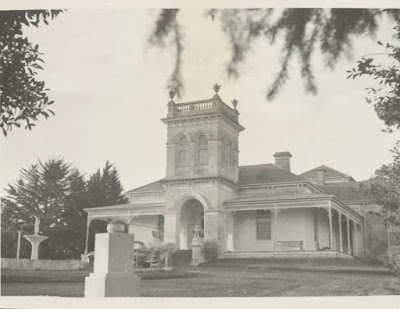


Holm Park owned by Mrs Armytage, described by The Vagabond as a 'champion showplace'
Holm Park, Beaconsfield, c. 1957.
Photographer: Colin Caldwell
State Library of Victoria Image  H84.276/7/23A

The champion show place around Beaconsfield is Holm Park, (16) the property of Mrs Armitage (16) This is about two miles from the railway line, and a mile from the road, the approach being by a private drive bordered with pines and English trees. On a high knoll with a broad view below Holm Park is certainly a place to be coveted, a charming adjunct to Toorak and Mount Sturgeon station. Another show place, which interests me even more, is the state school. This is far inland from the junction or cross roads near the Assembly hall, and where the new store and Mr Goff's (17) house are situated.

Past the Pinegrove Hotel (18) we descend into a hollow very like that of Nar-be-thong. Here we find Miss Russell presiding over 18 children, only six of whom are girls. When I was in Kara Kara the other day I found the proportion of the sexes quite the other way. A large number of children here are of German parentage, selectors who have taken up land towards Gembrook. At this Beaconsfield state school I am particularly pleased with the rules of the playground code of honour which are hung on the wall. These, signed by a committee of the scholars, set forth that at all games, " truth, gentleness and good temper must prevail; defaulters will be expelled from all games for the day." The like punishment will fall on " anyone calling names." This, I expect, is rough on the girls unless liberally interpreted. In selecting sides at cricket " choice of ' first pick' will be decided by throwing at a mark." I have visited many state schools in the colonies, and have seen nothing so sensible as this code of honour instituted by Miss Russell (19) It ought to be generally adopted by the department. Also, I think, this school should be a little nearer to the centre of population at the junction.

On our return we halt at the pleasant Pinegrove Hotel, a great stopping place, kept by a worthy German settler (18).  Here some new chums, sawyers and splitters, have made the occasion of my visit an excuse to knock off work and imbibe colonial beer. These are men from the midland counties, who came out as immigrants to Rockhampton, but soon took the chance of migrating south. They are pleased that I know "the old smoke" of the Black Country. I am pleased to meet a hardy pioneer, one of the first selectors in the Gembrook district. He is ploughing a paddock close by with a team of oxen and to gratify him I take the handles for a few minutes and strike a fairly straight furrow. The farmer gives me his views of the necessity of a light railway or tramway from the main Gipps Land line to Gembrook. It appears that this was included in Mr Bent's bill (20) and partly on the strength of that land was purchased and residences erected. A light line could be easily made, the gradient not exceeding 1 in 40, and only that at one or two places. I have just come from railway journeying in Queensland over grades 1 in 33 and 1 in 25 ! Not only are there the number of private residences on Beaconsfield heights causing traffic which would make a tramway pay, not only would it open out a new locality to pleasure and health seekers bringing Beaconsfield within an hour and a half of the city, but, above all, and this seems to me a special reason, there is a rich and valuable country at and around Gembrook, on which at the present moment small farmers are struggling for a living, owing to their distance from market.

The land at Gembook is far richer than at Beaconsfield. Much clearing has been done, and a vast amount of labour expended in converting dense bush into good grazing or agricultural land. Mr Crichton (21) has the largest place and the best improved. Dr Bromby (22),  and Messrs Alexander (23), Sharples (24), Godfrey (25), Le Souef (26), Whitfield (27), Tyler (28), Ford (29), and Nash (30) Captain Page (31)  and Mr McMahon (ex mayor of Fitzroy) (32) have properties here. Mr Curtois (33), Government engineer, who surveyed the route of the proposed line, reporting on its practicability, also adds - "The land is really good at and beyond Gembrook, where the general appearance of the country is very similar to Mirboo and neighbourhood, but owing to the cost of transit very little cultivation is carried on and that only tor local use. Mirboo, I believe, is one of the richest districts in Gipps Land , and so I hope Gembrook will soon get its railway. Our engineering authorites will here have a chance of inaugurating a series of light and inexpensive lines as feeders to the main railways.

Good bye to Beaconsfield. I leave with regret, and hope to come here again. It is not my own will which carries me back to Melbourne, but duties connected with the Cup Carnival. I would much prefer to linger on the lawn at the Big House to mixing with the throng on the lawn at Flemington. I carry away with me the pleasantest of souvenirs of a real good health giving time and kindly attention from the residents Even the splitters offer me 7s a day if I like to stop here with the proviso however that I find my own axe.

We return by the night train from Berwick, Mr Elms escorting me thither. We have lost our bugler, and the drive is a quiet one. Berwick is on the main Gipps Land road, on the banks of the Kardinia Creek. It lies in a hollow, green hills sloping down to the township, the fertile paddock of Mr. Buchanan (34) and Mr. Gibbs (35) being prominent features. A very pretty township this, the elms and poplars in the streets giving it an English look. Quite a live place too, centre of a dairy farming. district which helps to supply the metropolis. Berwick owns two churches, the Presbyterian a new and fine building, two banks, a state school and mechanics institute. Bain's Hotel (36)  however is the principal institution which concerns the passing traveller. This is the "Border House," sign of the time when all beyond was the unknown district of Gipps Land. Here we take our evening meal, and I feast on the best of strawberries and the thickest of cream, and stroll, talking theology with the Presbyterian pastor, in a walled-in garden rich in flowers and fruit. Everything here is thoroughly home-like. Peace and prosperity reign together.

The last train from town brings its contingent of citizens, and amongst them a worthy Collingwood blacksmith who has a nice country residence here. Then a "crack" with the landlord on geology, a drive to the station and a meeting with an esteemed correspondent. I find in the cars a fellow passenger in Mr Fairbairn, whom I last met on the Peak Downs. We agree that this is considerably better than Northern Queensland, although he certainly has the pick of his district there. Also, I agree with Mr Fairbairn that our railways have been made on far too expensive a system. Queensland could give us a lesson in that," says he: "we want a man like Mr Ballard (37) to teach Victorians how to make light and cheap railways, and so open up places like Beaconsfield. " So mote it be !

Foot Notes:
(1) Mrs Gissing was born Maria Brooks, married to George Gissing. You can read more about the Gissings on  Marianne Rocke's excellent and extensive website, Residents of Upper Beaconsfield https://www.upperbeaconsfieldhistory.au/index.htm. George's entry is here and Maria's entry is here.
(2) The Hotel at Beaconsfield was called the Gippsland Hotel, established by Janet Bowman in 1855. It is now known as the Central Hotel. Read more about  it, here.
(3) Professor Halford - George Britton Halford (1824 - 1910)  Residents of Upper Beaconsfield 
(4) Beaconsfield House was built by William Brisbane (1842 - 1910) in 1877, on the highest point in the town on what was to become St Georges Parade and Salisbury Road. Most of the building was destroyed by fire on the night of May 30, 1893. Sadly, we do not have  a photo of the building. This information is from Upper Beaconsfield: an early history by Charles W. Wilson.  More information on William Brisbane can be found Residents of Upper Beaconsfield  
(5) Mrs and Mrs Somner  - Arthur Hay and Grace (nee Foreman) Somner operated Beaconsfield House Residents of Upper Beaconsfield - Arthur's entry is here and Grace's is here.
(6) Alfred Smith - Upper Beaconsfield resident, Alfred Louis Smith (1831 - 1907)  Architect. He designed, with  his partner, Arthur Ebden Johnson (1821 - 1895)  the Esplanade Hotel in St Kilda, Como House and the Supreme Court buildings. Both men are written up in   Residents of Upper Beaconsfield  Alfred's entry is here and Arthur's is here.
(7) Mr Snell - Henry Snell (1839 - 1910) first person to build a house in Upper Beaconsfield Residents of Upper Beaconsfield 
(8) The Baron - Sir Ferdinand Jakob Heinrich von Mueller (1825-1896) Director of the Royal Botanic Gardens in Melbourne. Read his Australian Dictionary of Biography entry, here.
(9) Mr Guilfoyle - William Robert Guilfoyle (1840-1912) Director of the Royal Botanic Gardens, Read his Australian Dictionary of Biography entry, here.
(10) J. A. Kitchin -  John Ambrose Kitchen (1835 - 1922) Residents of Upper Beaconsfield 
(11) Mr Elms - William Elms (1825-1903) Residents of Upper Beaconsfield 
(12) Mr Walford - James Oliver Walford (1831 - 1896) Residents of Upper Beaconsfield 
(13) Miss Moon - Caroline Mercy Alice Moon (1855 - 1894) Residents of Upper Beaconsfield  The Steyne was built in 1878. When Alice Moon sold the property in 1888 it was bought by Amelia Noble and  later became the Guest House Kia Ora owned by Katie Hudson. (Upper Beaconsfield: an early history by Charles W. Wilson.) Caroline Moon shared the property with Harriet Elphinston Dick, Residents of Upper Beaconsfield  
(14) Mr Bullen  - George Bullen (1842 - 1925)  Residents of Upper Beaconsfield 
(15) Mr A'Beckett - Edward Fitzhaley A'Beckett (1836 - 1922)  Residents of Upper Beaconsfield 
(16) Holm Park and Mrs Armitage - Holm Park was built in 1879 by George Ramsden. In 1884 Caroline Morell (nee Tuckwell) Armytage became the owner, she was the widow of Charles Henry Armytage of Como House fame. Read the Victorian Heritage Database citation on Holm Park, here. Read about the Armytage family here - Residents of Upper Beaconsfield 
(17) Mr Goff -  William Henry Goff (1842 - 1906) Residents of Upper Beaconsfield 
(18) Pinegrove Hotel - Pine Grove Hotel in Upper Beaconsfield was built around 1880 and was destroyed in the Ash Wednesday fires in  1983. The 'German settler' referred to is Hubert Lenne (1843 - 1926) Residents of Upper Beaconsfield 
(19) Miss  Russell - Alice Russell (1861 - 1939). Head Teacher at the School from 1884 to 1889. Married John Robert Alp in 1886.  Residents of Upper Beaconsfield 
(20) Mr Bent  - Sir Thomas Bent - Commissioner for Railways, Premier of Victoria. Read his Australian Dictionary of Biography entry, here.
(21) Mr Crichton - William Alexander 'Sandy' Crichton (1835 - 1921) Residents of Upper Beaconsfield 
(22) Dr Bromby- Reverend John Edward Bromby (1809 - 1889) Read his Australian Dictionary of Biography entry, here.
(23) Mr Alexander - Charles Stiffing Alexander (1824 - 1889) Residents of Upper Beaconsfield
(24) Mr Sharples - John Sharples (1833 - 1896) Residents of Upper Beaconsfield
(25) Mr Godfrey - possibly F.R Godfrey, listed in In the Wake of the Pack Tracks, as selecting land in Pakenham Upper 'around the Raleigh property'
(26) Mr Le Souef - Albert Le Souef, early land owner at Gembrook. Le Souef was a member of a syndicate who applied for a lease to prospect for gemstones, in a creek he had called Gem brook. Many early settlers found small gems such as emeralds, garnets and sapphires in the area. Le Souef was also the first official settler in the area when he purchased 129 hectares (320 acres) of land in July 1873. He called this property Gembrook Park. (Forest to Farming: Gembrook an early history by Genseric Parker)
(27) Mr Whitfield - no other information at the moment
(28) Mr Tyler - possibly J.C. Tyler listed in In the Wake of the Pack Tracks, as selecting land in Pakenham Upper 'around the Raleigh property'
(29) Mr Ford - possibly Thomas Ford (1832 - 1921) Residents of Upper Beaconsfield 
(30) Mr Nash - William Douglas Nash (1852 - 1924)  Residents of Upper Beaconsfield
(31) Captain Page - Captain Page was the manager of Albert Le Souef's property. (Forest to Farming: Gembrook an early history by Genseric Parker)
(32) Mr McMahon - John McMahon, Mayor of Fitzroy 1880 - 1881. McMahon owned The Grange, Huxtable Road, Pakenham Upper.  He also founded the Fitzroy Football Club. You can read the Victorian Heritage Database citation on The Grange, here.
(33) Mr Curtois - Willoughby Curtois (1844-1934) Residents of Upper Beaconsfield 
(34) Mr Buchanan - James Buchanan (1827 - 1914) Member of the Legislative Council, Berwick resident. Read his Australian Dictionary of Biography entry, here.
(35) Mr Gibbs - James Gibb (1843 - 1919) Member of the Legislative Assembly, owned Melville Park (later known as Edrington) in Berwick at one time. His wife also owned the Tulliallan property in Cranbourne, read here.
(36) Bain's Hotel - Information on the Bain family and the Hotel can be found, here.
(37) Mr Ballard - Robert Ballard (1839 - 1912) Read his Australian Dictionary of Biography entry, here.