Friday, 21 December 2007

Preserving family treasures

Your family would own many precious historical documents and items. You might have a collection of old photographs, papers from Grandpa's business, old love letters or letters sent back from the Front in the First World War, Grandma's wedding dress or even Aunty Joan's 1950s belle of the ball gown.

There are many useful Internet sites with information on preserving your family treasures. The Collections Australia network is the public gateway to Australian Collecting Institutions such as Museums and Galleries http://www.collectionsaustralia.net/ Type in ReCollections in search box. ReCollections provides professional advice for the preventative care of items such as books, photographs, papers, leather, wood and textiles such as clothing or embroideries.
The State Library of Victoria http://www.slv.vic.gov.au/ also provides information on correct storage of precious books, papers and photographs. Click on Services then Conservation advice then Information guides or follow this link http://www.slv.vic.gov.au/services/conservation/index.html
Finally the National Archives of Australia http://www.naa.gov.au/ The N.A.A provides a range of preservation information. Click on Records Management then Secure, store and preserve or follow this link http://www.naa.gov.au/records-management/secure-and-store/index.aspx

Proper storage of family treasures will help preserve them for future generations. Sadly, we no longer have Grandma's wedding dress, but this is the wedding photograph of my Grandparents, Joseph Rouse and Eva Weatherhead, who were married at the Methodist Church at Garfield on November 22nd, 1922.

Thursday, 20 December 2007

Doveton

The suburb of Doveton was named in September 1954, after Captain John Doveton. Captain Doveton and his wife Margaret, owned land in the area from the 1890s. Doveton was established by the Housing Commission to provide housing for the employees of the 'Big Three' Industrial companies, International Harvestor Company, H.J Heinz and General Motors Holden. The Housing Commission had purchased the 267 hectare (660 acres) site in 1954 and the first houses were occupied in December 1955. A tight knit community soon developed and by 1960 there were two state schools and a Catholic school, shops, Scout groups, a Fire Brigade. Other community facilities followed. Maria Harding has written a book Doveton : a brief history, outlining the early days of the new town. It can be purchased at Doveton Library for the modest price of $3.00.

Syd Pargeter represented the people of Doveton, from 1963-1994, as a Councillor with the Shire of Berwick, City of Berwick and City of Casey. Syd has written an eclectic book The Money miracle that paid for a "new town" and created Australia's best new city. It tells of his life of a Councillor and the fight for facilities, such as the Doveton Library and the Doveton Swimming pool, and rate reform which would see the 'Big Three' pay a more equitable share of the rates.  These two books tell the story of the development of Doveton from the vacant paddocks in the 1950s to the community that it is today.


These photos are from Maria Harding's book Doveton: a  brief history.  The top photo is 'Looking west form Doveton Avenue in 1954' and the bottom photo is 'looking west in 1956' - clearly showing the development in the past two years.

Monday, 17 December 2007

Gembrook history

Gembrook was named by early European settler, Albert Le Souef. Le Souef was a member of a syndicate who applied for a lease to prospect for gemstones, in a creek he had called Gem brook. Many early settlers found small gems such as emeralds, garnets and sapphires in the area. Le Souef was also the first official settler in the area when he purchased 129 hectares (320 acres) of land in July 1873. He called this property Gembrook Park.

Other early Gembrook land owners were brothers Alexander and David Crichton; the Backhouse brothers - Albert, Talworth and Edward; John Ure (the owner of Silver Wells) and The Reverend John Bromby, the first Head Master of Melbourne Grammar School. You can read about the life of the Reverend Bromby, here, on the Australian Dictionary of Biography.

The Reverend Bromby  owned the land where the present town of Gembrook is now situated. In 1878 he also donated the land for the Union Church. The growth of the town was spurred on by the arrival of the Puffing Billy railway line in 1900.

This information comes from the interesting book Forest to farming Gembrook : an early history by Genseric Parker. Mr Parker's family have lived in Gembrook since 1908. The book includes many old photographs of Gembrook and information on early families. You can purchase a copy at the Emerald Museum http://www.emeraldmuseum.org.au/


Wednesday, 12 December 2007

The National Trust and Pioneer Park

Pioneer Park was officially opened in October 2005 on the site of the Old Berwick Primary school. This was the third Primary School in Berwick. The first school in Berwick was established in a hut on Robert Gardiner’s run in the 1850s (south of High Street). A new school was constructed in 1861 in Peel Street, opposite St Michael’s Catholic Church. The School re-located to the Pioneer Park site in 1869.The earliest part of the existing building dates to 1876, the 1869 room being demolished for an extension in 1914. The picture (above) shows the school c.1880. The School population moved to a new building in 2003 and the Community raised funds to purchase the site. Pioneer Park is an attractive park with a very rare steam clock, one of only three in the world, designed and built by Peter Weare. The old School building is now the Head Quarters of the Casey Cardinia branch of The National Trust, one of the Heritage groups in Casey and Cardinia. They run a gift shop, staffed by volunteers, which sells many unusual and interesting gifts, plus National Trust publications. By supporting the gift shop you are supporting the work of the National Trust in their endeavours to preserve the history of the region.
This is a National Trust Christmas card, available from the gift shop, which is a reproduction of a card originally printed in Sydney , by Gibbs, Shallard and Company in 1882. The gift shop is open 11.00am until 3.00pm , everyday except Tuesdays. For more information on the National Trust go to their website www.nattrust.com.au

Monday, 10 December 2007

Ancestry database and Electoral rolls.

Casey Cardinia Library Corporation subscribes to Ancestry database. Ancestry database is free to use at any of our Libraries. Follow this link to our website http://www.cclc.vic.gov.au/
Ancestry database now has the Australian Electoral rolls from 1901-1936. The rolls are indexed and you can also view the original document. The rolls for Victoria cover the years 1903 to 1954. These rolls are a great resource for both the Family Historian and the Local Historian.
Family Historians can use the rolls to track the movements of their ancestors. As an example, George Stephenson Weatherhead (1888-1944), who is my grandmother's brother, was listed on the Tynong roll in 1914. In 1919 George, and his wife Annie, are listed at Carstairs, south of Townsville in Queensland. From these entries, we can see that he has married and moved interstate.
The Electoral rolls are also a valuable resource for Local Historians. In the 1903 roll, most of what is now Casey and Cardinia was in the Flinders District. Emerald, Cockatoo and Gembrook were in the Mernda District. If you search the sub-district of, for instance, Yannathan you will get a "snapshot" of the 244 people on the roll, their names, addresses and their occupation. This can help you build up a picture of the area at that time. This image shows the first page of the Yannathan roll. Click on the image to enlarge it.

Thursday, 6 December 2007

Webb Street, Narre Warren


Webb street, in Narre Warren, was named after the early settler, Sidney John Webb. Sidney Webb had arrived in Australia, from England, in 1854. He was a journalist and worked on The Age, Leader and Australian News. Sidney retired to Narre Warren in 1880 and was instrumental in the growth of the town. He was responsible for obtaining the Narre Warren Railway Station, he donated land for the school and the Mechanics' Institute. The Webb property of 445 hectares (1,100 acres) was called Holly Green, which later became Brechin. The Brechin garden can still be enjoyed, it is on Brechin Drive at Fountain Gate. Webb was a progressive farmer, he was the first in the district to use the double-furrowed plough and also the first reaper and binder. Webb's lasting monument is the avenue of oak trees, that are still thriving on the northern side of the Princes Highway at Narre Warren. The trees were planted in 1890. The seedlings came from the Nobelius Nursery in Emerald. Unfortunately the trees on the southern side were removed some years ago for road widening. Sidney and his wife, Ann (nee Hart), had 14 children of which ten survived to adulthood. The photograph above shows Sidney Webb in front of Holly Green.

Monday, 3 December 2007

Cemeteries in Casey and Cardinia


With the upsurge of interest in family history, cemeteries have become a popular source of information for genealogists. If you are interested in researching cemeteries then you can access many cemetery records through the Australian Cemeteries website www.australiancemeteries.com.au
It's  a great site and sometimes, if you are lucky, it even has head stone photographs.
We will have  a look at the eight cemeteries in the Casey Cardinia area.

Berwick Cemetery The first Trustees were appointed for this Cemetery on July 25 1860. They were Charles Rossiter, James Feehan, John Brisbane, Abram Gardiner and Adam Ritchie.  They have  a website which includes a deceased search  www.berwickcemetery.com.au

Bunyip Cemetery The Bunyip Cemetery site was officially reserved on November 22, 1886 and on December 6, 1886 the first Trustees were appointed - Joseph Williams, George Birch and James Barnes.

Cranbourne Cemetery   The site for the Cemetery was reserved on December 11, 1857 and the following Trustees were appointed at the same time - Alexander Cameron, Patrick Thomson, James Smith Adams, William Sykes and Edward Malloy.
Gembrook Cemetery   Land for the Gembrook Cemetery was set aside on July 14, 1879 and on July 28 the following Trustees were appointed Talworth Benjamin Backhouse, Henry James, Alexander Crichton, John Walters and Charles Brache.

Harkaway Cemetery It was established in June 1873 as a private cemetery, called Zions Hill,  and owned by a group of local families. In 1905 it was decided that it should be gazetted as a public cemetery and Immanuel Wanke, Francis Barr, George Washington, Edward Hillbrich and John Durling were appointed Trustees on June 30 and on September 12 1905  it was officially gazetted as a public cemetery*.

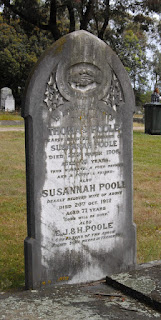
Lang Lang Cemetery The Lang Lang Cemetery site was reserved on December 5, 1887 and the first Trustees appointed December 10, 1889 were Thomas Poole (whose grave is pictured right), William Jones, Prosper Henry Victor Le Roux, Joseph Foster, William Norquay, Patrick McGrath, Edmund McGrath and Alexander McMillan.


Nangana Cemetery (also called Emerald Cemetery or Macclesfield Cemetery)  On February 6 1883 land was set aside for the Nangana Cemetery.    The first record of Trustees I can find is from February 27, 1893 when Carl Nobelius, Thomas Collis, Edwin Hunt, George Charman and James Slade. The Emerald Cemetery is now run by the Greater Metropolitan Cemeteries Trust  and there is a deceased search function on their website www.gmct.com.au

Pakenham Cemetery The site for the Pakenham Cemetery was reserved on February 13, 1865 and the first trustees were appointed on May 8, 1865 and they were John Startup, Richard Fortune, Michael Bourke, Thomas Mulcahy and George Ritchie (whose grave is pictured left)  It is believed that the first burials actually took place in the 1850s.

The Necropolis Springvale - Many people opt for cremation and for people in this area this was usually done at The Necropolis in Springvale,  where the first cremation took place in 1905. It's now called the Springvale Botanical Cemetery. Their burial records are on-line - you can access them at https://sbc.smct.org.au/


* Information from Harkaway Cemetery Tour: Ordinary people, interesting lives - a walk in the historic Harkaway Cemetery, published by the Narre Warren & District Family History Group, 2016. They have researched walks in the Berwick, Cranbourne, Harkaway, Lang Lang and Pakenham cemeteries - more information on these publications can be found on their wesbite http://nwfhg.org.au/